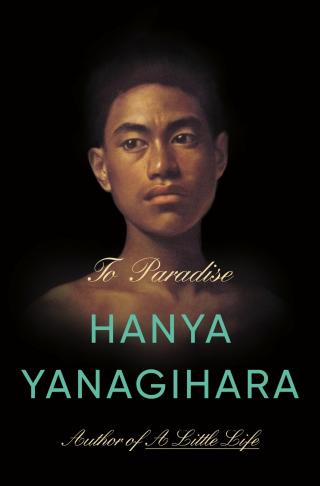
To Paradise
- Автор: Yanagihara Hanya
- Год: 2022
- Язык: английский
- Год: Knopf Doubleday Publishing Group
- Жанр: Современная русская и зарубежная проза

Электронная книга - «To Paradise». Краткое содержание книги:
In an alternate version of 1893 America, New York is part of the Free States, where people may live and love whomever they please (or so it seems). The fragile young scion of a distinguished family resists betrothal to a worthy suitor, drawn to a charming music teacher of no means. In a 1993 Manhattan besieged by the AIDS epidemic, a young Hawaiian man lives with his much older, wealthier partner, hiding his troubled childhood and the fate of his father. And in 2093, in a world riven by plagues and governed by totalitarian rule, a powerful scientist's damaged granddaughter tries to navigate life without him--and solve the mystery of her husband's disappearances.
These three sections are joined in an enthralling and...
After dinner, they reconvened in the parlor and Matthew poured the coffee and tea and Grandfather had shifted in his seat, just a bit, when Eliza suddenly sprung to her feet and said, “Peter, I keep meaning to show you the picture in that book of that extraordinary seabird I mentioned to you last week and promised I wouldn’t let myself forget again tonight; Grandfather Bingham, might I?” and Grandfather nodded and said, “Of course, child,” and Peter stood then, too, and they left the room, arm in arm, Eden looking proud to have a wife who was so well attuned to everything around her, who could anticipate when the Binghams would want to be alone and would know how to gracefully remove herself from their presence. Eliza was red-haired and thick-limbed, and when she moved through the parlor, the little glass ornaments trimming the table lamps shivered and jingled, but in this respect she was light and swift, and they had all had occasion to be grateful to her for this knowingness she possessed.
So they were to have the conversation Grandfather had told him they would back in January, when the year was new. And yet each month they had waited, and each month, after each family dinner—and after first Independence Day, and then Easter, and then May Day, and then Grandfather’s birthday, and all the other special occasions for which the group of them gathered—they had not, and had not, and had not, and now here it was, the second Sunday in October, and they were to discuss it after all. The others, too, instantly understood the topic, and there was a general coming-to, a returning to plates and saucers of bitten-into biscuits and half-full teacups, and an uncrossing of legs and straightening of spines, except for Grandfather, who instead leaned deeper into his chair, its seat creaking beneath him.
“It has been important for me to raise the three of you with honesty,” he began after one of his silences. “I know other grandfathers would not be having this discussion with you, whether from a sense of discretion or because he would rather not suffer the arguments and disappointments that inevitably come from it—why should one, when those arguments can be had when one is gone, and no longer has to be involved? But I am not that kind of grandfather to you three, and never have been, and so I think it best to speak to you plainly. Mind you”—and here he stopped and looked at each of them, sharply, in turn—“this does not mean I plan on suffering any disappointments now: My telling you what I am about to does not mean it is unsettled in my mind; this is the end of the subject, not its beginning. I am telling you so there will be no misinterpretations, no speculations—you are hearing it from me, with your own ears, not from a piece of paper in Frances Holson’s office with all of you clad in black.
“It should not surprise you to learn that I intend to divide my estate among the three of you equally. You all have personal items and assets from your parents, of course, but I have assigned you each some of my own treasures, things I think you or your children will enjoy, individually. The discovery of those will have to wait until I am no longer with you. There has been money set aside for any children you may have. For the children you already have, I have established trusts: Eden, there is one apiece for Wolf and Rosemary; John, there is one for Timothy as well. And, David, there is an equal amount for any of your potential heirs.
“Bingham Brothers will remain in control of its board of directors, and its shares will be divided among the three of you. You will each retain a seat on the board. Should you decide to sell your shares, the penalties will be steep, and you must offer your siblings the opportunity to buy them first, at a reduced rate, and then the sale must be approved by the rest of the board. I have discussed this all with you before, individually. None of this should be remarkable.”
Now he shifted again, and so did the siblings, for they knew that what was to be announced next was the real riddle, and they knew, and knew that their grandfather knew, that whatever he had decided would make some combination of them unhappy—it was only to be a matter of which combination.
“Eden,” he announced, “you shall have Frog’s Pond Way and the Fifth Avenue apartment. John, you shall have the Larkspur estate and the Newport house.”
And here the air seemed to tighten and shimmer, as they all realized what this meant: that David would have the house on Washington Square.
“And to David,” Grandfather said, slowly, “Washington Square. And the Hudson cottage.”
He looked tired then, and leaned back deeper still in his seat from what seemed like true exhaustion, not just performance, and still the silence continued. “And that is that, that is my decision,” Grandfather declared. “I want you all to assent, aloud, now.”
“Yes, Grandfather,” they all murmured, and then David found himself and added, “Thank you, Grandfather,” and John and Eden, waking from their own trances, echoed him.
“You’re welcome,” Grandfather said. “Although let us hope it might be many years still until Eden is tearing down my beloved root shack at Frog’s Pond,” and he smiled at her, and she managed to return it.
After this, and without any of them saying it, the evening came to an abrupt close. John rang for Matthew to summon Peter and Eliza and ready their hansoms, and then there were handshakes and kisses and the leave-taking, with all of them walking to the door and his siblings and their spouses draping themselves in cloaks and shawls and wrapping themselves in scarves, normally an oddly raucous and prolonged affair, with last-minute proclamations about the meal and announcements and stray, forgotten bits of information about their outside lives, was muted and brief, Peter and Eliza both already wearing the expectant, indulgent, sympathetic expressions that anyone who married into the Binghams’ orbit learned to adopt early in their tenure. And then they were gone, in a last round of embraces and goodbyes that included David in gesture if not in warmth or spirit.
Following these Sunday-night dinners, it was his and his grandfather’s habit to have either another glass of port or some more tea in his drawing room, and to discuss how the evening had unfolded—small observations, only verging on gossip, Grandfather’s slightly more fanged as was both his right and his way: Had Peter not looked a touch wan to David? Did not Eden’s anatomy professor sound insufferable? But tonight, once the door was closed and the two of them were again alone in the house, Grandfather said that he was tired, that it had been a long day, and he was going up to bed.
“Of course,” he’d replied, though his permission wasn’t being asked, but he too wanted to be alone to think about what had transpired, and so he kissed his grandfather on his cheek and then stood for a minute in the candlelit gold of the entry of what would someday be his house before he too turned to go upstairs to his room, asking Matthew to bring him another dish of the syllabub before he did.