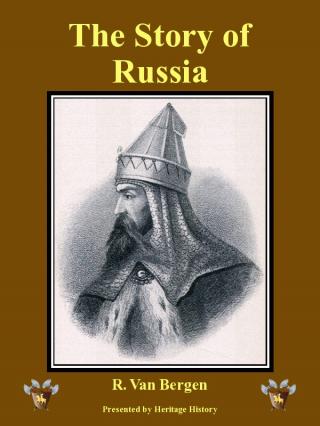
The Story of Russia
- Автор: Bergen Robert Van
- Год: 1905
- Язык: английский
- Год: Heritage History
- Жанр: История

Электронная книга - «The Story of Russia». Краткое содержание книги:
Like his father, he tried to attract artists and learned men, and exchanged embassies with most of the European Courts. He extended the frontiers of his empire, but ruthlessly suppressed free thought. It has been claimed that the Slav is fit only for an absolute government. The history of Russia contradicts the statement. The idea of autocracy was Asiatic and was imported with the Tartar yoke.
Ivan IV, the Terrible
IVAN IV.
When Vassili died in 1533, he left two infant sons, Ivan and George, the elder three years old. His widow, Helena Glinski, assumed the regency. She was a woman remarkable for spirit and beauty, and showed her courage in ruthlessly suppressing every attempt of high nobles to contest her authority. She sent her husband's brother George to prison, and let him die there. One of her own uncles, who had been in her confidence, showed too much ambition and suffered the same fate. Andrew, another brother of Vassili, tried to make his escape; he was promptly brought back and placed in confinement. This caused an unimportant war with Poland, ending in a truce in 1537. The Tartars of Kazan and the Crimea were frequently defeated. But Helena was cordially hated by the great nobles at Moscow; she was poisoned, and died in 1538.
Ivan, the oldest son and heir, was then eight years old. It must be placed to the credit of his mother that he had learned to read, for the children were sadly neglected after her death, and it was the boy's principal solace and occupation. In later years Ivan wrote of this time, "We and our brother Ioury (George) were treated like strangers, like the children of beggars. We were ill-clothed, cold and hungry." What impressed the child especially, was that when foreign envoys arrived he was placed upon the throne and the same nobles who showed him such contemptuous indifference, were respectful and even servile on such occasions. He noticed, too, that when these proud nobles needed anything, it was necessary that the papers should be signed by him. All this set the child thinking, and being a manly, bright boy, he came to the conclusion that, after all, he was the real master.
After many quarrels among themselves, Andrew Chouïski, the head of a noble family, had become all-powerful; all important offices were occupied by his favorites and friends. Ivan noticed it all, but said nothing. He was thirteen years old when, after the Christmas celebration of 1543, he suddenly summoned the boyards before him, and in a threatening tone sternly accused them of their misdeeds. "There are among you many guilty ones," he said, "but this time I am satisfied with making one example." He ordered the guards to seize Andrew Chouïski, and had him then and there torn to pieces by dogs. After this terrible punishment, he ordered the arrest of the most disobedient nobles, who were transported to distant places.
The thirteen-year-old boy then assumed the government, relying chiefly upon his mother's relations, the Glinskis. In 1547, at the age of seventeen, he directed the Metropolitan to crown him, not as Grand Duke but as Czar. In a Bible printed in the Slavonic language, he had read of the Czar Nebuchadnezzar, the Czar Pharaoh, David, Czar of Israel, etc. He knew, besides, that the former masters of the grand dukes, the khans, had been addressed by that title. Perhaps it was because he wished it to be known that he considered himself the equal of any Tartar ruler; perhaps because he desired to have a title superior to that of the nobles who descended from former grand dukes, and who inherited the rank without the power; at any rate Ivan IV was crowned as the first Czar.
Young as he was, and since his thirteenth year beyond control, Ivan's life had been the reverse of good. But when, soon after the coronation, he married Anastasia Romanof, he made an earnest effort to reform. The relatives of his mother and of his wife, the Glinskis and the Romanofs, enjoyed his favor at this time.
There was much suppressed dissatisfaction among the nobles, and many plots were hatched against him. In the year of his coronation, a fire swept wooden Moscow, and about 1,700 people perished in the flames. Ivan ordered an investigation, and withdrew to Vorobief. Crowds gathered in the thoroughfares, when mysterious persons appeared among them declaring that the Glinskis had set the city on fire. Soon after shouts were heard, "It is the Princess Anne Glinski who, with her two sons, has bewitched the city; she has taken human hearts, plunged them in water, and with this water has sprinkled the houses. This is the cause of the destruction of Moscow!" A mob collected and made for the palace of the Glinskis and one of them, George, was stabbed. They went on to Vorobief, where they demanded the life of Ivan's uncle. The czar's own life was in danger and the mob had to be dispersed by force.
Ivan did not forget this, and terrible was his vengeance upon the boyards. At this time he gave his confidence to two men, one a priest named Silvester, who had the reputation of being a very honest man; the other, a member of the smaller nobility, named Adachef who, in 1551, as Minister of the Interior, gave to Russian cities the first municipal liberties. Ivan showed an unusual interest in the people; it was under his orders that a new code of laws (Soudebnik) was prepared, and many reforms were made in the Church.
This rather increased than diminished the hostility of the nobles. Ivan's favorites, Silvester and Adachef had grown ambitious and the former especially was over-bearing. He openly opposed the czar, and tried to sow discord between him and his wife. When Ivan's favorite son died, Silvester told him that it was a punishment from heaven for his disobedience. The two men tried to procure the dismissal of the Glinskis and Romanofs, and for that purpose made friends with the boyards whom Ivan suspected. In 1553, the czar fell dangerously ill; he called in the boyards and ordered them to swear loyalty to his infant son Dmitri. They refused. He was informed that the nobles were conspiring with his cousin Vladimir, whose mother was distributing money in the army. He was in terror for the lives of his wife and son. Once he said to the boyards who had remained faithful, "Do not, I pray you, forget that you have sworn an oath to my son and to me; do not let him fall into the hands of the boyards; fly with him to some foreign country, whithersoever God may guide you." Ivan recovered but he never could forget the anguish of those days.
Ivan's character at this time was far from bail. He was only twenty years old, and on several occasions showed that he was compassionate instead of cruel. It was only natural that his nature should be perverted, surrounded as he was by men of whom he was suspicious. Still, such a change could only be gradual. The immediate consequence of the conduct of his nobles, was that it drew him closer to the people. This was shown in 1506, when he convoked the three orders, nobles, priests, and people, to discuss public affairs.
His first act, after his recovery, was to banish his former favorites. Silvester was ordered to the monastery of St. Cyril, and Adachef was sent to Livonia. Soon afterwards the Czarina Anastasia died: there was a strong suspicion that she had been poisoned. To add to his bitterness, Prince Andrew Kourbski, a descendant of Rurik and a great friend of Silvester and Adachef, permitted 15,000 Russians to be defeated by the Poles with whom Ivan was at war. Kourbski deserted to the King of Poland.
It appears that Ivan at this time feared for his life, for he withdrew to a neighboring castle with his friends, servants, and treasures. From there he wrote his abdication in two letters, one addressed to the Metropolitan, the other to the people of Moscow. This action struck terror among the nobles and the people. The former dreaded that the people might rise and avenge the czar, and the people were afraid that the nobles would once again usurp the government. The nobles and priests consulted and decided to beg Ivan's pardon and to submit to any punishment he might impose. Ivan consented to return to Moscow but on his own terms. This was accepted. After his arrival in the capital he established a special guard of one thousand men who had a dog's head and a broom hanging from their saddles, to show that they were ready to bite and ready to sweep the czar's enemies from off Russian soil.