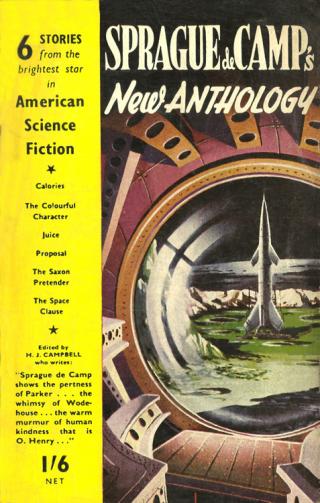
Sprague de Camp's New Anthology
- Автор: Де Камп Лайон Спрэг
- Год: 1953
- Язык: английский
- Год: Panther
- Жанр: Научная фантастика

Электронная книга - «Sprague de Camp's New Anthology». Краткое содержание книги:
Alice answered with half her mind, the other half silently urging the driver to get them home as soon as possible to rid her of this galactic bore.' At the doorstep, however, Stanko said:
"Wait, Miss Wernecke. I have several things to say. To begin, I think we had better forgo your custom of kissing, which strikes me as most unsanitary. You do not mind?"
"Not in the least!"
"Well then, we now come to the question of our next date. I wondered what we could do tomorrow. Another dinner and dance, perhaps? One of those places of revelry called night-clubs?"
"No, Mr. Stanko, you can't. In Philadelphia all the places of revelry are closed on Sunday."
"Then how about the theatre? It impresses me as a highly developed art-form—"
"They're closed, too."
"Another motion-picture?"
"I've seen all the good ones."
"Then how about doing something in the afternoon? For instance, we might pay a visit to the zoological gardens. I have already been there, but I should not mind repeating my visit."
Alice shook her head grimly. "The animals bother my allergies, and I see enough monkeys every day in my class."
"That is unfortunate. Perhaps we could have a swimming party. We"(here he used a word from his own language, full of nasal vowels and guttural consonants) "are good swimmers,"
"In October? That's much too cold for us mere humans, Mr. Stanko. All the pools will be drained."
Alice suspected that some heated indoor pools might be open in the Philadelphia area, but had no intention of giving him this opening by suggesting it. Interplanetary crisis or not, she was not going out with the Cultural Representative again as long as she could think of excuses.
"I see," he said, his alien form drooping a little as if with sadness, though his flat voice betrayed no emotion. "We seem to be at an impasse. Tell me, would you consider the term 'a few' as including the number 'two'?"
"What an odd question! I suppose you could, though 'few' doesn't have any definite limits."
"Well then, it could be said that I have had a few dates with you. We can count Thursday night's episode as half a date, I think. I had intended to have one more before putting my proposal to you—"
"What proposal?" said Alice, alarm running up her spine.
"—my proposal to you, but since that seems impractical I will stretch a point and proceed. Mr. and Mrs. Greer were kind enough to tell me much about your custom of marriage. They explained that it was common for a male of your nationality, after he has had a few dates with a female, if he likes her well enough to wish to live with her, to ask her to marry him. As I have now qualified, I ask you to marry me."
Alice stood staring, her throat refusing to make a sound for several seconds while the enormity of the proposal sank in. At last she squeaked:
"Did you say m-marry?"
"Yes. I assure you that I am not always so devoted to my work as during my present investigation, when I must make every minute count. Back on Wolf 359-1 you will find me an agreeable and not an exacting companion, and you shall enjoy such comforts and luxuries as you are accustomed to on your own world."
"But—b-but—Stanko, that's im-possible!"
"What is impossible about it? Marriage, as I understand it, is a matter of the couple's agreeing before a magistrate to live together in mutual affection and support for the rest of their lives. What prevents us from doing that?"
"It wouldn't be legal, you not being a human being ..."
"If your magistrates raise legal objections, the captain of our ship can devise the necessary contractual ceremony."
"Oh, no Oh, no. Stanko, you don't understand."
"And what do I fail to comprehend?"
"There's much more to marriage than that."
"Really? Please explain."
Alice found herself tongue-tied.
"Well? I await your reply, Miss Wernecke."
Alice, never having reared children of her own or taught adolescents, had not developed a technique for answering such questions. All that she could say was:
"Didn't the Greers ever say anything about the facts of life?"
"They have explained a great deal, but I do not know if that includes the facts that you have in mind."
"You know, about the bees and the flowers."
Stanko gave the Wolfian equivalent of a sigh. "Miss Wernecke, I am striving to follow you, but am admittedly finding it difficult. Why should the Greers lecture me on insects or plants? Neither is an entomologist or a botanist."
Alice, feeling her face flaming in the dark, had no choice but to explain in plain words what she meant. When she finished there was a little silence. Then Stanko said:
"I see. Miss Wernecke, I have committed a grave social error, and hope that you will accept my assurances that it was through ignorance and not through intent. By pure chance nobody had explained to me the connection between marriage and the reproductive process to which you allude. On Wolf 359-1 things are managed differently. A male there fertilizes a female only once in his life. After that he is assigned to another female to serve her in his time off from work. Our females are much larger than the males—about the size of one of your elephants—and of quite a different exterior form, so that they find it difficult to move about. They are also less numerous, so that each female has sixteen to twenty males assigned to her. And I had erroneously equated this latter relationship to your marriage."
"But what made you think—" began Alice in a small voice, close to tears.
"That you would find the relationship agreeable? I fear that I was judging by the reactions of my own kind. This contretemps goes back to when my fellow-explorers were discussing the matter, shortly after we had alighted, and I in a jesting way spoke of bringing an earthly female back home with me. Considering that you are hardly larger than I, the prospect looked inviting. You could hardly mistreat me as my ex-wife, from whom I was divorced so that I could come on this expedition, treated all her husbands."
Alice could hardly imagine Stanko's joking about anything, but let that pass. He continued:
"The others kidded me (I believe you say) about this rash boast until I swore that I would in fact carry it out. Now that I see that I have failed and have been humiliated in your eyes, my own, and those of my companions, there is nothing for me to do but die. I shall sit down right here and will myself to death."
"Oh!" cried Alice. "Don't do that!"
"I am sorry, but there is no alternative. Rest assured that the process will take only an hour or two, and then the garbage-collectors will remove my corpse in the morning."
"But—" Alice stared helplessly into the darkness, then remembered Byron Matthews's promise of surveillance. She called: "Help! F.B.I.! Help!"
"Coming." said a voice. Footsteps pounded.
Three men approached. One was the taxi-driver, one a man whom she had vaguely noticed sitting near her at the Bellevue-Stratford, and the third was Byron Matthews.
In strangled sentences Alice explained what had happened, pointing to Stanko, who had sat down with his back to the wall in a kind of yogic posture and seemed no longer conscious. Then, sobbing, she melted into Matthews's arms.
"Hell and damnation," he said, "does that guy have to get ahead of me in everything? I was going to propose to you, too, after a few more dates to get decently acquainted."
"You were?"
"Yes. But now there's only one thing to do."
"What?"
"You must marry him, as he says."
Alice, hardly believing her ears, squirmed out of Matthews's arms.
"Byron Matthews, are you crazy?"
"Wish I were. But we can't have this guy willing himself to death while we're responsible for him. It might cause God knows what kind of interplanetary crisis."