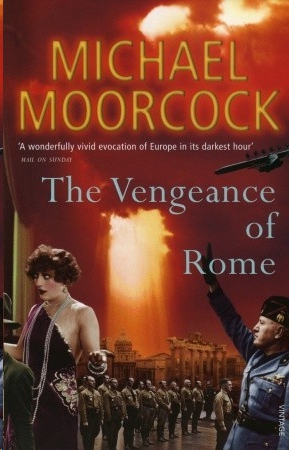
The Vengeance of Rome
- Автор: Муркок Майкл
- Серия: Between The Wars #4
- Язык: английский
- Жанр: Научная фантастика

Электронная книга - «The Vengeance of Rome». Краткое содержание книги:
‘I’m orlways ‘ere of an evenin’.’ Before we left, Mrs Cornelius gave me Nye’s card. She was planning to go back to England, she said. ‘Dezzie’ had long since been persuaded to rejoin UfA and continue to act in German films, but that didn’t suit her. ‘Too many of me pals keep disappearin’.’ Her new passport had finally come through.
I no longer had a passport, as I explained to Major Nye when I finally saw him. He asked if I had any objection to going to England. They needed someone with my skills and brains over there. He could not procure for me a British passport, but he had taken charge of a group of English prisoners who had been fighting Franco and had survived being machine-gunned on the beach as they came ashore near Palma after the fall of Barcelona. If I didn’t mind mucking in with them, he thought he could get me to London and see about sorting out papers for me once there.
That was how I was reunited with Major Johnny Banks who vouched for me as a member of the International Brigade. I was ‘repatriated’ to England in the autumn of 1939, shortly before the outbreak of the Hitler war. Zoyea, I heard, worked in Palma and married after the War. But we were never again to be lovers.
‘I have so much to thank you for,’ I tell Mrs Cornelius. ‘I might have died in Dachau.’
‘Y’ve got yer mate ter fank fer that,’ she insists. ‘The bloke who joined the Gestapo and then was in the SS. Wot’s his name? Prince Nicky Wotsit, wot got yer inter trouble in France. Killed at Stalingrad.’ Irrationally she still believes Kolya framed me for the Paris Airship fraud rather than saved me from the worst of the consequences. But I no longer argue. I am not even sure he died as she thinks. I will mourn him only when I have certain news. As usual my reply is logical.
‘But why should Kolya have arrested me and then freed me?’
‘Maybe ‘cause yer dumped ‘im in the desert that time? Tort yer a lesson, didn’t ‘e? Well, ‘e could see yer’d be useful in Spain, wot wiv talkin’ the language an’ that, so ‘e orlways knew ‘e could get yer art. Didn’t they make yer some sort o’ spy?’
‘I was supposed to gather intelligence. We were testing my ship. They mentioned your name. They said you were in Belsen. I’ve told you all this. Kolya was explicit. If I didn’t do what they wanted, you wouldn’t be freed. I didn’t know you had escaped until I got to Majorca.’
She laughs. ‘An’ found I’d been livin’ the life o’ fuckin’ Riley in th’ ol’ port at Dez Reid’s. Croonin’ in ther local dance band! I woz earnin’ a tidy littel livin’ for a few months, while the Aye-tayes an’ the soldiers woz still comin’. An’ everyfmk was so cheap, Ive. Bloody paradise. Still, ol’ Major Nye got yer ter England, eh, when they demobbed ther International Brigade. Better than going back ter Odessa like some o’ them poor buggers, or France, or Germany, yer gotta admit.’
She minimises her part in all that. Even in prison she was my guardian angel. Kolya was powerless to help me. He told me so. And if Kolya was able to get me released in 1937, why couldn’t he get me out earlier? Why, as Mrs C suggests, was it up to the SS? After all, the Spanish conflict began in 1936. By the time I arrived in Barcelona, the war was as good as won. Germany and Italy had thrown their weight behind Franco. True, Major Nye was the intelligence officer attached to the government authorities, but he could not have helped me if she hadn’t told me where to find him.
When it was clear Franco had overwhelmed the government forces, Major Nye sent me and a dozen others who had served under Johnny Banks on to Lisbon and from Lisbon home to London. By then the others knew I wasn’t American but believed me to be a German anti-Nazi and covered for me. I had actually seen Santucci and his Italians machine-gunning Republicans as they waded ashore in Majorca, thinking they had found at least some brief relief from their demoralising defeats. Whatever my sympathies, this massacre of defeated, tired soldiers disgusted and horrified me. At various times in Palma I had been threatened with hanging, both as a Spanish traitor and as a Russian spy, but I could easily prove the accusations false. Major Pujol had vouched for me all he could without getting court-martialled himself. He even colluded with Major Nye when the time came to get me to England. He took many risks and died, I learned recently, impoverished in Madrid, a minor civil servant.
I know nothing much worse than civil war, which is usually conducted with the worst ferocity. Yet for all the Spanish bloodshed and cruelty, I never witnessed anything as bad as the horrors of Ukraine, nor was Franco, in victory, as vengeful as Lenin, Trotsky or Stalin. Say what you will about the General, he remained a devout supporter of the Opus Dei all his life and was in turn thoroughly supported by that godly society, whose part in the Spanish revolution has never been properly acknowledged.
I hold no brief for Catholics or their leaders, but while Mussolini and Hitler sought rapprochement with the Pope to further their own political ends, Franco received genuine blessing for his efforts. America, too, remained a great friend to Spain throughout the War and long afterwards. The Generalissimo was permanently grateful for that. He believed it stupid to persecute Jews just for being Jews. He felt the same about Negroes. The last letter I ever received from Mr Mix, after he wrote from Washington many years later, made it clear how he owed his life to Franco’s pro-Americanism. Only when the Nationalists discovered Mix was an American, and not a Moroccan, did they spare his life. He, of course, continued to work in Europe until the early fifties, when he was recalled to the home bureau’ and became some kind of civil rights expert at CIA headquarters. I heard this from Major Nye. I never did understand why Mr Mix stopped writing to me. I am not, I hope, one to exploit a relationship, but that man owed me something. Americans have short attention spans. No doubt he forgot. US intelligence people are inclined to abstractions at the best of times. They are not people to remember favours.
FIFTY-EIGHT
Soon after I reached London in 1939 I made for Mr Green’s Whitechapel office. I quickly found 22 Leman Street. A worn brass plate announced the name of his firm, Green, Green & Collins (Import/Export) Ltd. Mounting the stone steps to the door, I hesitated before it just as I imagined an old Knight of Chivalry might have paused outside the Temple of the Grail. For many years I had dreamed of climbing those steps, knocking on the door and being received by the kindly old man. Mr Green would usher me into a mahogany and oak office lit by yellow gas casting warmth through the shadows. My Uncle Semyon’s old partner would sit me in a big leather armchair and send for a brass-bound box in which my financial papers and scientific patents were stored. My money would have made me considerable interest. Mr Green would congratulate me on my wealth. He would give me avuncular advice on how to invest it. Perhaps I would be offered a position with the company. He might suggest the firm back my scientific inventions. None of this pipe dream was unrealistic but based on promises Uncle Semyon and his people had made.
Yet when I was admitted into a shabby, unpainted reception room, I was told by a girl telephonist that the Greens had, in her words, gone down the drain after the old man’s death. The ‘old man’ was presumably the Mr Green my uncle had originally dealt with. She was the only person I was allowed to see. She was thoroughly ignorant. I was convinced her employers knew more, but even when I lost my temper, they refused to come out and meet me. The place was now a shipping office. Only the name had been retained, she said. She knew of no other connection. Eventually, when she offered to call the police from the nearby station, I left.