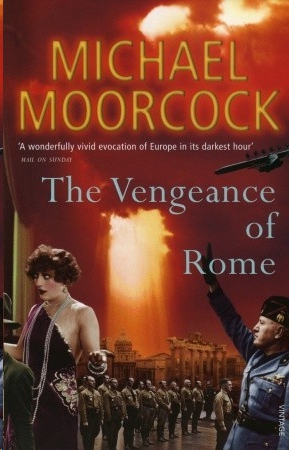
The Vengeance of Rome
- Автор: Муркок Майкл
- Серия: Between The Wars #4
- Язык: английский
- Жанр: Научная фантастика

Электронная книга - «The Vengeance of Rome». Краткое содержание книги:
Not entirely sure what to do, I found myself in Barcelona’s Ramblas district, where the food was cheap and the people very pleasant. This became my favourite place to spend time. I had to try to make friends who were not Reds and get out of Barcelona as soon as possible. My idea was to board a neutral ship calling at Palma de Majorca. There I was sure I would be able to join up with my Italian colleagues. But I dare not arouse suspicion. I had no way of knowing how Mrs Cornelius fared.
As I strolled down a wide avenue one morning, looking at secondhand books on the stalls set in the middle of the streets, I was surprised to hear the familiar wheezing out-of-tune melody of a barrel organ and, to my astonishment, within a few moments was reunited once again with my old friend, the delighted Signor Frau, and his lovely daughter Heckie, my own sweet Zoyea. Though glad to see me, Zoyea had a rather gloomy, self-contained air, as she danced for the Catalan crowd. Signor Frau’s attitude, however, was celebratory.
‘My dear friend. I have not seen you since —’
Hastily I cautioned him to silence on that subject. I knew he had left Munich, but how had he come here from Madrid? He grew sad. He had been caught up in the fighting there when travelling outside the city. They had started from Munich with three horses. Two had pulled the family wagon. The other drew the barrel organ. This horse was ridden by his son. A Falangist commander in a small village they had passed through decided to requisition the riding horse. Against his father’s wishes the boy resisted, lost his temper with the soldier and was shot. The horse was taken.
After giving his son a Christian burial, Frau had determined to get to Republican territory where he assumed he would be safer. He now feared for his daughter’s virtue. Things were hardly any better here. When I told him that I was homeless he demanded I come back with him to their wagon. Certain we would meet again, he had kept my plans and my pistols for me. They had a spare bed in the wagon. He did not have to say that the bed had belonged to his dead son. Frau longed to hear my story. I was forced to modify a little, to spare his feelings. I informed him I had been flying for the Republicans when my plane had been shot down. Everything else I told him was as it happened.
But now, I said, I had no wish to go on fighting. I wondered if I could get home from Majorca, but I simply had no idea how to make the ten-hour voyage to Palma. At this Frau began to laugh disbelievingly. He himself had plans to try to join the Italians in Majorca and from there hoped to get a ship to Genoa. Italy was officially neutral and ordinary freighters still plied back and forth. He was in the process of selling his barrel organ but, as I had heard, it had developed a wheeze again. If I could help him repair it so that he could get a better price for it, I was assured a place in the boat he intended to buy. A little sailing vessel was his at very low cost. It would take us to the island in about a day.
FIFTY-SEVEN
‘I’ve never known a luckier bastard than you, Ivan.’
I am not sure Mrs Cornelius knows what she is saying. How is it luck to be brought down out of the skies not once but four times?
She indicates her empty Guinness glass. ‘Not only did yer meet up wiv your Aye-taye mate in Barcelona, but when his boat started sinkin’ ya got picked up not by a bloody Russian or Frenchman, but by an Aye-taye submarine with another mate o’ yours on board!’
‘Major Pujol, the liaison officer, was scarcely a mate,’ I point out, ‘and let’s face it, our boat was rotten. Frau had been cheated. It was already sinking when the Italian RS-14 started strafing it. Frau was killed. Zoyea herself was nearly drowned.’
‘Put it this way,’ she hands me the glass, ‘ther boat would’ve sunk and th’ lot of ya’d ‘ave gorn ter th’ bottom. This way ther sub started lookin’ fer survivors an’ at least picked th’ two of yer up. An’ yer’d never ‘ave found Major Nye an’ me, would ya?’
Sometimes I cannot always follow her reasoning.
She thinks the traffic fumes have gone to my brain. I could accuse her of a similar condition. Or perhaps we are inhaling the new orange paint in the pub? It contains lead, after all. Our accounts of events are not always the same, to say the least. How can a man recollect anything in tranquillity when he lives in such miserable times? Things were not this bad when I first got to England, even though the War was soon to begin.
When I arrived here North Kensington was a decent place to live. In Notting Hill and Notting Dale you knew who your neighbours were, and they knew you. Nobody talked to the police or the NHS. Nobody told debt collectors where you lived. Admittedly there was a certain amount of tension after closing time, but at least you had a good idea who was who, and by staying on good terms with the O’Days, Connors and other important local families, you rarely had any difficulties. You made sure your nose was clean, as Mrs Cornelius said, and, when the occasion demanded, your head stayed down.
That was the same lesson I had learned in Kiev and Odessa’s Moldavanka. You kept trouble within boundaries. Local family rivalries were between each other or with the police. The police knew not to start trouble. If the press people called us ‘denizens’ rather than ‘inhabitants’ and thought it too dangerous to come down to Blenheim Crescent, we didn’t care. Other Londoners had the idea we were criminals and prostitutes. You could not get a taxi to take you all the way home. Cabbies had a line they drew. If you lived below the junction of Westbourne Grove and Portobello Road, they would drop you off at the corner of Ladbroke Grove on top of the hill, making you walk the rest. During the so-called race riots they would only take you as far as the top of Kensington Park Road. And what were those riots? Reading the Manchester Guardian you had the impression of hordes of blacks and whites with knives and razors. Go outside your own door and you saw a couple of Teddy boys jeering at a West Indian or three Jamaicans going nose to nose with three cockneys.
Needless to say, most people living in the Gate or the Grove were honest, decent and hard-working, as respectable as any in London. Mrs Cornelius knew everyone. She was related to most of them on both sides of her family. We weren’t space aliens. We all talked English, even if the accents differed. TV violence had not yet taken over from Dick Barton and ITMA on the wireless and the whole family listened to Variety Bandbox, Family Favourites and Workers’ Playtime. The same as everyone, we ate our Marmite on crumpets and our jam on bread and butter. We drank Typhoo tea or Brooke Bond Dividend Tips. On Sundays those who could afford it cooked some sort of joint. The men went to the pub and read the News of the World until it was ready. I soon learned to enjoy these customs. Those were my happiest days.
I loved the films, the Ealing comedies, the American musicals, the Westerns. We shared the same radio and cinema stars, read the same daily papers; once a week the men bought Tit-Bits and Reveille and the women bought Woman’s Weekly or Red Letter, boys had Dandy, Beano, Hotspur, Adventure and Knockout, girls had Schoolgirl’s Own and Girl’s Crystal. If you were more demanding in your fiction you ordered, as I did, the Sexton Blake Library, which published four books a month. By the 1940s the stories had become pure fiction and not up to the old standard, but I still found them entertaining. On the wireless we heard the same music. Every week I looked forward to Big Bill Campbell’s Rocky Mountain Round-Up, a show reminding me of our happiest times in the USA during the 1920s. For more intellectual stimulus we tuned in In Town Tonight. All popular programmes with millions of listeners. We talked about them in the pub. The BBC brought us together. Only later, after the death of Lord Reith and the debacle of the Festival of Britain, did things change, taken over by Buggers Broadcasting Communism, as we used to say. Even then not everyone at the BBC was a bugger or a communist.