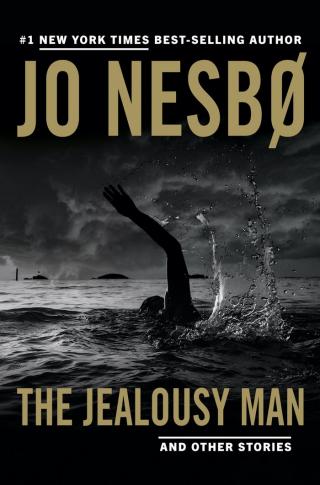
The Jealousy Man and Other Stories
- Автор: Несбё Ю
- Год: 2021
- Язык: английский
- Год: Alfred A. Knopf
- ISBN: 978-0-593-32100-3
- Переводчик: Robert Ferguson
- Жанр: Криминальные детективы

Электронная книга - «The Jealousy Man and Other Stories». Краткое содержание книги:
A detective with a nose for jealousy is on the trail of a man suspected of murdering his twin; a bereaved father must decide whether vengeance has a place in the new world order after a pandemic brings about the collapse of society; a garbage man fresh off a bender tries to piece together what happened the night before; a hired assassin matches wits against his greatest adversary in a dangerous game for survival; and an instantly electric connection between passengers on a flight to London may spell romance, or something more sinister.
With Nesbø’s characteristic gift for outstanding atmosphere and gut-wrenching revelations, The Jealousy Man confirms that he is at the peak of his abilities.
‘Come on,’ he said with a laugh. ‘I can’t recall your name but I remember you were climbing with Trevor Biggs, he’s a local lad. And that French girl who just flew up those slopes the rest of us had such a struggle with.’ His face suddenly became serious as if something had occurred to him. ‘Bloody back luck about Trevor, by the way.’
‘I think you’re getting me mixed up with someone else, sir.’
For a moment the Englishman stood there, open-mouthed and with an expression of mild surprise on his face. I could see his brain feverishly scanning his book of memories in search of his mistake. Then, as though he had found it, he nodded slowly. ‘My apologies.’
I turned back to the bar and in the mirror saw that he sat down with his climbing companions and their climbing wives. Said something and nodded in my direction. They resumed their conversation and they passed around the local guidebook with the climbing routes marked. It looked like a good life.
My gaze moved on to one of the other tables and met Victoria Hässel’s.
She sat there dressed in the climber’s evening outfit: clean climbing clothes. Her hair, which had earlier in the day been hidden under her cap, was blonde, long and flowing. She sat turned towards me, looked as though she had temporarily absented herself from the conversation. She held my gaze. I don’t know if she was waiting for something. A signal. Information about the Schmid case. Or just a nod of recognition.
I saw that she was on the point of standing up, but I was ahead of her and had already placed my euros on the bar. I slipped off the bar stool and left. Back in my room I locked the door.
In the middle of the night I was awoken by a loud bang, like a gunshot. I sat up in bed, my heart beating furiously. It was the window sash; a gust of wind must finally have torn it loose. I lay awake and thought of Monique. Monique and Trevor. I didn’t finally get back to sleep until daylight.
‘The forecast is for the wind to drop,’ said George and poured a coffee for me. ‘You’ll probably be able to make it over to Kos tomorrow.’
I nodded and looked out of the station window. Harbour life seemed strangely unaffected by the fact that the island was to all intents and purposes cut off for the third day running. But that’s how it is, life goes on, even — or perhaps especially — when you think it unliveable.
Christine and one of the constables entered and joined us.
‘You were right, George,’ she said. ‘Schmid bought the Luger from Marinetti. He recognised Franz from the photo and says he was in the shop in the afternoon the day before Julian was reported missing. He got the impression Franz was a collector. He bought the Luger and a pair of Italian handcuffs left over from the war. Marinetti swears, of course, that he thought the Luger had been spiked.’
George nodded and looked contented rather than annoyed. When I’d wondered how and not least why Franz had managed to carry a handgun with him on the plane from California, George had suggested we check Marinetti’s antique shop in Pothia. According to George, Marinetti had a cellar so full of antiques dating from the long years of the Italian and then the German occupation of Kalymnos that he hardly knew just exactly what he had.
‘Can we say the case is solved now?’ enquired Christine.
George turned to me as though forwarding the question.
‘Case closed,’ I said. ‘But not solved.’
‘No?’
I shrugged. ‘We have, for example, no body to give us final proof of what we think has happened. Maybe the two brothers are sitting on a plane back to the USA and laughing at us after the greatest practical joke ever.’
‘You don’t believe that,’ said George.
‘Absolutely not. But as long as there are other possibilities, there will always be a doubt. The physicist Richard Feynman says we can’t be absolutely certain about anything at all, the best we can do is presume with varying degrees of certainty.’
‘But if there is a doubt, what do we do about it?’ asked Christine, who actually looked quite upset about it.
‘Nothing,’ I said. ‘We content ourselves with a reasonable degree of certainty and set to work on the next case.’
‘Doesn’t that leave you—’ Christine stopped, looked as though she was afraid she might be about to go too far.
‘Frustrated?’ I asked.
‘Yes.’
I had to smile. ‘Remember, I’m the Jealousy Man. Usually I’m around for the first or second day of a murder investigation. I’m the man with the divining rod, the one who indicates the spot on the ground where water might be found, and then leaves the digging to others. I’ve had lots of training in leaving cases behind me without getting all the answers.’
Christine looked to be assessing me. I could see she didn’t believe me.
‘Am I jealous?’ she asked, putting her hands on her hips and adopting a provocative expression.
‘I don’t know. You would have to tell me something first.’
‘Such as what?’
‘What you think might have made you jealous, for example.’
‘What if I don’t want to, what if it hurts me too much?’
‘Then I would have no way of knowing,’ I said, and clapped my hands together. ‘And now, people, how about we get something to eat?’
‘Right!’ said George. But Christine carried on looking at me. She probably knew that I knew. The story behind those red eyes. She was jealous.
For the remainder of the day I wandered along narrow paths on the mountain on the southern side of the beach where we had found Franz Schmid’s car and gun. The high, inaccessible limestone walls reminded me of the vaulted ceilings in Christ Church Cathedral in Oxford which, in their dark, English seriousness were so different from, for example, the exuberant brightness of the Mitropoli Cathedral in Athens. Maybe that’s why — despite the fact that I am an atheist — I felt more at home in Christ Church. I spoke to my boss on the phone. He said they would send a detective and two techs the next day if the wind had dropped, and that he wanted me back, a woman had been murdered in Tzitzifies, and her husband couldn’t provide an alibi. I advised him to put someone else on the case.
‘The victim’s family say they want you,’ said my boss.
‘Surely that’s for us to decide.’
He said the name of the family. One of the shipping dynasties. I gave a sigh and hung up. I love my country, but some things just never change.
My eye caught an unusually broad overhang. Or more accurately: it was the overhang that caught my eye. I saw an elegant line running from a cleared belay station in towards the rock face. Here and there light from a metal glue-in bolt reflected the sunlight. Because of the overhang I couldn’t quite locate the anchor, and because the mountains fell directly into the sea right next to the path and the belay station, I was unable to step any further out. But it had to be a long route, at least forty metres.
I looked down fifty or sixty metres to where the waves broke against the rocks. When the climber was lowered down from the anchor, he or she would have to swing back and forth so as to reach the belay station and not be lowered straight down into the sea. But what a beautiful route it was! In due course, as my gaze moved upward, my brain began automatically to analyse, to visualise the climbing movements the holds and contours would require. It was like turning over the ignition in a machine unearthed after being buried beneath ruins for years. Did it still work? I turned the key, pressed the accelerator. The climbing motor whined reluctantly, coughed, protested. But then it started. And the protests stopped. Now the muscles remembered and glowed with pleasure as the brain recalled climbing. I could see no other routes in the vicinity and guessed that most climbers thought it was a long way to travel just to climb one — even though spectacular — route. But I would have done it, even if it was the last route in my life.