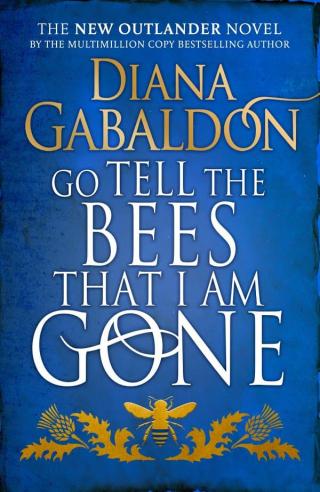
Go Tell the Bees That I Am Gone
- Автор: Гэблдон Диана
- Серия: Outlander #9
- Год: 2021
- Язык: английский
- Год: Delacorte Press
- ISBN: 978-1-473-51900-8
- Жанр: Исторические приключения

Электронная книга - «Go Tell the Bees That I Am Gone». Краткое содержание книги:
The past may seem the safest place to be . . . but it is the most dangerous time to be alive. . . .
Jamie Fraser and Claire Randall were torn apart by the Jacobite Rising in 1746, and it took them twenty years to find each other again. Now the American Revolution threatens to do the same. It is 1779 and Claire and Jamie are at last reunited with their daughter, Brianna, her husband, Roger, and their children on Fraser’s Ridge. Having the family together is a dream the Frasers had thought impossible. Yet even in the North Carolina backcountry, the effects of war are being felt. Tensions in the Colonies are great and local feelings run hot enough to boil Hell’s teakettle. Jamie knows loyalties among his tenants are split and it won’t be long until the war is on his doorstep. Brianna and Roger have their own worry: that the dangers that provoked their escape from the twentieth century might catch up to them. Sometimes they question whether risking the perils of the 1700s—among them disease, starvation, and an impending war—was indeed the safer choice for their family. Not so far away, young William Ransom is still coming to terms with the discovery of his true father’s identity—and thus his own—and Lord John Grey has reconciliations to make, and dangers to meet . . . on his son’s behalf, and his own. Meanwhile, the Revolutionary War creeps ever closer to Fraser’s Ridge. And with the family finally together, Jamie and Claire have more at stake than ever before.
“Well, I’ve been giving them lunch and a light supper. But they’ve been going back up to the captain’s cabin in the evening and coming down midmorning. They’ve repaired the stable door,” I offered, in extenuation, “dug over my garden, chopped two cords of wood, carried all the stones you and Roger dug out of the upper field down to the springhouse, and—”
He made a slight gesture indicating that he accepted my decision and now would like to change the subject. Which he did by kissing me and asking what was for supper. He smelled of road dust, ale, and faintly of cinnamon.
“I believe Fanny and Lieutenant Bembridge are making burgoo. It has pork, venison, and squirrel in it—apparently you must have at least three different meats for a proper burgoo—but I have no idea what else is in it. It smells all right, though.”
Jamie’s stomach rumbled.
“Aye, it does,” he said thoughtfully. “And what does Frances make o’ them?”
“I think she’s somewhat smitten,” I said, lowering my voice and glancing toward the hall. “Cyrus came to call yesterday while she was serving the lieutenants lunch, and she asked him to stay, but he just drew himself up to about seven feet, glared at them, said something rude in Gaelic—I don’t think she understood it, but she wouldn’t need to—and left. Fanny went pink in the face—with indignation—and gave them the dried-apple-and-raisin pie she’d meant for Cyrus.”
“Is fheàrr giomach na gun duine,” Jamie said, with a philosophical shrug. Better a lobster than no husband.
“You don’t actually think that, do you?” I asked, curious.
“In the case of most lassies, yes,” he said. “But I want someone better for Frances, and I dinna think a British sailor will do. Ye say they’re leaving in the spring, though?”
“So I understand. Ooh!” I tenderly massaged the throbbing bruise on my foot. The pestle had struck smack at the base of my big toe, and while the original pain had receded a bit, trying to put my weight on the foot and/or bend it resulted in a sensation like hot barbed wire being pulled between my toes.
“Sit yourself down, a nighean,” he said, and pushed the big padded chair that Brianna had dubbed the Kibitzer’s Chair toward me. “I brought a few bottles of good wine from Salisbury; I expect one o’ those would make your foot feel better.”
It did. It made Jamie feel better, too. I could see that he’d come home carrying something, and I felt a small knot below my own heart. He’d tell me when he was ready.
So we sipped our wine—it was red—and felt together the gentle touch of the grape. I told him about Elspeth’s sudden appearance and our conversation after dinner. He told me about seeing Ian and Rachel and Jenny off, relieving his clear sense of sorrow at their parting with Jenny’s remark about her pistol.
“That took Rachel aback, as ye might suppose,” he said, eyes alight with amusement. “But then Young Ian steps in and says, ‘Dinna be fratchetty, Mam. Ye ken if we meet any villains, Rachel will talk them into a stupor afore ye have time to load.’”
I laughed, as much because the cloud seemed to be lifting from Jamie’s face as because it was funny.
“I hope Jenny doesn’t feel obliged to shoot what’s-her-name—Ian’s wife—”
“Wakyo’teyehsnonhsa,” Jamie said patiently, and I flipped a hand.
“Emily, then. You don’t suppose she’d try to—to get Ian back?”
“She didna want him when she put him out of her house,” Jamie pointed out. “Why would she now?”
I looked at him over the rim of my second—or possibly third—glass.
“How little you know of women, my love,” I said, shaking my head in mock dismay. “And after all these years.”
He laughed and poured the rest of the bottle into my glass.
“I dinna think I want to ken anything about any woman other than you, Sassenach. After all these years. Why, though?”
“She’s a widow with three small children,” I pointed out. “She put Young Ian out because he couldn’t give her live children, not because he was a bad husband. Now she’s got live children, she doesn’t need a husband for that purpose—but there are a lot of other things a husband’s good for. And I rather think Ian might be very good at some of those things.”
He looked at me thoughtfully, then tossed off the rest of his glass.
“Ye talk as though Young Ian had nothing to say about it, Sassenach. Or Rachel.”
“Oh, Rachel will have something to say about it,” I said, though I wasn’t sure what she might say. Rachel was neither timid nor inexperienced in the ways of the world, but meeting one’s spouse’s ex-wife might be more complicated than either she or Ian thought.
“Look at what happened when I met Laoghaire again,” I pointed out.
“Aye, she shot me,” he said dryly. “D’ye think Wakyo’teyehsnonhsa is likely to kill Rachel, rather than let her have Ian? Because I think my sister might have something to say about that.”
“She is a Mohawk,” I said. “They have rather different standards, I think.”
“They havena got different standards of hospitality,” he assured me. “She wouldna kill a guest. And if she tried, my sister would put a bullet through her head before ye could say … what is it ye could say?”
“Jack Robinson,” I said. “Though I’ve always wondered who he was and why that should be quicker to say than Fogarty Simms or Peter Rabbit. Is there more of that wine?”
“Aye, plenty.” He stood up and went to the door of the surgery, where he paused to listen. The singing in the kitchen had stopped, and there was just the murmur of conversation—interrupted by occasional laughter—and the rattle of plates.
“Will your foot stand the stairs, Sassenach?” he asked, turning to me. “I could maybe carry ye up, if not.”
“Upstairs?” I said, rather surprised. I glanced involuntarily toward the kitchen. “What, now?”
“Not that,” he said, with a brief smile. “Not yet. I meant the third floor.”
THE BENEFICIAL EFFECTS of half a bottle of wine were sufficient to get me up the stairs with Jamie’s supportive elbow, and I emerged into the open space of the third floor with a sense of exhilaration. There was a strong, cold breeze blowing from the east, and it swept away the last remnants of cooking, dog, sweaty young men, and left-too-long laundry from the house below. I spread my arms and my shawl flared out behind me like wings, my skirts pressed flapping round my legs.
“Ye look like you’re meaning to fly away, Sassenach,” Jamie said. “Maybe ye’d best sit down.” He sounded half serious but was smiling when I turned to look at him.
He had brought a stool up with him, along with the second bottle of wine. He hadn’t bothered with glasses but drew the cork with his teeth, sniffed the contents appraisingly, and then handed me the bottle.
“I dinna think decanting would improve it much.”
I was in no mood for niceties. The relief of having him home subsumed all minor considerations, and I wouldn’t have minded drinking water. Still, the wine was good, and I held a mouthful for a few moments before swallowing.
“This is wonderful,” I said, gesturing toward the view with the bottle. “I haven’t been up since we saw Bree and Roger off.” The memory of standing up here, watching their wagon disappear slowly into the trees, twisted my heart a little, but the Ridge spread out around us now in all its glory—and it was glorious, with flaming patches and sparks of autumn beginning to burn amongst the rippling cool dark greens and blues of spruce and fir and pine and sky. Here and there I could make out the white threads of chimney smoke, though the tossing trees hid the cabins themselves.