Esperanto Revolutionaries and Geeks: Language Politics, Digital Media and the Making of an International Community
- Автор: Fians Guilherme
- Год: 2022
- Язык: русский
- Жанр: Культурология

Электронная книга - «Esperanto Revolutionaries and Geeks: Language Politics, Digital Media and the Making of an International Community». Краткое содержание книги:
Alongside the schisms taking place within both the workers' and the neutral Esperanto movements,[11] a further layer was added to the neutral movement. Since 1920, short-lived initiatives attempted to estab- lish a youth-oriented Esperanto association, which became consolidated in 1956, with the Tutmonda Esperantista Junulara Organizo (World Esperanto Youth Organisation, henceforth TEJO) receiving more direct support from UEA (Lins 1974). This association, together with the regu- larly held Universal Congresses and other national and international Esperanto gatherings, produced a perception of diversification and, at the same time, stability of the Esperanto community and movement.
During the second half of the twentieth century, the worldwide spread of Esperanto also became prone to accountability at the national level through the landaj asocioj (national Esperanto associations) linked to UEA. Similarly, the emergence and dissolution of several fakaj asocioj (specialist associations, focused on promoting the language among interest groups or gathering Esperantists around particular subjects, hobbies or professional occupations) became seen as indexes of the themes that drive people to the language over time. In this regard, the rise and, recently, the fall of associations for Esperantist Catholics or railway workers took place alongside the growth, for instance, of commercial associations connecting Chinese Esperanto-speaking businesspeople with the rest of Esperantujo.
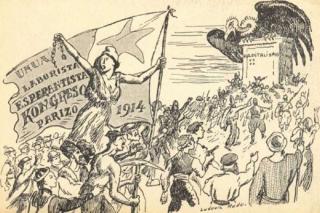
Beyond the institutional framework, the language initially spoken only by its initiator became associated with several forms of internationalism, drawing from diverse social and political agendas. From the language of Jews and Tolstoyans, it also became the language of French intellec- tuals and bourgeois and, later, that of proletarians, pacifists, anti-fascists and groups such as, nowadays, language lovers and geeks. As Garvfa highlights:
Esperantists came from all walks of life and chose to learn the language for quite different reasons. They were Bolsheviks, anarchists, and social- ists; atheists, and religious-minded people; Catholics and Protestants; feminists and conservatives; blind people; Social Darwinists and people convinced of the sacrality of all human life; Herderians and anti- nationalists; people exploring new life styles and 'hidden worlds', and people concerned about real-world problems; scientists and Nobel Prize winners and workers with a basic education; librarians and Taylorist engineers; and radical and conservative pacifists. (2015: 128)
These shifts were followed by a tendency of dispersion and a notable spatial reconfiguration of Esperantujo, with a growth in the number of Esperantists and Esperanto associations particularly in the Americas and East Asia.[12] To this dispersion trend, it can be added the spread of Esperanto in parts of the African continent, despite the limited financial resources available to associations, rigorous visa requirements of citizens from several African countries to travel abroad and reduced access to transportation and communication technologies, which partly hinder the participation of African Esperantists in Universal Congresses and online Esperanto settings.
Further highly significant political and territorial reconfigurations included the Cold War, during which Esperanto was conveyed as a more politically neutral alternative to Russian and English, the two competing hegemonic languages at the time of tensions between the United States and the Soviet Union. However, the end of this conflict marked the triumph of English and undermined this sound argument for Esperanto. More recently, the creation of the European Union, in 1993, and the Brexit referendum, in 2016, set the stage for addressing the language problem within debates about European integration, with pressure groups using Esperanto as a platform to debate multilingualism and language rights.
2.4 On Failing to Become Universal
Throughout the twentieth century, these ebbs, flows and short-lived occasions of relative success marked the mise en discours of Esperanto that conveyed it as a language that failed to take hold. Alongside the diffi- culties in creating occasions for Esperanto to gain and retain support, a prevalent emphasis—given by historians and Esperantists alike—on the language's past significance contributes to a generalised perception of Esperanto as a 'thing of the past'. Along these lines, the remark- able historical analysis carried out by Ulrich Lins (2016, 2017, as referred extensively throughout this chapter), for instance, investigates how Esperanto was depicted as an enemy of the state when its speakers were persecuted by totalitarian regimes in twentieth-century Europe. Likewise, historians such as Muller and Benton (2006) and Rapley (2013a, b) emphasise how, during the same period, the Chinese and Japanese governments came to fear Esperanto for its associations with communism, anarchism and opposition to national values. These histor- ical perspectives contrast sharply with the present, where no historian would describe Esperanto as a threat to law and order.
Reaching back to the vignette that opened this chapter, this histor- ical background brings about two contrasting manners of depicting Esperanto in the present. At the headquarters of Esperanto-France, on the one hand, Colette asserted that 'history is what matters the most'. This perspective emphasises how Esperanto was politically relevant and engaged in significant ways with world history, gathering revolution- aries and encouraging diverse forms of internationalist critique of the contemporary, which would potentially configure arguments to justify the learning of the language in the present. On the other hand, Thomas, due to his young age and late contact with the language, did not partic- ipate himself in Esperantos history except for three or four recent and relatively uneventful years. When compared to the historical narratives he read and heard about, the political relevance of Esperanto in the twenty-first century appears to be less manifest. Being rarely persecuted or seen as threats, present-day Esperanto speakers are hardly regarded as members of a potentially disruptive and timely radical social move- ment. In this sense, perhaps conveying the language as regular, logical, YouTube-friendly and easy to learn could make it more attractive to those attending Esperanto-France's open day.
Concerns over how non-Esperantists perceive Esperanto are a frequent subject of discussion among Esperantists. This is also the theme of several books and articles that attempt to demystify Esperanto and dispel misapprehensions—the most popular certainly being Esperanto sen mitoj (Esperanto without myths; van Dijk 1999). Published in Esperanto, Ziko van Dijk's work is a comprehensive account of misunderstandings about the language and rebuttals to them, frequently used to prepare Esper- antists to more convincingly promote the language. In the case of an association's open day, such concerns could not be otherwise.
The drawing, hung on the association's wall, of children holding hands and understanding each other 'thanks to Esperanto' is one of the resources mobilised at Esperanto-France to produce a discourse of Esperanto as an effective tool to bring cultures and people together, as this image elegantly illustrates Zamenhof's original project. At the same time, the colourful and modern-looking leaflet whose front page puts forward Esperanto as the 'fair language' bets on the language ideology of fairer and more egalitarian communication (to be discussed in Chapter 5) to convey the timelessness of Esperanto: what effectively matters is to communicate fairly, which can be done regardless of the language's relevance in the past or of how many people speak it. Yet, at the associations office, the flagship producer of practical knowledge about Esperanto is the world map. Taking centre stage in the associa- tion's meeting room, the pins on the map show not how many people speak the language, but how many 'countries' have visited Esperanto- France. Adding colourful pins to cover an already colourful set of printed nation-states helps produce the perception that the world is bountiful, with Esperanto being a key mediator to give people access to such bountifulness.