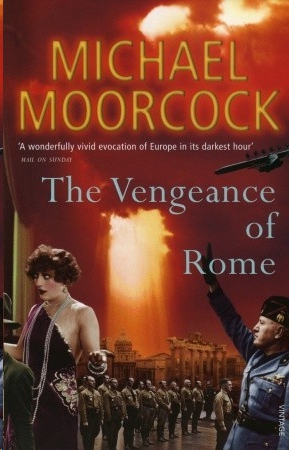
The Vengeance of Rome
- Автор: Муркок Майкл
- Серия: Between The Wars #4
- Язык: английский
- Жанр: Научная фантастика

Электронная книга - «The Vengeance of Rome». Краткое содержание книги:
‘Nor at the Flashlite.’
‘This Gloria Cornish, your co-star, as I understand it —’
‘She abhors all drugs. She was a platonic friend of Herr Göring’s. She was forever trying to get me to stop. Do you know where she is now?’
‘She might have gone abroad. What can you tell us about her? Her name has been linked with a Major Nye, an English intelligence officer.’
‘She hates politics. Nye was infatuated with her, that’s all. I can tell you nothing else. I would rather be shot now than compromise that wonderful woman.’
‘Don’t worry. She is in no danger. There was that other Englishman you worked with. Desmond Reid. Was he not a critic of the government?’
‘Well, he was no friend of communism. He might even have thought Hitler soft on Röhm. I have had no contact with him since the last picture we made together. I thought he had left the country.’
‘He’s in Czechoslovakia. Help yourself, Dimka! Give my superiors something.’
‘Have I no right to defend myself against Prince Freddy’s false accusations? Against Kitty’s?’
‘Unfortunately Prince Badehoff-Krasnya died in Dachau two weeks ago. He had apparently bribed guards. Sadly he was due to be transferred to better conditions in the Belsen camp. Some relatives had interceded for him. As for Fräulein Kitty, I am told she is no longer in custody. Released from the women’s quarters in Stadelheim, she took a train immediately for Budapest. I’m afraid they have left you high and dry, Dimka.’
‘Contact Mrs Cornelius. Believe me, she is a good friend of Hermann Göring. She will speak for me.’
‘I will get in touch with her personally, I promise, assuming she is still in Germany. I am not sure how much good even a well-connected English actress can do for you, however. Have you any other friends?’
‘Hanfstaengl is in Berlin, too, isn’t he? Some American journalists.’ I named Morgan and Grisham among them. ‘And Miranda Butter. I don’t know what has happened to her.’
‘These are all foreigners and, apart from Miss Butter’s, their words are not worth very much, I fear. She was Mussolini’s mistress for some years and arranged to have many of his articles published in America. Then something happened and she came to Berlin. She was infatuated with Hitler. But Hitler already had people who were buying his articles. She returned to New York last December. Do you know if any of those journalists had reason to oppose the policies of the present government?’
I could not absorb so much information, if information it was. ‘I have not been in touch with them recently. They were not, I will admit, all entirely enthusiastic about Hitler. But this was ages ago, when I first arrived in Germany. Surely they have long since been replaced by their editors?’
‘Anything you can think of will be useful and will in turn let me do what I can to help you. Miss Butter, I think, is beyond reproach. Since returning to America she has written the most laudatory pieces about the Führer. Some have appeared in the New York Times and the Washington Post!
‘Then surely she can speak for me,’ I said. ‘I had no idea she was linked with Il Duce, but we were good friends. A word from her would make a difference, wouldn’t it?’
Kolya lit two cigarettes and handed me one, tapping my dossier with his index finger. ‘We have already interviewed her. She did not speak very well of you at all. She seems to think you a liar and a charlatan who deceived Mussolini with some hare-brained nonsense. She considered you a turncoat, perhaps even an Italian spy. Your behaviour towards her in Rome was apparently not the most gentlemanly.’
Were all women by nature so treacherous?! ‘It was not I who betrayed her, Kolya. You know how loyal I am to my friends and lovers. I had no choice. That Jewish bitch Sarfatti was forcing me to be her lover. I was being blackmailed.’
‘She mentioned your association with that Jewess.’ He flicked through the dossier, pausing now and again to read. ‘You seem to have made yourself rather vulnerable to blackmail, Dimka.’
‘I have trusted too many people. Oh, Maddy! Maddy!’ Suddenly I found myself breaking down. My body began to shake. The tears started in my eyes. I could not stop weeping. The tiredness, the humiliation and now this awful shock had taken control of me. How could Maddy, whom I had helped see the political light, who had been my pupil in the ways of the world, betray me? Now I knew she had been Mussolini’s lady friend for so long, much was coming clear. At every turn I had been deceived.
‘Shoot me here, Kolya,’ I sobbed. ‘My life is meaningless. All I had hoped to do for the world, all my loyalties, all my loves and friendships, are ashes. I am robbed of any future. My future, too, is ashes.’
‘Unfortunately, Dimka dear, I have no orders to shoot you.’ Kolya came to put a hand on my shoulder. ‘Let us continue. There must be something we can think of between us.’
But there was nothing. My mind was numb. A little later Kolya had me escorted to a comfortable cell and gave orders to let me sleep as long as I needed. He said he would return the next day, and we would put our heads together.
The following afternoon he supplied me with sheets of paper and a pencil. He asked me to write down the names of the journalists I had known and what I thought of their political attitudes, their failings and weaknesses. Then he asked me a little about Mussolini and the work I had been doing with Il Duce. What surprised me was that he did not show a great deal of interest in my association with the Italian leader. Either Maddy had told them everything or Kolya did not wish to compromise me. Even when I mentioned some of my inventions, Kolya did not pursue this avenue. I suspected his masters knew nothing of my real strengths and weaknesses, and he was not going to compromise me any more than I had already compromised myself.
I filled the sheet as best I could.
By the following morning Kolya had finished his interrogation. He had been unable to find anything which would stop the inevitable. I asked what was to become of me. He spread his elegant hands. I would soon be taken to Dachau under indefinite arrest. He would do what he could for me. I would be given a violet armband marking me as a privileged prisoner, an Ehrenhäftling, with an individual cell. If he saw any chance of obtaining my early release he would put matters in motion. Meanwhile, he suggested I reconcile myself to my fate. After all, there were worse ones, including that from which he had rescued me several years earlier.
I wept when he eventually left my cell. I feared in my heart that I was forsaken for ever, and I would never see him or any of my beloved friends again.
FORTY-NINE
Surrounded by heretics, I did not become a Mussulman. I know their object was to make me one: to reduce me from so much to so little would have been their ultimate triumph. In their hearts they understood they had sterilised themselves. To ensure a predictable present, they betrayed their future. Because they were incapable of creativity, they hated any true visionary. To order a world too complex for them, they imposed their simplified pattern and then demanded that the rest of us conform to it. We had to substantiate their infantile certainties. If we refused, we died. Died in the Soviet Union. Died in the Third German Reich. Died in Italy and Spain and Hungary. They died because they refused to deny their experience. They died for justice and the truth. The very men and women who elected to record the complex variety of the world, whose very subjectivity provided us with crucial information, were punished until they conformed or, if they refused, were silenced. I had thought the powers wanted information. I was misguided. They wanted only silence. That which refused to confirm and conform to their views was destroyed. But the evidence for the evidence they could not destroy.