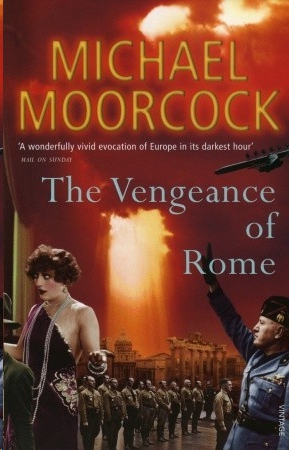
The Vengeance of Rome
- Автор: Муркок Майкл
- Серия: Between The Wars #4
- Язык: английский
- Жанр: Научная фантастика

Электронная книга - «The Vengeance of Rome». Краткое содержание книги:
I spent all day and all the next night in Brennero. Allowing me to keep myself clean and change clothes, the officials fed me well and worked hard to make my stay comfortable. I resisted drawing on my personal friendship with Mussolini, especially after what I had been told, yet the fact remained that neither the Spanish Embassy nor the Germans could help me get to Rome. I must return to Munich and obtain the appropriate visa or get myself a ticket for Barcelona and try to obtain a visa there. If so, I would have to give them my papers and have them returned to me once I got to Spain. I would not be allowed to disembark from the train en route.
I dared not give up my papers or reveal my US documents. I had little money left. Any further travel must be made in third class. I thought this hardly fair since I had originally purchased a first-class ticket. Once more the officers were courtesy itself. Regulations did not permit me to stay any longer in Italy. They advised me to go back to Vienna where the Spanish Embassy would doubtless accommodate me.
I was in a terrible position. I had good reason for not contacting the Spanish Embassy. I was not even sure how good my documents were, since they had been obtained in North Africa. Gallibasta was by no means a common name. They could easily check on me. My Spanish was imperfect. If I told them I had been living on Majorca, my connection with Stavisky might be revealed. Reluctantly I decided it would be better to take the Vienna train and use my American papers. In Vienna, at least, I would be safe from the German authorities. But where would I find money? Perhaps Otto Strasser could help if he was still there?
After a short, uncomfortable stay in Italy, I found myself in a third-class carriage crowded with peasants and workers who stared curiously at my suitcase and my smart clothes. I was immediately stereotyped as a Jewish travelling salesman. They had seen the police helping me aboard and decided I was some sort of crook forced to leave Brennero in a hurry and returning to Vienna to rejoin my kind. The Austrians among them showed the most appalling prejudice, far worse than anything I had experienced at the hands of the Germans. I attempted to explain how I was a Spanish citizen, an engineer. Those who could understand me at all merely laughed and told me to shut up. Some even made attempts to open my case until I threatened to call the guard and report them to the police when we arrived at the next station. Not for years had I experienced such wretched humiliation. The journey now became a horror. When we eventually pulled into Vienna, I disembarked quickly, my clothes stinking of working-class sweat and worse.
Unless Fiorello was still there, I knew no one in the Austrian capital, but I found some cheap lodgings not far from the station. In the privacy of a room reeking of cheap sausage and sauerkraut, noisy from the street outside and the business of the other lodgers around me, I tried to take stock of my situation. Without the appropriate papers, I was not going to get into Italy unless I could find someone to smuggle me over the border. I would have to forget Rome as an immediate destination. By living frugally, I could survive in Vienna for a while. I wished now that I had stayed with the Fraus and travelled with them. At least in their company I would have made some sort of modest living. Now it was too dangerous for me to go back to Munich. I had burned my bridges. Every instinct told me I would not be safe until Hitler was certain he had rounded up all his enemies. My association with Röhm was enough to damn me. The likes of Baldur von Schirach would perhaps even put two and two together. I had been released almost by accident, because I was not associated with the old Nazis. If I was picked up again, I was not likely to be so lucky.
I became deeply despondent. I had no friends in Vienna. My only acquaintance, Herr Stross, was in Innsbruck and not likely to be staying long, even if he could have helped me. Budapest would be even worse for me, and the only person I knew who had been living in Prague, but might now be in Vienna, was Otto Strasser, himself even more of an SS target than I. Perhaps if I stayed for a while in Vienna I might be able to pick up some information or learn a way of getting into Italy which would not involve me obtaining a visa. Could I somehow contact my cousin Shura with his useful connections with Stavisky? Of course, this association was a two-edged sword. The newspapers said Stavisky was in France. Shura would be with him. But I was still unwilling to risk travelling in a country where I could be arrested at any moment. Perhaps it made sense to go back into Spain, as the immigration people had suggested? I could try to contact Signor Frau’s relatives or possibly make my way to Majorca, where I still might find acquaintances.
With my money dwindling, I spent two or three fruitless weeks in Vienna, trying to find work and contacts. I found neither. The country was in another economic crisis. They had no work for locals, let alone for a desperate foreigner. Everywhere I went people assumed I was a Jew. This alone was enough to weaken my morale. While Austria had no official policy towards Jews, decent people did not want to employ them. And no matter how often I assured prospective employers that I was Spanish, they were too blinkered by their prejudices to believe me. They disliked the Spanish almost as much as they hated Jews. Only Jews offered me work, but at such disgusting terms I was bound to refuse.
Eventually, having failed in two attempts to cross the border, I had no choice but to work for a Jewish motor mechanic who put me to repairing the cars of his richer co-religionists. I had never in my life sunk so low, but it paid for food and accommodation over the workshop. I stood this humiliation until the winter, when I could not afford fuel for the stove in my lodgings and was having to wear one of my summer suits over the other. I could not buy winter clothing, and the Jew had no cast-offs to offer me. The cold was the final blow. I could take no more. Deciding it was probably safe now to risk returning to Germany, I determined to throw myself on the hospitable mercy of the Frau family while I decided what to do. Anything was better than having to bite my tongue and suffer under the ignominy of the Jewish heel.
Desperation and circumstance made me rationalise the situation. Perhaps I should have stayed in Vienna or tried to get to Prague, but the only friends I had were the Fraus. So one January morning, not long after my thirty-fifth birthday, I took a bus from the working-class Jewish Quarter and began my journey to Munich.
The bus was packed with returning Germans who had been visiting relatives for Christmas, and I felt I would be anonymous among them. Almost with relief I found myself looking forward to seeing Munich again. Ironically, it proved almost as difficult to get back into Germany as it had been to get into Italy. The authorities were carelessly suspicious and unwelcoming, in spite of my insistence that I was Spanish and not Jewish, that I had a job and a home in Munich. Eventually, I think, they reasoned that no foreign Jew in his right mind would be trying to get into their country and let me in. By early February, no doubt looking considerably older than my years, I arrived back in Munich and went immediately to the little mews where I had left the rest of my belongings. I was anxious to get some winter clothes and the small amount of money I had left there. I arrived late in the evening around the time I knew the Frau family went to bed. No lights were on in the house, and I was hesitant to wake anyone up, but I was too cold to follow my conscience. I rapped loudly on the door, calling out to Signor Frau. Eventually the Fraus’ next-door neighbour came out. He told me that they had left a month ago.
I was distraught. Where had they gone?
‘I don’t know. They had some trouble with the police. He thought it best to visit his cousin. Could that be in Spain somewhere? His boy was beaten up a couple of times. You know how it is. We’re thinking we should leave too if things get any worse. It used to be a good living here, but it’s drying up.’ The Fraus had not left a forwarding address. They had relatives in Madrid, he knew. They had packed everything in a wagon and planned to make a living on the road. He suspected the whole mews was being watched intermittently by plain-clothes men. All Italians, indeed all foreigners, were under suspicion.