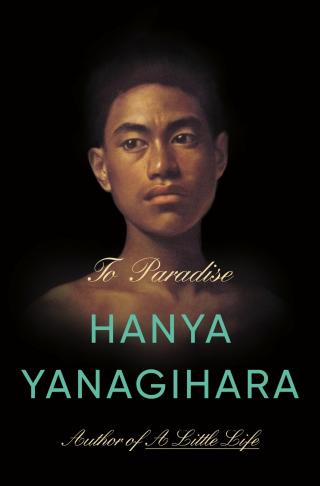
To Paradise
- Автор: Yanagihara Hanya
- Год: 2022
- Язык: английский
- Год: Knopf Doubleday Publishing Group
- Жанр: Современная русская и зарубежная проза

Электронная книга - «To Paradise». Краткое содержание книги:
In an alternate version of 1893 America, New York is part of the Free States, where people may live and love whomever they please (or so it seems). The fragile young scion of a distinguished family resists betrothal to a worthy suitor, drawn to a charming music teacher of no means. In a 1993 Manhattan besieged by the AIDS epidemic, a young Hawaiian man lives with his much older, wealthier partner, hiding his troubled childhood and the fate of his father. And in 2093, in a world riven by plagues and governed by totalitarian rule, a powerful scientist's damaged granddaughter tries to navigate life without him--and solve the mystery of her husband's disappearances.
These three sections are joined in an enthralling and...
“Cat,” she said, finally.
“How about something more—descriptive?” I asked her. (“Make her describe things to you,” her psychologist said. “Make her keep talking. You won’t necessarily be able to reawaken her imagination, but you can remind her that it’s there for her to use.”)
She was quiet for so long, staring at the kitten and stroking its fur, that I thought she’d had another seizure. Then she spoke again. “Little Cat,” she said.
“Yes,” I said, and my eyes grew hot. I felt, as I often do when watching her, a deep ache, one that radiates from my heart to every part of my body. “He is little, isn’t he?”
“Yes,” she agreed.
She’s so different now. Before the illness, I would watch her from the doorway of her bedroom, unwilling to interrupt her play by speaking, listening to her talk to her stuffed animals, using one pitch of voice to command them and another to inhabit each one, and feel something inside me swell. When I was in med school, I remember a woman, the mother of a child with Down syndrome, had come to talk to us about the manner in which the doctors and geneticists had discussed her daughter’s postnatal diagnosis with her, which ranged from heartless to clueless. But then, she said, on the day she and her baby were being discharged, the attending resident had come to say goodbye to them. “Enjoy her,” he had said to this woman. Enjoy her: No one had ever told her that she might delight in her baby, that her baby might be a source not of troubles but of pleasure.
And in the same way, I had always enjoyed Charlie. I always knew I did—that enjoyment, that pleasure I took in the fact of her, was inextricable from my love for her. Now, though, that enjoyment is gone, replaced by some other sensation, one deeper and more painful. It’s as if I cannot see her without experiencing her in triplicate: the shadow of who she once was, the reality of who she is, the projection of who she might become. I mourn one, am bewildered by the next, and fear for the third. I had never realized just how much I had assumed about her future until she emerged from her coma so changed. I knew I wouldn’t be able to predict what New York, this country, the world might look like then—but I always knew that she’d be able to meet her future bravely and forthrightly, that she had the self-possession and charm and intuition to survive.
But now I fear for her constantly. How will she live in this world? Who will she be? That image I hadn’t even realized I had, of her banging into the house, a teenager, after visiting a friend, me lecturing her for being late—will that still happen? Will she be able to walk through the Village—sorry, Zone Eight—alone? Will she have friends? What will become of her? My love for her at times feels terrible, huge, dark: a wave so towering and silent that there is no fighting, no hope against it—you can only stand and wait for it to smother you.
I understand that this dreadful love is being compounded by a growing awareness of how the world that we live in—a world that, yes, I helped create—is not one that will be tolerant of people who are fragile or different or damaged. I have always wondered how people knew it was time to leave a place, whether that place was Phnom Penh or Saigon or Vienna. What had to happen for you to abandon everything, for you to lose hope that things would ever improve, for you to run toward a life you couldn’t begin to imagine? I had always imagined that that awareness happened slowly, slowly but steadily, so the changes, though each terrifying on its own, became inoculated by their frequency, as if the warnings were normalized by how many there were.
And then, suddenly, it’s too late. All the while, as you were sleeping, as you were working, as you were eating dinner or reading to your children or talking with your friends, the gates were being locked, the roads were being barricaded, the train tracks were being dismantled, the ships were being moored, the planes were being rerouted. One day, something happens, maybe something minor, even, like chocolate disappears from the stores, or you realize there are no more toy shops in the entire city, or you watch the playground across the street from you be destroyed, the metal jungle gym disassembled and loaded into a truck, and you understand, suddenly, that you’re in danger: That TV is never returning. That the internet is never returning. That, even though the worst of the pandemic is over, the camps are still being built. That when someone said, in the last Committee meeting, that “certain people’s chronic procreation was welcome for once in history,” and no one reacted, not even you, that everything you had suspected about this country—that America was not for everyone; that it was not for people like me, or people like you; that America is a country with sin at its heart—was true. That when the Cessation and Prevention of Terrorism Act was passed, allowing convicted domestic insurgents the choice between internment and sterilization, it was inevitable that Justice would eventually find a way to extend that punishment to first the children and then the siblings of those convicted insurgents.
And then you realize: I can’t stay here. I can’t raise my granddaughter here. So you reach out to some contacts. You make some discreet inquiries. You reach out to your best, your oldest friend, your former lover, and you ask him to help get you out. But he can’t. No one can. You are told by your government that your presence is essential. You are told that you’d be allowed to travel on a limited-term passport, but that a passport cannot be issued for your granddaughter. You know that they know that you would never leave without her—you know that she is the reason you have to leave; you know she is how they will ensure that you never will.
You lie awake at night; you think of your dead husband, your dead son, the bill being proposed that would make a family like the one you once had illegal. You think of how proud you once were: how you once bragged about being a young lab chief; how you volunteered to help build the systems you now want to escape. You think of how your safety is guaranteed only by your ongoing participation. You want nothing more than to scroll back through time. It is your dearest dream and wish.
But you can’t. You can only try to keep your granddaughter safe. You are not a brave man—you know that. But, as much of a coward as you are, you will never abandon her, even as she has become someone you can’t access and don’t understand.
You ask every night for forgiveness.
You know you’ll never receive it.
Love, Charles
PART VII
Summer 2094
I was nervous on the day I met my husband for the first time. This was in the spring of 2087; I was twenty-two. The morning I was to meet him, I woke earlier than usual and put on the dress that Grandfather had gotten for me somewhere—it was green, like bamboo. There was a sash around the middle that I tied in a bow, and long sleeves, which hid the scars I had from the sickness.
At the marriage broker’s office, which was in Zone Nine, I was taken to a plain white room. I had asked Grandfather if he would be there for the meeting with me, but he had said that I should meet with the candidate alone, and he would be right outside, in the waiting room.
After a few minutes, the candidate entered. He was nice-looking, as nice-looking as he was in his picture, and I felt unhappy, because I knew I wasn’t nice-looking myself, and his attractiveness would make me less so. I thought he might laugh at me, or look away from me, or turn around and leave.
But he did none of those things. He bowed to me, deeply, and I bowed back, and we introduced ourselves. Then he sat, and I sat, too. There was a pot of powdered tea and two cups, and a little dish with four cookies. He asked if I wanted some tea, and I said I did, and he poured me some.
I was anxious, but he tried to make the conversation easy. We already knew all the important things about each other: I knew that his parents and sister had been declared guilty of treason and had been sent to labor camps, and had later been executed. I knew that he had been a graduate student in biology, and that he had been studying for his doctorate before he was expelled for having traitorous relatives. He knew who Grandfather was, and who my father was. He knew the disease had left me sterile; I knew that he had chosen to be sterilized rather than be sent to the rehabilitation camps. I knew he had been a promising student. I knew he was very smart.