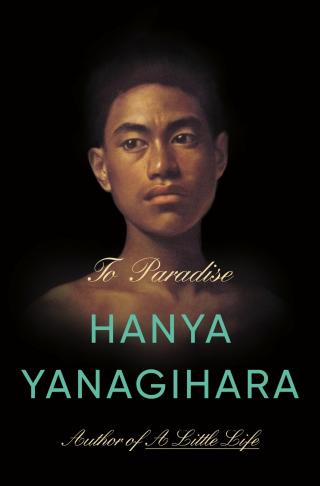
To Paradise
- Автор: Yanagihara Hanya
- Год: 2022
- Язык: английский
- Год: Knopf Doubleday Publishing Group
- Жанр: Современная русская и зарубежная проза

Электронная книга - «To Paradise». Краткое содержание книги:
In an alternate version of 1893 America, New York is part of the Free States, where people may live and love whomever they please (or so it seems). The fragile young scion of a distinguished family resists betrothal to a worthy suitor, drawn to a charming music teacher of no means. In a 1993 Manhattan besieged by the AIDS epidemic, a young Hawaiian man lives with his much older, wealthier partner, hiding his troubled childhood and the fate of his father. And in 2093, in a world riven by plagues and governed by totalitarian rule, a powerful scientist's damaged granddaughter tries to navigate life without him--and solve the mystery of her husband's disappearances.
These three sections are joined in an enthralling and...
The Committee had discussed what was happening in the U.K.—sorry, New Britain—since the election. You’ll be happy to hear that everyone thought that the transition seemed much more harmonious than you do. And you’ll be not at all surprised to hear that everyone thinks that, despite everything, you’ve made the wrong decision, and that you’ve been far too lenient with the population, and that you’ve conceded to the protestors. Everyone also agreed it was crazy that you were reopening the Underground. You know I don’t entirely disagree.
After I ate, I wandered the house. This is something I’ve begun doing at the end of each week. It began that first Saturday after the event, when I had woken from a dream. In it, Nathaniel and I were back in Hawai‘i, in the house we once lived in, but at the age we are now. I don’t know if David existed in this dream—if he was in his own house, or living with us but out running an errand, or if he had never been born at all. Nathaniel had been looking for a photo, one from shortly after we’d met. “I noticed something funny in it,” he said. “I have to show you. I just can’t remember where I put it.”
That was when I had woken up. I knew I had been dreaming, and yet something compelled me to get up and start looking as well. For the next hour, I walked from floor to floor—this is before the nanny and the cook moved onto the fourth floor—opening random drawers and taking random books from shelves and flipping through their pages. I sifted through the bowl of junk on the kitchen counter—twist ties and rubber bands and paper clips and safety pins: all the small, poor, necessary items that I remembered from my childhood, all the stuff that had remained even when so much else had changed. I looked through Nathaniel’s closet, his shirts that still smelled of him, and his bathroom cabinet, the vitamins he took, even long after they had been proven ineffective.
In those first weeks, I had neither the right nor the inclination to enter David’s room, but even after the investigation had finished, I kept the door shut, moving downstairs to what had been Nathaniel’s room so that there was no need to ever visit the third floor. It wasn’t until two months later that I was finally able to do so. The bureau had left the room very tidy. Part of this was simply a matter of reduced volume: Gone were David’s computers and phones, the papers and books that had covered the floor in heaps, the rolling plastic cupboard containing dozens of tiny drawers, each filled with items, nails and tacks and bits of wire, meant for things I couldn’t contemplate too hard, for if I had, I would have had to report him to the bureau myself long ago. It was as if they had erased the past decade altogether, so that what remained—his bed, some clothes, some monster figurines he had made when he was a teenager, the Hawaiian flag that had hung in whatever room he occupied from the time he was a baby—was his teenage self, just before he had joined The Light, before he and Nathaniel and I had broken from one another, before the experiment of our family had failed. The only indication that time had indeed passed after all were two framed pictures of Charlie atop the table near his bed: The first, which Nathaniel had given him, was of her on her first birthday, grinning hugely, with mashed peaches smeared over her face. The second is a short video Nathaniel took a few months later, of David holding her by her arms and spinning her around. The camera moves first to his face, and then to hers, and you can see they’re both shouting with laughter, their mouths wide with happiness.
Now, nearly four months after that day, I find that hours can pass in which I think of neither of them, in which the flashes of delusion—wondering, in the middle of a dull meeting, what Nathaniel would be making for dinner, for example, or whether David would stop by this weekend to see Charlie—no longer flatten me. What I cannot stop doing is thinking of the moment itself, even though I didn’t witness it, even though, when I was offered the chance to review the classified images, I declined: the explosion, the people nearest to the device bursting into bits, the jars around them shattering. I know I’ve told you before that the one image I did look at, before I closed the file for good, was taken that night. It was of the ground, close to where the device had gone off, in the sauces-and-soups aisle. The floor was covered with a gluey red substance, though it wasn’t blood but tomato paste, and scattered through it were hundreds of nails, burned black and twisted by the heat of the explosive. On the right-hand side of the image was a man’s disembodied hand and part of an arm, a watch still strapped to the wrist.
The other image I saw was the video clip documenting the moment David rushes into the store. There’s no sound on the video, but you can tell by how he swivels his head that he’s frantic. Then he opens his mouth, and you can see him shout something, a single syllable: Dad! Dad! Dad! And then he runs deeper into the store, and then there’s nothing, and then the image of the door, now shut, wobbles and goes white.
It’s this video clip that I’ve been showing investigators and ministers for months, ever since I got it, trying to prove to them that David couldn’t have been responsible for the explosive, that he had loved Nathaniel, that he would never have wanted to kill him. He knew Nathaniel did his grocery shopping there; when he had realized what The Light had planned, and when Nathaniel had sent him a message saying he was going to the store, had he not run inside to find him, to save him? I could not definitively say he wouldn’t have wanted to kill anyone else—though I said so anyway—but I knew he wouldn’t have wanted to kill Nathaniel.
But the state does not agree with me. On Tuesday, the interior minister himself came to see me, and explained that, as David was a “prominent and known” member of an insurgent organization responsible for the deaths of seventy-two people, they would have to issue him a postmortem censure for treason. This meant that he could not be buried or interred at a cemetery, and that his descendants would be prohibited from inheriting any of his assets, which would be seized by the state.
Then a strange look came over his face, and he said, “So it’s fortunate—if I may use that word in this horrible situation—that your ex-husband had specified in his will that his house and all his property would bypass your son and go directly to your granddaughter.”
I was so dazed by what he had just said about David’s censure that I couldn’t understand what he was trying to communicate to me. “No,” I said, “no, that’s not true. It was all to go to David.”
“No,” said the minister, and he drew something from the pocket of his uniform, which he handed me. “I believe you’re mistaken, Dr. Griffith. It reads quite clearly in his will that his entire estate is to be left to your granddaughter, with you as its executor.”
I unfolded the sheaf of papers, and there it was, as if I had not been witness to the creation and signing of this will just a year ago: There was to be a trust established for Charlie, but David would inherit the house, with the provision that he must leave it to Charlie upon his death. But now here was a document, signed by Nathaniel and by me, watermarked and stamped with all three of our name seals—the lawyer’s, Nathaniel’s, and mine—attesting to what the minister had said. And something else: Charlie’s official name on the document was listed not as “Charlie Bingham-Griffith,” but as simply “Charlie Griffith”—her father’s name, Nathaniel’s name, edited out of existence. I looked up, and the minister looked back at me, a long, unreadable stare, before standing. “I’ll leave you that copy for your records, Dr. Griffith,” he said, and then he left. It wasn’t until I got home that night that I held it to the light, looking at how perfect the signatures were, at how exact the seals were. And then I was suddenly frightened, and convinced the paper itself was somehow bugged, although that technology is a decade off, at least.