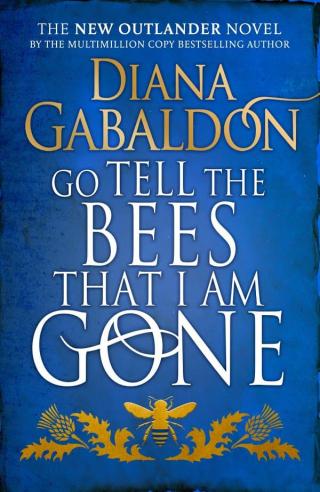
Go Tell the Bees That I Am Gone
- Автор: Гэблдон Диана
- Серия: Outlander #9
- Год: 2021
- Язык: английский
- Год: Delacorte Press
- ISBN: 978-1-473-51900-8
- Жанр: Исторические приключения

Электронная книга - «Go Tell the Bees That I Am Gone». Краткое содержание книги:
The past may seem the safest place to be . . . but it is the most dangerous time to be alive. . . .
Jamie Fraser and Claire Randall were torn apart by the Jacobite Rising in 1746, and it took them twenty years to find each other again. Now the American Revolution threatens to do the same. It is 1779 and Claire and Jamie are at last reunited with their daughter, Brianna, her husband, Roger, and their children on Fraser’s Ridge. Having the family together is a dream the Frasers had thought impossible. Yet even in the North Carolina backcountry, the effects of war are being felt. Tensions in the Colonies are great and local feelings run hot enough to boil Hell’s teakettle. Jamie knows loyalties among his tenants are split and it won’t be long until the war is on his doorstep. Brianna and Roger have their own worry: that the dangers that provoked their escape from the twentieth century might catch up to them. Sometimes they question whether risking the perils of the 1700s—among them disease, starvation, and an impending war—was indeed the safer choice for their family. Not so far away, young William Ransom is still coming to terms with the discovery of his true father’s identity—and thus his own—and Lord John Grey has reconciliations to make, and dangers to meet . . . on his son’s behalf, and his own. Meanwhile, the Revolutionary War creeps ever closer to Fraser’s Ridge. And with the family finally together, Jamie and Claire have more at stake than ever before.
IT WAS DARK outside; the moon had set and dawn was some way off. It was cold, but the cold didn’t touch me.
I’d let him take the baby, at last. Felt his hands on mine as he took her, warm and sure, his face filled with light. He’d knelt carefully and given the baby to Susannah, placing his hand on the child in benediction.
Then he’d stood and wrapped me in my cloak and walked me outside. I couldn’t feel the ground beneath my feet, or see the forest, but the cold air smelled of pine and lay like a balm on my heated skin.
“All right, Sassenach?” he whispered. I seemed to be leaning against him, though I didn’t remember doing it. I’d lost track of where my body began and ended; the pieces seemed to be floating about in a loose sort of cloud of exaltation.
I felt Jamie’s hands tremble a little as he touched my face. From exhaustion, I thought. The same small, constant quiver seemed to be running through me from crown to sole, like a low-voltage current of electricity.
In fact, I’d passed clear through exhaustion and out the other side, as one does sometimes in moments of great effort. You know that your bodily energy has been used up, and yet there’s a supernatural sense of mental clarity and a strange capacity to keep moving, but at the same time, you see it all simultaneously, from outside yourself and from your deepest core—the usual intervening layers of flesh and thought have become transparent.
“I’m fine,” I said, and I laughed. Let my forehead fall against his chest and breathed for a moment, feeling all my pieces come to rest, whole again, as the enchantment of the last hour faded into peace.
“Jamie,” I said, a few moments later, raising my head. “What color is my hair?”
This was an absurd question; it was the depth of the night and we were standing in a pitch-black forest. But he made a small noise of appraisal and lifted my chin to look.
“All the colors o’ the earth,” he said, and smoothed the hair from my face. “But here, all about your face—it’s the color of moonlight, mo ghràidh.”
55
The Venom of the North Wind
RACHEL WOKE SUDDENLY, COMPLETELY alert but with no idea what had woken her. She moved, turning her head to see if Ian was awake. He was; his hand clamped across her mouth and she froze. It was dark in the cabin, but there was light enough from the banked fire for her to see his face, eyes dark with warning.
She blinked, once, and with a tiny nod he removed his hand. He lay quite still and so did she, though her heart thumped hard enough that she thought it would wake Oggy, snuggled between them.
Thumping hard enough that she couldn’t hear anything, either—Ian was listening, though. His long body hadn’t moved, and yet he seemed to have coiled up, somehow, like a snake gathering itself. She shut her eyes, concentrating.
There had been wind all night; berries from the big red cedar that guarded the house had been thumping on the roof at intervals. But Ian would have recognized that sound …
Suddenly Ian moved, rising onto one elbow; she heard him breathe in, sharply, and by reflex did the same. Tobacco. In the next instant, he’d slid out of bed and padded naked to the door.
She let out her breath with a sense of relief; a friend, then. Soft voices on the porch, then Ian stuck his head back in, smiled briefly at her, and snatching a folded blanket from the top of the chest closed the door behind him.
Oggy, disturbed by the sense of movement, stirred and made snuffling noises. She rose with haste in order to make use of the chamber pot before he roused all the way; he wasn’t a patient child.
Her shawl round her shoulders and the baby at her breast, she stole up to the window by the door. It was covered with an oiled hide, tacked down against drafts, so she couldn’t see anything, but sounds came through from the porch fairly well.
Not that it did her much good. The visitors—she made out at least two different voices, besides Ian’s—were Indians, and speaking in their own language. Perhaps Standing Heron Bradshaw and a friend from the Cherokee villages, come to help hunt the catamount that had been seen near the creek. That was a merciful thought; the more men there were, the safer they’d be. Presumably.
She was just about to go and check the porridge in the pot, in case the visitors needed breakfast, when she heard a word that froze her in her tracks and made her squeeze Oggy so hard that he emitted a small, surprised hoof! and stopped feeding for an instant.
He latched on to her breast again with instant ferocity, but she barely noticed. Not Cherokee. Not at all. They were Mohawk, and the word that had caught her ear was “Wakyo’teyehsnonhsa.”
SHE DIDN’T WAIT to put the child down or dress. When she stepped out onto the porch, the boards were icy under her bare feet, and the light was just beginning to fade into view. So were the interested faces of not two but three Mohawks, all of whom looked at her and nodded politely.
One of them said something that made Ian cough and glance sideways at her. He was wearing the blanket wrapped about his waist, and the sight of his bare chest, the nipples gone small and hard with cold, made her own nipples do something in sympathy that made Oggy choke and cough, spluttering milk all down the front of her shift. The Indians looked away as though nothing had happened.
“Thy friends are welcome, Ian,” she said, trying not to grit her teeth. She smiled at them. “Will they eat with us?”
They understood English, for all three at once went into the cabin. Ian made to follow them, and she grabbed his arm with her free hand.
“What’s happened?” she said, low-voiced.
“A massacre,” he said, and she saw now that he was upset, his face tight with worry. “There was an attack on a settlement—only a few houses, but all Whigs. It was Joseph Brant and some of his men. But then some fighters from Burk Hollow made a raid on a Mohawk settlement. In revenge.” He tried to turn toward the door, but she tightened her grip enough to stay him, not caring if she bruised him.
“Thy wife?” she said. “I see they came to give thee news of her. Was she in that settlement? Does she live?”
He didn’t want to answer, but to his credit, he did.
“I dinna ken. She was alive, when Looks at the Moon saw her—but that was near five months ago.” His eyes shifted past her and she knew he was looking toward the peak of the distant mountain, where a faint dusting of snow had appeared a week before. Works With Her Hands—and her children—were far to the north. How far? she wondered, and drew the shawl over Oggy’s round, bare head.
LOOKS AT THE MOON swallowed the last of his turkey hash and gave a loud belch of appreciation in Rachel’s direction, then handed her his plate before resuming the story he had been telling between bites. Fortunately, it was mostly in Mohawk, as the parts that had been in English appeared to deal with one of his cousins who had suffered following an encounter with an enraged moose.
Rachel took the plate and refilled it, envisioning the light of Christ glowing within their guests. Owing to an orphaned and penurious childhood, she had had considerable practice in such discernment and was able to smile pleasantly at Moon as she placed the newly filled plate at his feet, not to interrupt his gesticulations.
On the good side, she reflected, glancing into the cradle, the men’s conversation had lulled Oggy into a stupor. With a glance that caught Ian’s eye, and a nod toward the cradle, she went out to enjoy a mother’s rarest pleasure: ten minutes alone in the privy.