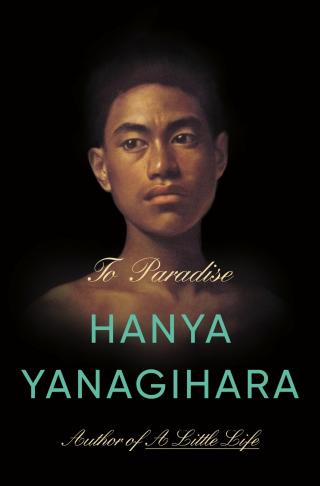
To Paradise
- Автор: Yanagihara Hanya
- Год: 2022
- Язык: английский
- Год: Knopf Doubleday Publishing Group
- Жанр: Современная русская и зарубежная проза

Электронная книга - «To Paradise». Краткое содержание книги:
In an alternate version of 1893 America, New York is part of the Free States, where people may live and love whomever they please (or so it seems). The fragile young scion of a distinguished family resists betrothal to a worthy suitor, drawn to a charming music teacher of no means. In a 1993 Manhattan besieged by the AIDS epidemic, a young Hawaiian man lives with his much older, wealthier partner, hiding his troubled childhood and the fate of his father. And in 2093, in a world riven by plagues and governed by totalitarian rule, a powerful scientist's damaged granddaughter tries to navigate life without him--and solve the mystery of her husband's disappearances.
These three sections are joined in an enthralling and...
“Yes,” I said. I had learned this in civics class as well. “Because it meant that the sick people were in one place, so people who were healthy wouldn’t get sick, too.”
“That’s right,” Grandfather said.
“Then why didn’t people like them?” I asked.
He looked up at the ceiling, which was something he did when he was thinking of how to answer me. “It’s difficult to explain,” he said, slowly, “but one of the reasons is that, back in those days, you would remove just the infected person, not their whole family, and some people thought it was cruel to separate people from their families.”
“Oh,” I said. I thought about this. “I wouldn’t want to be separated from you, Grandfather,” I said, and he smiled.
“And I would never be separated from you, little cat,” he said. “This is why the policy changed, and now the entire family goes to the center together.”
I didn’t need to ask what happened at the centers, because I already knew: You died. But at least you died somewhere clean, and safe, and well-equipped—there were schools for the children to go to, and sports for the adults to play, and when you got very sick, you were taken to the center hospital, which was gleaming and white, and where doctors and nurses took care of you until you died. I had seen pictures of the centers on television, and there were pictures of them in our textbook as well. There was one, taken at Heart Mountain, of a laughing young woman holding a little girl, who was also laughing; in the background, you could see their cabin, which had an apple tree planted in front of it. Standing next to the woman and little girl was a doctor, and even though she was wearing her full protective suit, you could tell she was laughing as well, and she had her hand on the woman’s shoulder. You couldn’t go visit people at the centers, for your own protection, but the sick person could bring whomever he or she wanted, and sometimes whole extended families would go in a group: mothers and fathers and children and grandparents and aunts and uncles and cousins. At first, going to the centers was voluntary. Then it became required, which was controversial, because Grandfather said that people didn’t like being told what to do, even if it was for the good of their fellow citizens.
Of course, by that point—this was in 2075—there were fewer people in the centers, because the pandemic had been almost contained by then. Sometimes I looked at that picture in my textbook and wished I lived in one of the centers myself. Not because I wanted to be sick, or wanted Grandfather to be sick, but because it looked so nice there, with the apple trees and wide green fields. But we would never go, not only because we weren’t allowed but because Grandfather was needed here. That was why we hadn’t gone to a center when I had been sick—because Grandfather needed to be near his lab, and the nearest center was on Davids Island, many miles north of Manhattan, which would have been too inconvenient.
“Do you have any more questions?” Grandfather had asked, smiling at me.
“No,” I said.
That had been a Friday. The following Monday, I had gone to school, and instead of my teacher standing at the front of the room, there had been someone else, a short, dark man with a mustache. “Where’s Miss Bethesda?” someone had asked.
“Miss Bethesda is no longer at this school,” said the man. “I am your new teacher.”
“Is she sick?” someone else asked.
“No,” said the new teacher. “But she is no longer at this school.”
I don’t know why, but I didn’t tell Grandfather that Miss Bethesda was gone. I never told him, even though I never saw Miss Bethesda again. Later, I learned that the centers may not have resembled the pictures in my textbook after all. This was in 2088, at the beginning of the second uprising. The following year, the insurgents were defeated for good, and Grandfather’s name was cleared and his status was restored. But by that point, it was too late. Grandfather was dead, and I was left alone with my husband.
Over the years, I have occasionally wondered about the relocation centers: Which version of them was the correct one? In the months before Grandfather was killed, protestors marched outside our home carrying blown-up photographs they said were taken at the centers. “Don’t look,” Grandfather would tell me, on the rare occasions we left the house. “Look away, little cat.” But sometimes I did look, and the people in the photographs were so deformed that they didn’t even look like humans any longer.
But I never thought Grandfather was bad. He had done what had needed to be done. And he had taken care of me for my entire life. There was no one who was kinder to me, no one who loved me more. My father, I knew, had disagreed with Grandfather; I don’t remember how I had come to know this, but I did. He had wanted Grandfather to be punished. It was an odd thing, knowing that your own father had wanted his father to be imprisoned. But it didn’t change my feelings. My father had left me when I was young—Grandfather never had. I didn’t see how someone who abandoned his child could be any better than someone who had only tried to save as many people as he could, even if he had made mistakes while doing so.
The following Saturday, I met David in the Square as always, and he once again suggested we go to the center, and this time, I agreed, as it was by now very hot. We walked the eight and a half blocks north slowly, so as not to overtax our cooling suits.
David had said that we were going to listen to a concert, but when we paid for our tickets, there was only a lone musician at the front of the room, a young, dark-skinned man with a cello. Once we had all sat down, he bowed to us, and then he began to play.
I had never thought I cared for cello music very much, but when the concert was over, I wished I hadn’t agreed to walk on the indoor track afterward and could instead go home. Something about the music made me think of the music Grandfather had played on the radio in his study when I was small, and I missed him so badly that it was difficult to swallow.
“Charlie?” asked David, looking worried. “Are you okay?”
“Yes,” I said, and I made myself stand up and walk out of the room, which everyone else, even the cellist, had already left.
At the edge of the indoor track there was a man selling iced fruit drinks. We both looked at the man and then at each other, because neither of us knew whether the other could afford to buy one.
“It’s okay,” I said at last, “I can.”
He smiled. “I can, too,” he said.
We bought the drinks and sipped them as we walked around the track. There were only about a dozen other people there. We were still wearing our cooling suits—once you were in them, it was easier to just keep them on—but had deflated them, and it felt good to move as we usually did.
For a while, we walked in silence. Then David said, “Do you ever wish you could visit another country?”
“It’s not allowed,” I said.
“I know it’s not allowed,” he said. “But do you ever wish you could?”
Suddenly I was tired of David’s strange questions, his tendency to always ask things that were, if not illegal, then at least impolite, subjects that you didn’t think about, much less discuss. And what was the point of wishing for anything that wasn’t allowed? Wishing for things would change nothing. For months, I had wished every day that Grandfather would come back—if I am to be honest, I wished for it still. But he never would. It was better not to want at alclass="underline" Wanting just made you unhappy, and I was not unhappy.
I remember once, when I had been in college, one of the girls in my class had figured out a way to access the internet. This was very hard to do, but she had been very smart, and though a few of the other girls had wanted to see what it was like as well, I had not. I knew what the internet was, of course, though I was too young to remember it: I was only three when it became illegal. I wasn’t sure I even understood, exactly, what it did. Once, when I was a teenager, I had asked Grandfather to explain it to me, and he had been quiet a long time, and then he finally said it was a way for people to communicate with one another across vast distances. “The problem with it,” he said, “was that it often allowed people to exchange bad information—untrue things, dangerous things. And when that happened, there were serious consequences.” After it was forbidden, he said, things became safer, because everyone was receiving the same information at the same time, which meant there was less chance for confusion. This seemed like a good reason to me. Later, when the four girls who had looked at the internet disappeared, most people thought they’d been taken by the state. But I remembered what Grandfather had said, and wondered if they had been contacted by people on the internet with dangerous information and something bad had happened to them. The point is that there was little purpose in wondering what it would be like to do things or go places that I would never be able to. I did not think about trying to find the internet, and I did not think of going to another country. Some people did, but I did not.