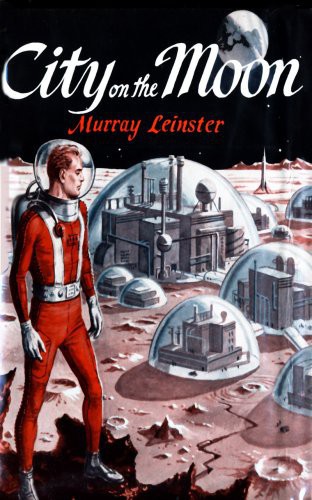
City on the Moon
- Автор: Лейнстер Мюррей
- Серия: To the Stars #3
- Язык: английский
- Жанр: Научная фантастика

Электронная книга - «City on the Moon». Краткое содержание книги:
"Is there anything I can do?" asked Arlene quietly.
Kenmore said coldly, as he worked, "Just pray. And you're better at it than we are."
Mike added, "And I'm saying 'Amen' when you finish, Arlene!"
The little Shuttle-ship floated up and up and up. There was no weight in it. Mike still sat before the control board; this was his ship. So Kenmore made loops of torn cloth from a ripped cushion, and fastened them to the manual-release levers of the rockets outside. There were buttons for release, and the manuals were intended for use if the buttons failed. Kenmore tested each strip repeatedly.
It was strange that he could think clearly. There had been sabotage and murder in all stages of the project of which Civilian City was a part. But earlier outrages had been mere snipings—hindrances and obstacles, but no more. This was all-out, desperate assault.
Kenmore's jeep should have been crushed in a rockslide. The Earthship should have crashed hopelessly without a beam to land by. The Shuttle itself ought to have battered itself to scrap metal in the Apennines, on the way from the Laboratory; certainly it should have been wrecked on this take-off, if it survived the earlier landing. And there was the vanishing of all the people of the City. All these disasters should have brought them to gibbering fury or numbed despair. But somehow both reactions were inappropriate—perhaps because nobody could submit to defeat by such means as had been practiced against the City.
The Shuttle-ship's hull was already strained; another blow, no more violent, might crumple it. Two or three, and it would inevitably become a mere tangle of junk in space.
Kenmore finished the job of the loops on the release handles. He went to Arlene, and filled the back of her helmet with stuff from the torn-up cushion, to make a pillow against more violent shocks.
"Seal up your suit," he commanded. "If there's another wrong rocket, this'll help the back of your head. Now put this helmet on, and turn on your suit-talkie." She obeyed and settled herself in the contour chair. She smiled at him. He grimaced back; he couldn't smile. Mike carefully fitted one mittened hand into one of the strips of cloth Kenmore had fastened to a rocket-release handle. He could hold his hand up against two gravities, or three or four. But another impact like the firing of the last rocket—which had so many gravities he didn't want to guess at it—would force his hand down. Then the rocket would be freed.
"Swing the ship around," said Kenmore, taking command without thinking of it. "Aim at the City and count down. We don't make the Laboratory this trip, anyhow." Mike said brittlely, "This ought to be a ten-two job. Five—four—three—two—"
Weight struck, but tolerable weight. It was a ten-two rocket; two gravities for ten seconds. They were pointed back toward the moon. Their velocity away from it was lessened, but by no means canceled.
When the pressure ended, Mike said calmly, "A six-three this time. Five—four—three—"
There was an impact like a pile driver, slamming Kenmore back into his seat. But Mike's hand was forced down by the impact, too. The manual release operated. The super-powerful Earthship's rocket tore away from the Shuttle with an acceleration past computing. It would undoubtedly strike somewhere on the silent, dreary emptiness. which was the moon. The ship was left weightless, its velocity unaffected. The rocket had been freed in time to prevent destruction, but the shock had still been great.
Mike asked savagely, "Anybody living?"
Arlene's voice in the helmet phones was unsteady. "I am."
"And Joe's grinding his teeth. I hear him," growled Scandia. "We're losing air. That jolt started something!" He ripped open his faceplate and snapped into the microphone of the ship's communicator, "You lugs down there in the spotter stations! If you're trying to figure out this radar pip heading out to space, it's us. Me, Mike Scandia, with Joe Kenmore and Arlene Gray aboard the Shuttle. We're blasting to come back in. We might make it. Track us and do what you can!" Then he snapped viciously, "Somebody switched markings on the rockets at the city! Sabotage!"
He snapped his faceplate shut, and Kenmore heard him panting. Air was going fast; the needle on the pressure gauge said six pounds. Five . . . That last bump had strained the plates of the Shuttle. Mike had used the last possible second of air to pant a message directed at anybody in one of the spotter stations whose radars watched for freight-rockets coming unmanned up from Earth. There were four of those stations.
The air-pressure needle hit zero; all air was gone, now. There was no way to talk from a sealed-up suit into a space-phone, or to hear what the space-phone received. There was no way to know if Mike's message had been received. On the whole, it was not likely. Spotter-station men did not usually man their equipment unless a cargo drone was due. There was nothing for them to look for. Mike said venomously through the talkie, when his breathing was easy again, "I shoulda called them before. Not much chance, but I shouldda done it! Hang on to your tonsils! I'm firing another six-three. Five—four-three—two—one—"
Another violent blow. It was like a monstrous fist; it was enough to make anybody black out. But this rocket, too, released itself by the weight of Mike's small fist in a loop to the manual handle the instant it proved its power.
"This don't look good!" said Mike icily. "Ready, Joe? I'm trying what's marked for a four-three. Five—four—" It was a four-three. The rocket pushed valiantly against the momentum that took the Shuttle toward the stars. It burned out. Mike gave warning and fired another rocket; that also was what it should be.
They ceased floating out, three firings later. Another flaming pusher and another. . . . The Shuttle-ship moved moonward, but it was airless, now. Kenmore said into his helmet phone, "Mike, we're headed back in. I think we'd better take it floating. No more shooting until we're about to touch. The ship's badly strained. It might come apart. But if we can get down in one piece, we can go outside and check the markings and make sure of what's left. We might even be able to lift off again, and land somewhere near the City. But don't risk any more firings until we're close to ground!"
Mike said grudgingly, "That makes sense. I'll spend the time figuring out what to do to the guy who switched those marks!"
The little ship floated downward. They had an indefinite velocity toward the moon, now, which increased as the feeble gravity pulled at them. It had seemed that the gravity was trivial because the rate-of-fall was slow. The ship would hit with only one-sixth the speed, and therefore one-sixth violence, of the same object falling the same distance to Earth. From a height of six yards it would hit no harder than from a fall of one yard on the mother planet; but their height was several times six miles.
There was little for them to do, of course. They could move about, weightless, in the airless cabin. The ship's gyros still ran, and still kept its nose pointed in the direction in which the last rocket had urged it. Kenmore pulled himself to the forward vision port and sighted.
"We'll land somewhere out on a sea, Mike."
Scandia did not answer. Kenmore heard his small teeth grinding in a full-sized rage. Kenmore himself couldn't afford to indulge his feelings, yet. Right now he had to think coolly. Their chances were so few that he couldn't afford to throw away any of them. But he couldn't think of a really good move, at that.
Presently he checked the ship's reserve tanks. He had Arlene top off her suit, then fixed a hose, and had the three of them breathing the ship's reserve air. He watched out the forward port.
"We got a break," he said presently. "I think I'm getting good bearings on a spotter station I know about. We may ground as close as sixty or seventy miles from it!"
"With," growled Mike, "two hours of air in our tanks!"