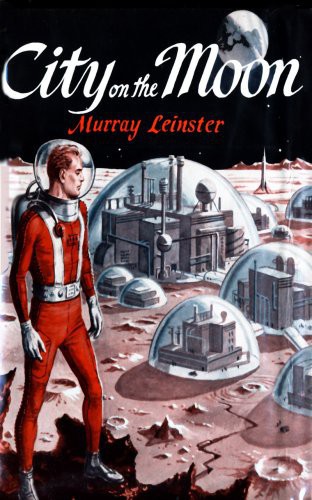
City on the Moon
- Автор: Лейнстер Мюррей
- Серия: To the Stars #3
- Язык: английский
- Жанр: Научная фантастика

Электронная книга - «City on the Moon». Краткое содержание книги:
Arlene's vacuum-suited figure moved as she looked from one to the other.
"Things are bad!" insisted Mike. "They wouldn't believe me, back on Earth. They might not believe Arlene and me. But—"
"I'll call Earth back," said Kenmore.
He wheeled and went back into the City. When he returned, his headphones picked up Arlene's voice: "Can you use a compass here, Mike?"
"Huh!" said Mike. "No need. Look up at Earth and you got your directions. Well?"
"I'll go with you," said Kenmore. "I left Moreau in charge."
He followed Arlene up the cleat ladder on the ship's fin. She went first into the lock. They settled themselves inside; five minutes later Mike joined them.
"Taking off at two gravities," he said grandly. "Slow enough for you really to see some scenery! Firing five seconds, four, three two—"
He pressed a firing button marked "5-2". There was a roaring and a very great weight. He'd counted down to firing time, because it is desirable to have one's lungs full when such acceleration begins suddenly.
The weight, though, lasted only five seconds. Five-two. Five seconds, two gravities. Then there was no weight at all. There was a great and restful silence; the rocket floated up and up. And there were ports—they would be shielded beyond the shadow of the moon, to keep sunshine out—through which Arlene could see the quite incredible landscape in the earthlight. The silence lasted, and the dusty frozen "sea" reached out and out in the pale twilight, and the mountains dropped down and down.
For ninety-odd seconds the ship floated up, and as it rose ever higher the mountains dropped more slowly. The revelation of ever-new wildernesses of peaks came more gradually, with the disclosure of ever more breathtaking wonders. At twenty-three thousand feet there were thousands of square miles of mountains visible on the one hand, and the downward-curving lunar sea on the other.
Mike said, "This view is kinda pretty, Arlene, even by earthlight. I thought you'd like to see it like this. Now we head around for the Laboratory. Settle back, now. We're blowing off." To Joe, he said crisply, "A six-three, Joe. It'll be neat."
Mike counted according to precedent: "Five, four, three, two, one—"
He pressed the firing button, and the cosmos seemed to explode.
The little ship should have disintegrated. A rocket flamed outside, but it was not a three-gravity acceleration which flung the small spacecraft forward. It was an overwhelming, unbearable thrust which was the equivalent of a continuous explosion. Joe Kenmore was thrust back in the contour chair by a brutal pressure, which held him immovable. He could not lift his hands against it; he could not move at all. He felt his cheeks drawn back, exposing his teeth. He felt the flesh of his body straining to spread out, to flatten, to burst with the weight of blood going to the back part of his body. He fought fiercely to stay conscious, with blood draining from the forepart of his brain. His struggle seemed to last for centuries.
But it ended; he battled back to full awareness, and tried to move. His arms and legs would not obey him at first; they fluttered feebly. He croaked, "Arlene! Arlene! Are you alive?"
There was no answer, and the silence was a horrible stimulus. He reeled up—he was weightless—and a light came on in the cabin. He pulled himself to the chair which held Arlene. Her eyes were barely flickering back to life when he heard Mike Scandia's voice behind him. Mike gasped incoherently; his small body writhed with anguish and with rage. He turned blazing eyes upon Kenmore.
"This was—on purpose!" he panted. "I—checked these rockets! Somebody's been—tampering! To kill us! They switched Earthship rockets for Shuttle ones! Oh . . ." He moaned with the fury that filled him. But Kenmore called again: "Arlene . . ."
She whispered faintly, "I think—I'm all right . . ." And then Kenmore began really to appreciate the crime that had been committed against the City, and the Laboratory, and Arlene and himself. He dragged himself to a port and looked out. The ship was far, very far out from the moon's surface; that did not matter. It was still headed out; that meant little, though its velocity would be of the order of half a mile per second or more. Even that was not necessarily deadly.
But one of the rockets had ben mismarked. Mike himself had chosen the rockets, and bolted them in their proper racks. But instead of a solid-fuel rocket, intended to give the Shuttle-ship three gravities acceleration for six seconds, Mike had mounted and later fired a rocket intended to lift the big ship back toward Earth. A thrust meant for a ship twenty times heavier had been used on the Shuttle; the consequences were bad, but the prospects were worse.
Any or all of the remaining rockets might be absolutely anything. Any of them might be another take-off job for the Earthship, and another would crumple the little Shuttle like an eggshell.
But rockets had to be fired. The ship was rising; it had to be turned back, or it would start the long fall down to Earth, into whose atmosphere it would plunge like a flaming meteor. And should they turn back toward the moon, it would need to be checked before it crashed on the rocky surface there. Somehow, the Shuttle had to be landed. Each of these maneuvers required the firing of rockets; and any of them might involve the collapse of the ship's structure under the stress of forces it was not designed to endure.
Even more: There would be little use in merely landing on the moon. On the nearside lunar hemisphere, there was the land-surface of a large continent—much more land-surface than on the entire continent of North America. In that vastness, with its mountain ranges miles high, and hundreds of miles long, there were just three guided-missile bases, and four radar-spotting posts, and the abandoned Civilian City. That was the equivalent of four hamlets, and as many trappers' huts, on a continentsized wilderness. And when or if the small ship landed, the people in it would be wearing vacuum suits which held just two hours' supply of air.
The odds against landing the ship as an intact object were great, the odds against surviving a landing were greater. And against landing in the lunar night, within foot-travel distance of shelter, with two hours' air travel on . . .
Survival seemed completely impossible. Appropriately enough for an emergency in space, the odds against success were astronomical.
CHAPTER VIII. THE WRECK
MIKE said brittlely, "If this was a telecast, we'd walk outside the hull with magnet-soled shoes, and do something dramatic, and fix everything. Huh?"
His tone was scornful, but there was despair in his meaning. There was no simple and dramatic answer to the situation they were in. Hull-walking would do no good at all; there wasn't much chance that anything else would. They were, to all intents and purposes, already dead. So Mike watched Kenmore at work, and he had no hope at all—though he would try what Joe was preparing for. The three of them still wore their vacuum suits, save for the helmets; but Kenmore wriggled out of the top half of his armor to be able to use his fingers. He'd ripped a cushion cover to strips. He tested their strength. Now he handed a strip to Mike.
"See if it's strong enough," he commanded. "I'll tear some more. We have to have everything fixed from the beginning, in case the ship loses its air."
Mike took the cloth strip in his clumsily mittened hands. He pulled it. He nodded, his small head looking even smaller in the full-sized neck of his cut-down vacuum suit.
"That'll pull the release," he agreed.