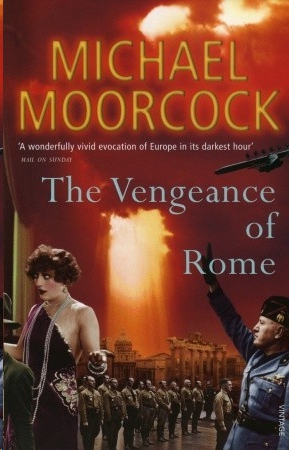
The Vengeance of Rome
- Автор: Муркок Майкл
- Серия: Between The Wars #4
- Язык: английский
- Жанр: Научная фантастика

Электронная книга - «The Vengeance of Rome». Краткое содержание книги:
It crossed my mind that the British Foreign Office would be more than interested in what I had to show them. Von Schirach and Röhm had so far failed to interest anyone in my designs. Röhm said it was because everyone’s attention was focused on getting and keeping power. Hitler had promised him the Reichswehr if he played a good hand. He told me not to approach Göring, whom he loathed increasingly, and I was beginning to wonder if Ernstie had any serious intention of helping me.
If it had not been for Baldur von Schirach, I might have despaired of the NSDAP altogether. I had some substantial conversations with the Youth Leader. Von Schirach shared my enthusiasm for the future. Once he saw my designs, he was ecstatic. Instinct told me he would understand them. He was deeply impressed. ‘But Herr Peters, you are a genius! I had no idea you possessed such sophisticated engineering skills. Surely you have studied at a great university!’ I told him how I had been the youngest Professor of Physics at St Petersburg University.
‘Russia?’ He was startled, frowning, no doubt working out my age.
Of course not, I told him. Florida. Thus I avoided a too complicated explanation. I had forgotten it was unwise to say anything of my Russian education or even of the important aristocrats with whom I mixed in those days. I had friends to protect. My American passport was worth too much to me. There was, too, always a chance that Mussolini would realise how he had been tricked into turning against me and recall me to Rome, even though I now had work, plentiful sources of sneg from the hospitable Prince Freddy, and a pleasant choice of lovers.
Little Zoyea continued to drag me to the cowboy pictures, even as I prepared for my role as the great Lord of the Prairie. I was besotted with her. She, of course, was equally besotted, mostly with my fame, though I think she saw in me some kind of twin spirit. Our ‘romance’ blossomed. Her father, knowing our relationship to be as harmless as Lewis Carroll with his Alices, continued to smile on us especially since I was able to keep his organ and those of his extended family in spanking condition for a fraction of what it would cost them elsewhere. So I remained a popular fellow in Munich’s ‘Little Italy’.
One Saturday night, when I had returned home from the Fraus’ alone, I found a black Mercedes and its driver outside Corneliusstrasse. I recognised both, and sure enough Röhm was waiting for me when I got upstairs. He was a little distracted. While he had made every attempt to protect me, Frau Oberhauser had grown suspicious of his delays and wanted to know when I would be arrested. She now had the ear of Göring, and possibly of Goebbels, and she was threatening to take her case against me to them! Röhm was doing everything he could, but he wasn’t sure how much longer he could keep her away from the others. We would have to make a decision soon. I told my friend and patron he could make whatever decision was necessary, as long as her lies did not become public. I was about to embark on an important new aspect of my career. She could ruin me. She could destroy me. Soon I would have some money. If that would help, he would have my first cheque. He embraced me very tenderly and said that would not be necessary. Indeed, he had brought me an envelope.
There was something profoundly sensitive about his last, almost embarrassed kiss.
In the following weeks my life changed dramatically. In spite of his geniality in Rome, Doctor Hugenberg was at first by no means friendly. He probably saw me as a rival for Mrs Cornelius’s affections. He was mollified to some large extent by my enthusiasm for the great Karl May, my contempt for those who had attempted to blacken his name.
With his impeccably waxed iron-grey moustache, a sparkling grin and a rather boyish enthusiasm for flags and uniforms, Hugenberg was a man of about my height, of stiff, rather than military bearing with old-world charm. He wore high collars, pre-war finery. He had not served at the front but admired men of action and loved the cinema. During the War he had risen high in the ranks of Krupp. He still had connections to the firm but had realised early how control of the media was of utmost importance in a populist democracy. Bit by bit he had gained majority holdings in almost all the important German studios. He also purchased many publications and was now in a position to publicise his own films and promote his own political ideas in a dozen popular forms. Hugenberg was no socialist and rather suspected Hitler’s socialism. He was in fact a convinced monarchist, pointing to British and Scandinavian stability under a constitutional monarch. But he was a realist, prepared to believe what he called ‘the brown rabble’ to be a useful defence against Bolshevism.
When Doctor Hugenberg learned from Mrs Cornelius that I had fought against the Reds and was an officer in the White Cossack cavalry, his manner warmed all the more. He wanted to know how a young American flyer had wound up in such strange circumstances. I said that I had wanted to take a crack at the Bolshevists. In normal times, of course, I would not have risen to the rank of Colonel. He understood, he said. He knew how rapidly they had wiped out White officers wherever they could. A relative of his was a great friend of Hetman Skorapadsky. He had heard some wonderful tales of Cossack courage. I had a poorer opinion of the Hetman. He had fled back to Berlin leaving us at the mercy of Petlyura, for whom I had been forced to build my Violet Ray and who failed to save Kiev because he lacked the sense to defend the electric power lines feeding my invention.
Petlyura was assassinated in Paris by an angry Jew furious at his alleged pogroms, but his lieutenants were ingratiating themselves with the German authorities as White exiles. The only thing Greens had in common with Whites was that both had been defeated by the Blacks and the Reds in alliance. That the Reds had betrayed the Blacks was almost inevitable, so now we even had Blacks, as well as disaffected Reds and Greens, pretending to be White. Enough, Mrs Cornelius remarked, to turn anyone Blue. Meanwhile, Hitler’s Browns made strategic alliances with men offering the bright, multicoloured banners of monarchy! He was convinced, said Doctor Hugenberg at dinner one night, that variety and tolerance were the watchwords of a constitutional monarchy A republic was always too open to corruption. Look at America with her gangsters and crooked judges! Karl May himself made such points in his romances.
I reminded my new employer how, as Russia collapsed into chaos, I consoled myself with the works of Karl May, absorbing the tales of Arab and Apache, which May had collected on his own adventurings in the Middle East and Far West. Baron Huggy Bear smiled when I assured him that no calumnies levelled against that great German novelist by Red cynicism or right revisionism would ever be received by me with anything but the utmost contempt and disgust. I reminded him that Benito Mussolini, also a keen reader as well as a published novelist, supported King Victor Emmanuel. Hugenberg let me know that Hitler, too, was a fan, though, sadly, scarcely a king. A set of May’s books had accompanied Albert Schweitzer into the Congo on his personal mission of honour. A great Christian, said Hugenberg dutifully. He himself was a devout Catholic and was clearly relieved to know of my Spanish connections and my uncle, the cardinal.
Hugenberg had heard good reports of me from the more sophisticated party members such as von Schirach. He knew, of course, that I was a friend of Mussolini’s and was glad I had become a co-religionist.
I now regret that for a while I turned away from the faith of my ancestors and embraced Rome. Sometimes it was not always easy to find others of my faith or a place to pray. I have to satisfy that spiritual dimension. I needed to pray and could not always choose where I prayed. I prayed to my mother. I prayed for Esmé. I prayed even in that synagogue. I prayed in the cathedral. For some years my yearning soul sent its messages up to heaven and received no answer.