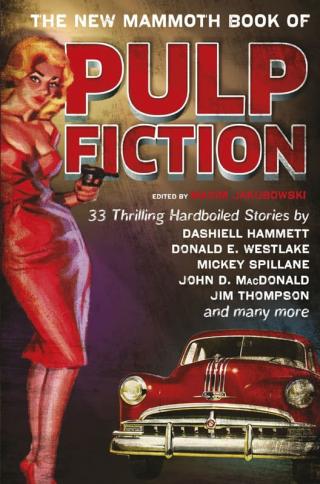
The New Mammoth Book of Pulp Fiction
- Автор: Якубовски Максим, Беллем Роберт
- Год: 2014
- Язык: английский
- Год: Constable & Robinson
- ISBN: 9781472111807
- Жанр: Крутые детективы

Электронная книга - «The New Mammoth Book of Pulp Fiction». Краткое содержание книги:
“I would think so, yes.”
“I guess I made the right decision.” He took his glasses off, inspected them, decided they were clean, put them back on again. “Sometimes I’m not so sure,” he said. “Sometimes I wonder. I’ll get that list for you. I should probably check with someone to make sure it’s all right but I’m not going to bother. You know lawyers. If you ask them whether it’s all right to do something they’ll automatically say no. Because inaction is always safer than action and they can’t get in trouble for giving you bad advice if they tell you to sit on your hands and do nothing. I’m going overboard. Most of the time I like what I do and I’m proud of my profession. This’ll take me a few minutes. Do you want some coffee in the meantime?”
His girl brought me a cup, black, no sugar. No bourbon, either. By the time I was done with the coffee he had the list ready.
“If there’s anything else I can do—”
I told him I’d let him know. He walked out to the elevator with me, waited for the cage to come wheezing up, shook my hand. I watched him turn and head back to his office and I had the feeling he’d have preferred to come along with me. In a day or so he’d change his mind, but right now he didn’t seem too crazy about his job.
The next week was a curious one. I worked my way through the list Aaron Creighton had given me, knowing what I was doing was essentially purposeless but compulsive about doing it all the same.
There were thirty-two names on the list. I checked off my own and Eddie Halloran and Genevieve Strom. I put additional check marks next to six people who lived outside of New York. Then I had a go at the remaining twenty-three names. Creighton had done most of the spadework for me, finding addresses to match most of the names. He’d included the date each of the thirty-two codicils had been drawn, and that enabled me to attack the list in reverse chronological order, starting with those persons who’d been made beneficiaries most recently. If this was a method, there was madness to it; it was based on the notion that a person added recently to the will would be more likely to commit homicide for gain, and I’d already decided this wasn’t that kind of a killing to begin with.
Well, it gave me something to do. And it led to some interesting conversations. If the people Mary Alice Redfield had chosen to remember ran to any type, my mind wasn’t subtle enough to discern it. They ranged in age, in ethnic background, in gender and sexual orientation, in economic status. Most of them were as mystified as Eddie and Genevieve and I about the bag lady’s largesse, but once in a while I’d encounter someone who attributed it to some act of kindness he’d performed, and there was a young man named Jerry Forgash who was in no doubt whatsoever. He was some form of Jesus freak and he’d given poor Mary a couple of tracts and a Get Smart – Get Saved button, presumably a twin to the one he wore on the breast pocket of his chambray shirt. I suppose she put his gifts in one of her shopping bags.
“I told her Jesus loved her,” he said, “and I suppose it won her soul for Christ. So of course she was grateful. Cast your bread upon the waters, Mr Scudder. Brother Matthew. You know there was a disciple of Christ named Matthew.”
“I know.”
He told me Jesus loved me and that I should get smart and get saved. I managed not to get a button but I had to take a couple of tracts from him. I didn’t have a shopping bag so I stuck them in my pocket, and a couple of nights later I read them before I went to bed. They didn’t win my soul for Christ but you never know.
I didn’t run the whole list. People were hard to find and I wasn’t in any big rush to find them. It wasn’t that kind of a case. It wasn’t a case at all, really, merely an obsession, and there was surely no need to race the clock. Or the calendar. If anything, I was probably reluctant to finish up the names on the list. Once I ran out of them I’d have to find some other way to approach the woman’s murder and I was damned if I knew where to start.
While I was doing all this, an odd thing happened. The word got around that I was investigating the woman’s death, and the whole neighborhood became very much aware of Mary Alice Redfield. People began to seek me out. Ostensibly they had information to give me or theories to advance, but neither the information nor the theories ever seemed to amount to anything substantial, and I came to see that they were merely there as a prelude to conversation. Someone would start off by saying he’d seen Mary selling the Post the afternoon before she was killed, and that would serve as the opening wedge of a discussion of the bag woman, or bag women in general, or various qualities of the neighborhood, or violence in American life, or whatever.
A lot of people started off talking about the bag lady and wound up talking about themselves. I guess most conversations work out that way.
A nurse from Roosevelt said she never saw a shopping-bag lady without hearing an inner voice say There but for the grace of God. And she was not the only woman who confessed she worried about ending up that way. I guess it’s a specter that haunts women who live alone, just as the vision of the Bowery derelict clouds the peripheral vision of hard-drinking men.
Genevieve Strom turned up at Armstrong’s one night. We talked briefly about the bag lady. Two nights later she came back again and we took turns spending our inheritances on rounds of drinks. The drinks hit her with some force and a little past midnight she decided it was time to go. I said I’d see her home. At the corner of Fifty-seventh Street she stopped in her tracks and said, “No men in the room. That’s one of Mrs Larkin’s rules.”
“Old-fashioned, isn’t she?”
“She runs a daycent establishment.” Her mock-Irish accent was heavier than the landlady’s. Her eyes, hard to read in the lamplight, raised to meet mine. “Take me someplace.”
I took her to my hotel, a less decent establishment than Mrs Larkin’s. We did each other little good but no harm, and it beat being alone.
Another night I ran into Barry Mosedale at Polly’s Cage. He told me there was a singer at Kid Gloves who was doing a number about the bag lady. “I can find out how you can reach him,” he offered.
“Is he there now?”
He nodded and checked his watch. “He goes on in fifteen minutes. But you don’t want to go there, do you?”
“Why not?”
“Hardly your sort of crowd, Matt.”
“Cops go anywhere.”
“Indeed they do, and they’re welcome wherever they go, aren’t they? Just let me drink this and I’ll accompany you, if that’s all right. You need someone to lend you immoral support.”
Kid Gloves is a gay bar on Fifty-sixth west of Ninth. The decor is just a little aggressively gay lib. There’s a small raised stage, a scattering of tables, a piano, a loud jukebox. Barry Mosedale and I stood at the bar. I’d been there before and knew better than to order their coffee. I had straight bourbon. Barry had his on ice with a splash of soda.
Halfway through the drink Gordon Lurie was introduced. He wore tight jeans and a flowered shirt, sat on stage on a folding chair, sang ballads he’d written himself with his own guitar for accompaniment. I don’t know if he was any good or not. It sounded to me as though all the songs had the same melody, but that may just have been a similarity of style. I don’t have much of an ear.
After a song about a summer romance in Amsterdam, Gordon Lurie announced that the next number was dedicated to the memory of Mary Alice Redfield. Then he sang.