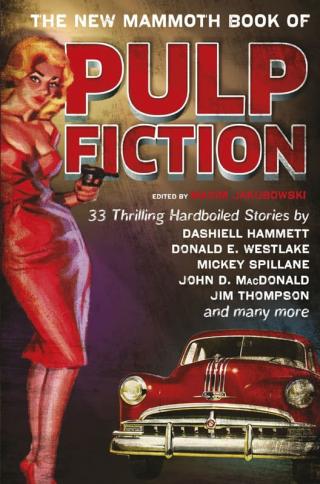
The New Mammoth Book of Pulp Fiction
- Автор: Якубовски Максим, Беллем Роберт
- Год: 2014
- Язык: английский
- Год: Constable & Robinson
- ISBN: 9781472111807
- Жанр: Крутые детективы

Электронная книга - «The New Mammoth Book of Pulp Fiction». Краткое содержание книги:
“No, I don’t suppose she was.”
He sipped at his coffee. “She probably belonged in an institution,” he said. “At least that’s what people would say, but she got along in the outside world, she functioned well enough. I don’t know if she kept herself clean and I don’t know anything about how her mind worked but I think she must have been happier than she would have been in an institution. Don’t you think?”
“Probably.”
“Of course she wasn’t safe, not as it turned out, but anybody can get killed on the streets of New York.” He frowned briefly, caught up in a private thought. Then he said, “She came to our office ten years ago. That was before my time.” He told me the name of his firm, a string of Anglo-Saxon surnames. “She wanted to draw a will. The original will was a very simple document leaving everything to her sister. Then over the years she would come in from time to time to add codicils leaving specific sums to various persons. She had made a total of thirty-two bequests by the time she died. One was for twenty dollars – that was to a man named John Johnson whom we haven’t been able to locate. The remainder all ranged from five hundred to two thousand dollars.” He smiled. “I’ve been given the task of running down the heirs.”
“When did she put me into her will?”
“Two years ago in April.”
I tried to think what I might have done for her then, how I might have brushed her life with mine. Nothing.
“Of course the will could be contested, Mr Scudder. It would be easy to challenge Miss Redfield’s competence and any relative could almost certainly get it set aside. But no one wishes to challenge it. The total amount involved is slightly in excess of a quarter of a million dollars—”
“That much.”
“Yes. Miss Redfield received substantially less than the income which her holdings drew over the years, so the principal kept growing during her lifetime. Now the specific bequests she made total thirty-eight thousand dollars, give or take a few hundred, and the residue goes to Miss Redfield’s sister. The sister – her name is Mrs Palmer – is a widow with grown children. She’s hospitalized with cancer and heart trouble and I believe diabetic complications and she hasn’t long to live. Her children would like to see the estate settled before their mother dies and they have enough local prominence to hurry the will through probate. So I’m authorized to tender checks for the full amount of the specific bequests on the condition that the legatees sign quitclaims acknowledging that this payment discharges in full the estate’s indebtedness to them.”
There was more legalese of less importance. Then he gave me papers to sign and the whole procedure ended with a check on the table. It was payable to me and in the amount of twelve hundred dollars and no cents.
I told Creighton I’d pay for his coffee.
I had time to buy myself another drink and still get to my bank before the windows closed. I put a little of Mary Alice Redfield’s legacy in my savings account, took some in cash, and sent a money order to Anita and my sons. I stopped at my hotel to check for messages. There weren’t any. I had a drink at McGovern’s and crossed the street to have another at Polly’s Cage. It wasn’t five o’clock yet but the bar was doing good business already.
It turned into a funny night. I had dinner at the Greek place and read the Post, spent a little time at Joey Farrell’s on Fifty-eighth Street, then wound up getting to Armstrong’s around ten-thirty or thereabouts. I spent part of the evening alone at my usual table and part of it in conversation at the bar. I made a point of stretching my drinks, mixing my bourbon with coffee, making a cup last a while, taking a glass of plain water from time to time.
But that never really works. If you’re going to get drunk you’ll manage it somehow. The obstacles I placed in my path just kept me up later. By two-thirty I’d done what I had set out to do. I’d made my load and I could go home and sleep it off.
I woke around ten with less of a hangover than I’d earned and no memory of anything after I’d left Armstrong’s. I was in my own bed in my own hotel room. And my clothes were hung neatly in the closet, always a good sign on a morning after. So I must have been in fairly good shape. But a certain amount of time was lost to memory, blacked out, gone.
When that first started happening I tended to worry about it. But it’s the sort of thing you can get used to.
It was the money, the twelve hundred bucks. I couldn’t understand the money. I had done nothing to deserve it. It had been left to me by a poor little rich woman whose name I’d not even known.
It had never occurred to me to refuse the dough. Very early in my career as a cop I’d learned an important precept. When someone put money in your hand you closed your fingers around it and put it in your pocket. I learned that lesson well and never had cause to regret its application. I didn’t walk around with my hand out and I never took drug or homicide money but I certainly grabbed all the clean graft that came my way and a certain amount that wouldn’t have stood a white glove inspection. If Mary Alice thought I merited twelve hundred dollars, who was I to argue?
Ah, but it didn’t quite work that way. Because somehow the money gnawed at me.
After breakfast I went to St Paul’s but there was a service going on, a priest saying Mass, so I didn’t stay. I walked down to St Benedict the Moor’s on Fifty-third Street and sat for a few minutes in a pew at the rear. I go to churches to try to think, and I gave it a shot but my mind didn’t know where to go.
I slipped six twenties into the poor box. I tithe. It’s a habit I got into after I left the department and I still don’t know why I do it. God knows. Or maybe He’s as mystified as I am. This time, though, there was a certain balance in the act. Mary Alice Redfield had given me twelve hundred dollars for no reason I could comprehend. I was passing on a ten percent commission to the church for no better reason.
I stopped on the way out and lit a couple of candles for various people who weren’t alive anymore. One of them was for the bag lady. I didn’t see how it could do her any good, but I couldn’t imagine how it could harm her, either.
I had read some press coverage of the killing when it happened. I generally keep up with crime stories. Part of me evidently never stopped being a policeman. Now I went down to the Forty-second Street library to refresh my memory.
The Times had run a pair of brief back-page items, the first a report of the killing of an unidentified female derelict, the second a follow-up giving her name and age. She’d been forty-seven, I learned. This surprised me, and then I realized that any specific number would have come as a surprise. Bums and bag ladies are ageless. Mary Alice Redfield could have been thirty or sixty or anywhere in between.
The News had run a more extended article than the Times, enumerating the stab wounds – twenty-six of them – and described the scarf wound about her throat – blue and white, a designer print, but tattered at its edges and evidently somebody’s castoff. It was this article that I remembered having read.
But the Post had really played the story. It had appeared shortly after the new owner took over the paper and the editors were going all out for human interest, which always translates out as sex and violence. The brutal killing of a woman touches both of those bases, and this had the added kick that she was a character. If they’d ever learned she was an heiress it would have been page three material, but even without that knowledge they did all right by her.