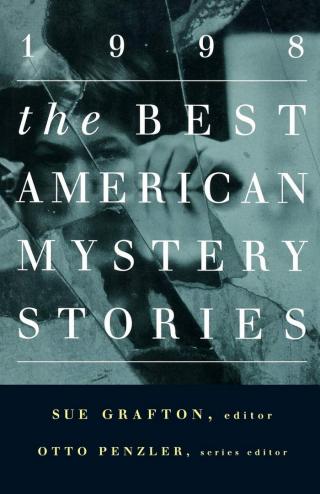
The Best American Mystery Stories 1998
- Автор: Ballard David, Bartels Scott
- Год: 1998
- Язык: английский
- Год: Houghton Mifflin
- ISBN: 978-0-395-83586-9
- Жанр: Другие детективы

Электронная книга - «The Best American Mystery Stories 1998». Краткое содержание книги:
The diverse styles and themes employed in this collection showcase an impressive array of talent certain to further the popularity of the genre. Already a bestseller in its first year, The Best American Mystery Stories, as evidenced by this year’s edition, promises to keep readers intrigued and coming back for more.
• The best satire, I think, leaves us naked in a room with our clothes at our feet — clothes which, we suddenly realize, were see-through all along. In “Twelve Days out of Traction” I found a narrator and situation which I liked a great deaclass="underline" a con-man whose crimes have more to do with anarchy and identity than with any willful cruelty. I also found a happy marriage between humor and anarchy. Laughter, I think, often is anarchy, an open acknowledgment of personal and societal foibles. At the same time, laughter also can be an acknowledgment that each of us perhaps desires, to some extent, that which is the object of our ridicule. I hoped “Twelve Days” ultimately would work as a story about surrender, in the process describing some of those odd transparent garments to which we all cling. If the story fails to achieve these aspirations, though, I hope it will at least make the reader laugh.
Helen Tucker grew up in Louisburg, North Carolina. A former newspaper reporter and writer for radio, she also worked in the editorial department of Columbia University Press in New York and as director of publicity and publications at the North Carolina Museum of Art in Raleigh.
She is the author of eighteen novels and a number of short stories. In 1971 she became the first woman to receive the Distinguished Alumni Award from Wake Forest University, and in 1992 the Franklin County (North Carolina) Arts Council named her Artist of the Year for outstanding service in the field of literary arts.
She and her husband, William Beckwith, live in Raleigh, where she writes fiction full-time.
• Included on my “beat” as a newspaper reporter was Superior Court, and I was completely fascinated, not only by the machinations of the lawyers and the court system, but also by the criminals. Studying them, their motives, and exactly how their crimes were committed became almost second nature to me.
I think probably the idea for “The Power of Suggestion” first came to me as I watched one of those TV commercials for psychics, and I began to solve the mystery in my mind of how a woman could convince her husband that she was psychic.
Donald E. Westlake was born many years ago in the dorp of Brooklyn, New York, but was raised in exile in Albany, also in the great state of New York. He began telling lies at an early age, then figured out how to do so at a profit, and has never looked back. Telling lies for money, he has published over seventy novels, been credited (or debited) with five produced screenplays, and filled the interstices with short stories, criticism, and the occasional essay (aka occasional occasional). The only flaw in his happy existence is that he now finds it impossible to lie for free.
• It was a dark and stormy night. Fortunately, I was indoors, at a party that had something to do, as I recall (or, more accurately, do not recall), with the Mystery Writers of America. As in uffish thought I stood, Mary Higgins Clark approached to say that she and Liz Smith were assembling a collection of original short stories to be published in a book called The Plot Thickens to raise money in aid of literacy. Now, if it weren’t for a general run of literacy in this world I have no idea what would have become of me (farmhand, perhaps, losing limbs one at a time), so that was a charity I felt I could wholeheartedly support. Also, I have been grateful to Mary for some time for her having wrested the annual Edgar Awards dinner out of its church-basement-supper era and brought it to a height of splendid occasion. So I said yes. So she told me the gimmick: All the stories had to contain a thick book, a thick fog, and a thick steak. So I went away and mused, and wondered if I could do a switcheroo with one of those elements: “Stake” instead of “steak,” for instance, as in “through the heart.” But then it came to me to use “stake” in another way, and do the switcheroo on a different requirement. Thus the story pratfell into existence, and here it is. And isn’t it nice that we are all literate.
A native of Mississippi, Steve Yarbrough lives in Fresno, California, where he is professor of English at California State University, Fresno. He is the author of the short story collections Veneer (due out in the fall of 1998), Mississippi History, and Family Men. His novel The Oxygen Man will be published in 1999. His stories and essays have been published in many journals and magazines, and he has won a Pushcart Prize and a fellowship from the National Endowment for the Arts.
• In 1996 Kathleen Kennedy, who produced such movies as The Color Purple and E.T., read an essay of mine about southerners and guns and got interested in my work. I went down to L.A. and had a meeting with her, and before too long her production company had optioned an unpublished novel of mine called The Oxygen Man and hired me to do the screenplay for it.
The novel has two time frames several years apart, and many of my struggles with the screenplay involved either cutting out material from the past or trying to find a way to work that material into the present action. “The Rest of Her Life” is the first piece of fiction I wrote after finishing the filmscript. The structure of the story, in which most of the action takes place in the past, probably grew out of my impatience with the limitations screenwriting placed on me.