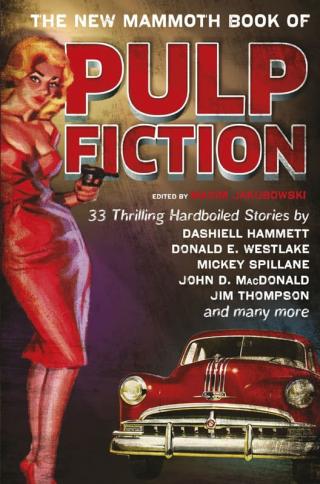
The New Mammoth Book of Pulp Fiction
- Автор: Якубовски Максим, Беллем Роберт
- Год: 2014
- Язык: английский
- Год: Constable & Robinson
- ISBN: 9781472111807
- Жанр: Крутые детективы

Электронная книга - «The New Mammoth Book of Pulp Fiction». Краткое содержание книги:
A Zenith man planted in Lewisburg for the express purpose of welcoming strayed sheep back into a world of light – and incidentally learning their attitude and plans for the future, when possible – had tried to shake Lorenz’s hand at the pen gate. He’d got the hand but in the stomach, together with Lorenz’s “Scram, gum heel! You don’t have nothing on me and you ain’t gonna get nothing. You won’t even see me around in a couple days.”
Being the usual fearless type of Zenith operative, the man had oozed along in Lorenz’s wake, nonetheless, had seen him buy the ’41 Chevvy, had talked with the used-car dealer, learning that Lorenz hadn’t been at all critical of the car, though he’d paid cash. Lorenz had said that he wanted a car for only a few days and then the hell with it.
While the tags were being transferred, Lorenz had gone to a respectable enough saloon and taken on a cargo of gin and bitters. At one point he had asked for a road map and had drawn a pencil line on it from Lewisburg to Treverton, and this was how the Zenith operative – snitching the map later – had surmised Lorenz’s destination.
Slabbe clucked admiringly at the Zenith sleuth’s ingenuity and inquired if the man had by any chance checked back with prison officials to learn who had visited Max Lorenz lately, and so on.
Mr Oliver said quietly: “We have been established in this business since 1872, Mr Slabbe.”
“Excuse it,” Slabbe said.
“It’s excused,” Mr Oliver murmured. “Lorenz’s last visitor, on June 28, just eight days before he was released, was a man who operates a private detective agency in your town, Mr Slabbe.”
Slabbe sat up.
“The name is Jacob George,” Mr Oliver continued, “and it was he who deposited five hundred dollars with the warden to be paid to Lorenz upon his release, which, of course, explains how Lorenz was able to buy an automobile for cash. The price, incidentally, was three hundred and seventy-five dollars plus the cost of transferring the license tags.”
Slabbe managed something about Zenith being quite a neat outfit. Mr Oliver passed this and purred that perhaps with this information in his possession Mr Slabbe might now do a bit more than he had in the past few days, if he hoped to be considered an alert investigator by the Zenith Detective Agency. The phone clicked.
Slabbe swore quietly but emphatically, jiggled the phone, gave a number and demanded of the female voice that answered: “Where’s Jake, Susie?”
“I don’t know, Benjie. Probably on a toot, the poor guy. Hasn’t been in since Monday afternoon.”
“ ’Cause why?”
“ ’Cause a client that was going to pay heavy got killed in that plane wreck Monday.”
“Who?”
“We-ell, it’s confidential.”
“Look, Susie kid, you know me. Tell me. There’s a guy dead over this, and if Jake hasn’t showed since Monday . . . well, you better tell me.”
“Benjie! You don’t think—”
“Talk, cookie.”
“Gee, yeah! Jake was working for Mr John Nola. He was tracing somebody for him for weeks. He had a big expense account and last week he was up to Lewisburg and said the job was practically cinched if his party showed up when he was sprung.”
“Did the party show? Was he about five-eight, light complected, a limp in the left leg?”
“Yes! He came to the office about three o’clock Monday afternoon and he saw Jake and went right out. Jake called him Lorenz. On the way out he whispered to me: ‘I’m taking him to Nola’s home and we collect.’ And about an hour later Mr Nola called and said Jake’s job was done and that he’d put a check for a thousand dollars in the mail next morning. I called around for Jake, caught him at Fudge Burke’s and told him. He said we’d celebrate that night, only a little later it came over the radio that Mr Nola was one of the passengers in the plane wreck and I guess when Jake heard that Nola had burned up and wouldn’t be putting the check in the mail after all, Jake got burned up, too, and . . . Ooo, I don’t mean it like it sounds!”
“Keep your snood on, honey. And I’ll call you back.”
Slabbe called seven numbers, said each time, “Seen Jake George?” and received four “Naws,” one negative grunt and two “No, dearies.” He called City Hall, reminded Carlin that this constituted cooperating with authority and relayed his information.
“We’ll put him on the air,” Carlin said. “What are you going to do?”
“See Fudge Burke,” Slabbe said and went there.
2. The Bitter and the Sweet
It was a block-long edifice which, besides serving as rendezvous and clearing house for the underworld, rendered various public services, starting with juke jive for the kiddies and working up to pool, bowling, bingo, a night spot complete with craps and roulette and geisha girls.
One wall of Fudge’s executive-type office on the third floor was slotted one-way glass overlooking the casino and bar. Slabbe handed over his compact .38 to an expert at the metal door and waded through the sponge-rubber-cushioned oriental rug, nodded genially to the candy man.
Fudge flapped a plump hand at one of the red leather club chairs. His dumpy body was a marshmallow. His face was a buttered bon-bon, topped with a puddle of chocolate syrup for hair. He said: “Trouble?”
Slabbe said, “Information.”
“Candy?” Fudge pushed a hammered copper dish an eighth of an inch toward Slabbe. “Drink?” He flapped a soft hand at his private bar. Slabbe looked over the bottles of various nectars and liqueurs, shook his grizzled head.
Fudge said: “Such as?”
“Max Lorenz,” Slabbe said. “Ex-con. See him here?”
The soft brown raisins of Fudge Burke’s eyes moved lovingly over the hammered copper dish. He selected a chocolate-covered cherry and nestled it in his cheek, sucked experimentally.
He said: “I don’t keep customers by advertising ’em.”
Slabbe agreed solemnly, but pointed out: “He’s cooked though, and that makes a difference. You can talk when they’re dead, can’t you?”
Fudge caressed the jowl that held the cherry. “I guess,” he said and spoke to the watcher on duty at the one-way glass. “Seen a Max Lorenz, Slip?”
Slip didn’t turn. “I’d say no even if I did, but I didn’t.”
“Know him?” Slabbe pressed.
“I would if I’d seen him here. Ten minutes after a stranger comes in down there, he ain’t a stranger or he ain’t in no longer. If he don’t make himself satisfactory, he goes out.”
Slabbe said to Fudge: “Slip isn’t on twenty-four hours. How about the other watchers? Maybe they saw Lorenz.”
“Charley’s sick and Slip and Dink Quint have been on alone for ten days,” Fudge said. “Dink’ll be here later. You can ask him.”
There was the sound of Slabbe’s hand sand-papering his gray-bristled jaw line. He said: “Tough about John Nola going in that plane crack-up, Monday.”
Fudge said delicately: “He was only one out of twenty-six. Why so tough about him?”
“Oh, prominent man and stuff,” Slabbe said. “His silk company gives work to about eighteen hundred men. Son a hero in the Pacific. Didn’t know Nola myself, did you?”
“To see,” Fudge yawned. “The hero pays his dues here regular. Blackjack and craps player. Can’t settle down, I guess, after what he went through. Maybe he’s here now. Is he, Slip?”
Slip didn’t turn. “Yeah. At the bar with that Reed biscuit. She’s a lotta woman, but built.”
Slabbe looked through the one-way glass at a couple half turned to face each other at the gleaming bar below. She was a lot of woman, he agreed. She was at least five feet eleven, a red-lipped brunette, an Amazon princess.