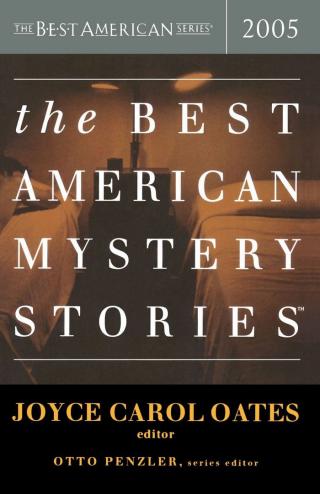
The Best American Mystery Stories 2005
- Автор: Хиггинс Джордж, Камински Стюарт Мелвин
- Год: 2005
- Язык: английский
- Год: Houghton Mifflin Harcourt
- ISBN: 978-0-618-51744-2
- Жанр: Другие детективы

Электронная книга - «The Best American Mystery Stories 2005». Краткое содержание книги:
My laptop died, taking this story with it, and I became so frustrated in my attempts to find and salvage it that I almost reneged on my promise to Bob. I’m glad I persevered and finally recovered it.
Tim McLoughlin was born in Brooklyn, New York, where he still resides. His first novel, Heart of the Old Country, was a selection of the Barnes & Noble Discover Great New Writers program and won Italy’s Premio Penne award. He is the editor of the crime-fiction anthology series Brooklyn Noir.
I began writing a novel about a white graffiti artist growing up in a predominantly Hispanic neighborhood, and the story got away from me. It became a complicated tale about fathers and sons, one I was not yet prepared to write. “When All This Was Bay Ridge” is taken from the core of that novel, and I think it scratches the surface of the emotional landscape I found myself navigating. I hope to return to it on the broader canvas one day, older, wiser, and better girded.
Lou Manfredo was born in Brooklyn and holds a bachelor of arts degree in English literature from St. John’s University in New York. A former New York City schoolteacher and legal investigator, he has recently completed a novel in which “Case Closed” appears as the first chapter. He is the father of one daughter, Nicole, and currently lives in Manalapan, New Jersey, with his wife, Joanne, and their long-haired dachshund.
I always strive for a realistic character-driven flavor in my fiction, with strong attention to dialogue. That is what I attempted in “Case Closed.” When I read fiction, or, for that matter, view a film or television show, I need to believe that the “who” and “what” being portrayed reflect reality. I feel that if a writer can successfully develop believable characters and dialogue, the plot will often develop on its own.
David Means’s stories have appeared in The New Yorker, Harper’s Magazine, Esquire, and numerous anthologies, including The Best American Mystery Stories 2001. His second collection of stories, Assorted Fire Events, won the 2000 Los Angeles Times Book Prize and was a finalist for the National Book Critics Circle Award. His third book, The Secret Goldfish, has just been published by HarperCollins.
As I wrote this story, my characters moved according to their own wishes, and I watched as they became locked into the mystery of their relationship with each other, but also with the hard realities of postindustrial Michigan where they were venturing and the fact that erotic energies are most often best served between two people, not three. When I was doing the final edits on this story, I was staying in West Cork, Ireland, living for a few weeks in a small town called Durrus, working at a little table on the back patio. One day I looked up from the pages to watch a cow graze in the field just behind our cottage. As I watched, a farmer came out and began to pat the side of his cow, talking softly into her ear, and I thought: Man, I’m a long way from the world of Michigan and the place where these characters reside. I was happy to be away from all of that violence and chaos, but then I got back to work and was perfectly content to be amid the darker forces I’d set in motion.
Kent Nelson has published four novels and four collections of short fiction. His most recent novel, Land That Moves, Land That Stands Still, published in 2003, won the Colorado Book Award and the Mountains and Plains Booksellers Award. In addition, with his daughter, Dylan, he has edited Birds in the Hand, a collection of stories and poems about birds. Nelson has run the Imogene Pass Run three times and the Pikes Peak Marathon twice, most recently in 2001. He is also an avid birder, with 739 North American species on his life list.
When my son was four or five, my older daughters got him into a dress and put lipstick and eyeliner on him, and he looked as beautiful as any girl possibly could. This was a fleeting image that stayed with me, and I meant to merge it somehow with some of my brutal experiences playing ice hockey in college. It was originally to be called “Girly Boy,” but what emerged in the writing of it was a much darker story than I’d ever intended.
The point of view became important, too. I experimented with a perspective I’d never tried before — the general viewpoint of a town, as Faulkner uses in “A Rose for Emily.” “Public Trouble” is not Faulkner, but at least the point of view worked well enough to get the story published.
Daniel Orozco was a Scowcroft and L’Heureux Fiction Fellow at Stanford University, then a Jones Lecturer in Fiction in the creative writing program there. His stories have appeared in the Best American and Pushcart Prize anthologies, and in Harper’s Magazine, Zoetrope All-Story, and others. He currently teaches in the creative writing program at the University of Idaho.
When I taught classes at Stanford, I commuted there by train. It was a short walk to the station, a short wait for the train, and a ten-minute ride after that, so I never had the space I needed to really read anything. I killed time thumbing through the free local dailies. The police blotters caught my eye, and I started clipping them:
Woman yelling for help. Officers found man and woman arguing over trash.
Citizen reported a suspicious man crouched down in a driveway. Man was gone when officers arrived.
Citizen shooting BB gun.
Resident reported a bad odor and said it might be a dead animal. Officers determined it was pollen in the air.
Dogs running loose.
Phone fell off a truck.
Sterling silver ring found near bleachers.
Man found his watch in a pawn shop. His daughter had sold it.
Fourteen-year-old boy cited for allegedly possessing a cigar.
One student burned another with a penny.
Karate instructor suspected of injuring domestic partner.
Two men fighting. One ran away carrying scissors.
Four large women suspected of stealing from a beauty supply store.
Drunken nineteen-year-old crashed Jefferson High School prom and wouldn’t leave.
Skateboarders causing disturbance.
Student out of control, yelling and screaming.
Suspicious person seen.
Suspicious person spotted.
Solicitor selling magazines was being abusive to residents.
A resident woke up and saw a strange man crawling on his knees in the living room of his house. Suspicious crawler escaped through sliding glass door.
Caller reported bald man in his late forties sitting in a white BMW for thirty minutes.
Caller reported a loose German shepherd. Officers couldn’t find the dog.
Caller reported squashed watermelons on a car.
Caller reported lost tortoise.
Terrier found whose name is Owen.
I thought about the officers who would respond to such incidents on this metaphorical day, and I thought about what their story might be as they attended to all these other stories. And I thought, How could I not at least try to write this?
David Rachel has worked as a factory laborer, forest fire fighter, hospital chaplain, massage therapist, letter carrier, teacher, professor, and professional storyteller. Author of several technical works, he now concentrates on fiction and poetry and divides his time between Europe and North America. His work has been broadcast on public radio stations and published in more than eighty literary journals in the United States, Canada, Britain, and Australia, including Antigonish Review, Dalhousie Review, Indiana Review, Midwest Poetry Review, Pangolin Papers, Prism International, and South Carolina Review.