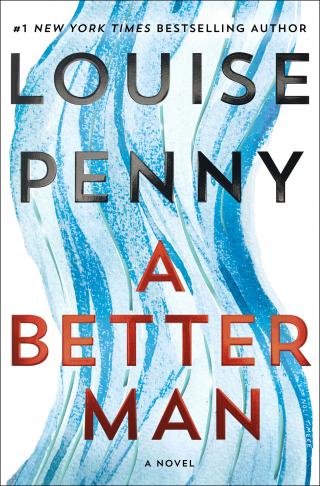
A Better Man
- Автор: Пенни Луиза
- Серия: Chief Inspector Gamache #15
- Год: 2019
- Язык: английский
- Год: St. Martin's Publishing Group
- ISBN: 9781466873711
- Жанр: Другие детективы

Электронная книга - «A Better Man». Краткое содержание книги:
It's Gamache's first day back as head of the homicide department, a job he temporarily shares with his previous second-in-command, Jean-Guy Beauvoir. Floodwaters are rising across the province. In the middle of the turmoil, a father approaches Gamache, pleading for help in finding his daughter.
As crisis piles upon crisis, Gamache tries to hold off the encroaching chaos, and realizes the search for Vivienne Godin should be abandoned. But with a daughter of his own, he finds himself developing a profound, and perhaps unwise, empathy for her distraught father.
Increasingly hounded by the question, how would you feel..., he resumes the search.
As the rivers rise, and the social media onslaught against Gamache becomes crueler, a body is discovered. And in the tumult, mistakes are made.
In the next novel in this constantly surprising series that deepens and darkens as it evolves (The New York Times Book Review), Gamache must face a horrific possibility, and a burning question.
What would you do if your child's killer walked free?
Her courage was almost unimaginable.
And once free …
“Something went wrong,” Beauvoir said quietly. “Maybe she tripped. Maybe he pushed her away. If he did, I don’t think he meant to kill her.”
But maybe that was wishful thinking.
“I realize now that he almost told me what happened,” said Armand. “That afternoon, when the case was thrown out. We stood out there”—he nodded toward the path along the Bella Bella—“and I told him how sorry I was. He talked about forgiveness and asked if some things were too horrible to forgive. I thought he was talking about Tracey’s acquittal. He asked if a sincere apology really helped.” Armand looked into the fire, remembering Homer’s worn face. The exhaustion in those eyes. “I think he told her, on the bridge that night, how sorry he was. And asked forgiveness.”
“Do you think he meant it?” Reine-Marie asked.
“I want to believe he did. Yes.”
Mostly, though, Armand hoped and prayed that the last thing Vivienne Godin saw wasn’t the monster, coming at her out of the dark again. But her father, reaching out. Trying to save her.
They’d never know the full truth. But they could hope.
CHAPTER FORTY-TWO
“So I’m confused,” said Gabri.
“We know you are,” said Ruth, patting his hand. “And so’s Olivier. Gays and confused.”
“Homer killed his own daughter?” said Gabri, ignoring her.
“It looks like it,” said Olivier.
They were sitting in the bistro over after-dinner drinks.
Gabri was shaking his head. “It’s all so sad.”
“And confusing?” asked Ruth.
“Yes. Why would he do it?”
“Those cops explained it all,” said Ruth. “Weren’t you listening?”
“By ‘those cops,’ you mean Armand, Jean-Guy, and Isabelle?” asked Olivier.
“Whoever. But yes, that’s what they said. Homer did it.”
They, of course, had said slightly more than that.
The villagers had seen Armand and Jean-Guy, Isabelle and the other officers return to Three Pines that morning.
Jean-Guy, wet, cold, bruised, had gone straight to the Gamache home.
While Armand, disheveled, slightly wild-eyed, hand wrapped in a scarf, had walked with Isabelle and the others to the path through the woods. That took them to the bend in the river, where the Bella Bella left Three Pines.
A few minutes later, an ambulance, Sûreté cars, the coroner returned.
Homer was discovered exactly where Vivienne had been found. Knocking gently up against a huge tree trunk.
Only then did Armand and Isabelle return home, watched by Clara, Gabri, Olivier. By Billy Williams and Myrna. By Ruth, with Rosa, who was silent for once. Though she did watch Armand with sad eyes. But then, ducks were often sad.
By that afternoon the sun was out in full force. Snowdrops and fragrant, delicate lily of the valley were beginning to appear. Crocuses broke through the grass of the village green.
Life had not just been restored, it had burst forth, as Isabelle and Jean-Guy, Armand and Reine-Marie walked into the bistro.
They joined Clara and Ruth and Rosa by the fieldstone fireplace. Billy Williams sat at a distance from Myrna but stole glances at her. Catching her eyes once, he smiled. And when Myrna smiled back, he blushed and looked away.
Olivier brought them cafés au lait and warm almond croissants, then perched on the arm of the large chair, next to Gabri.
The fire crackled in the background as they heard what had happened.
Ruth looked down at her thin, veined hand, holding Gabri’s pink, pudgy one.
You would have a different body by then,
An old murky one, a stranger’s body you could
Not even imagine, and you would be lost and alone.
But not lost, she thought.
And not alone.
That evening, Clara was in her studio. Ruth’s final comment as she left to head home, ringing in her ears.
“Maybe there’s a reason they call it a stool,” she’d said, nodding to where Clara sat in front of the easel. “Something to think about.”
Fuck, fuck, fuck. But this time it didn’t come from the duck.
Once she stopped muttering, Clara turned to Myrna, who was sitting on the sofa, her bottom resting on the concrete floor. Her knees up around her ears.
“Homer kept saying he was going to kill Tracey,” said Clara. “He even tried. Why would he do that if he knew Tracey hadn’t killed his daughter? Was it an act?”
“I don’t think so,” said Myrna.
“You think Armand and the others might be wrong, and Tracey really did kill Vivienne?”
“No. I think Homer was mad with grief, with guilt. I think he couldn’t bear to accept what he’d done. All those years of abuse and then being responsible for Vivienne’s death.”
“And his granddaughter’s.”
“Yes. I think his own self-loathing and his anger at Tracey for his abuse of Vivienne got all mixed up. He saw himself in Tracey and decided both must die. It’s pretty obvious by what Armand said that Homer meant to take his own life, along with Tracey’s. Both must go into the river.”
“To be cleansed?” asked Clara.
“To be punished.”
“You think his grief was real? It sure seemed real. Fooled everyone, including Armand.”
“I don’t think anyone was fooled. I think Vivienne’s death destroyed Homer. I doubt it was on purpose. I want to believe he went to the bridge to try to make amends.”
“I don’t understand,” said Clara. “He beat her. His own daughter. A child. God knows what else he did to her. And now what? You’re saying he really did love her?”
“I’m saying people change.” She held up her hands to ward off Clara’s protests. “I know, it’s easy to say. And it doesn’t undo the damage. But we’ve seen changes of heart. Changes of perception. It happens. Racists, homophobes, misogynists, they can change. And some do.”
“Truth and reconciliation,” said Clara.
“Yes. The truth must come first. And then, maybe, reconciliation. Maybe.”
“You think Vivienne and her father might’ve reconciled?”
“Maybe. I think getting the courage to confront him was the first step. If not to forgiveness, at least to healing. And I think Homer’s willingness to meet her, and to take the money, shows that maybe he wanted that, too. Maybe.”
“He killed her,” Clara reminded Myrna. “Then he was willing to see Carl Tracey tried and convicted for something he himself did. Hardly the acts of a contrite man.”
“True.” Myrna pushed herself out of the sofa. “I guess I just want to believe.”
Just as she’d wanted to believe, desperately, that Clara’s miniatures were brilliant.
But that had proved a delusion. Dominica Oddly had made that clear. And had, with a few well-turned phrases on her site, destroyed Clara’s credibility as an artist.
Her gallery had dropped her. Collectors were returning paintings. Social media was on a feeding frenzy.
Myrna looked at the tiny paintings, nailed to the wall where Clara had put them. Where she could always see them. A reminder. A warning.
Oddly had been right about them. But she’d also been wrong. She might have a duty to tell the truth, but there was no need to be so cruel.
“Are you going to do a portrait of her?” asked Myrna.
“Her who? Vivienne? I never met her.”
“No, you know who I mean.”
Myrna waited for the answer. That would reveal so much about her friend’s state of mind.
But Clara didn’t answer. Or maybe she did, thought Myrna, as she watched her friend stare into the vast, white, empty expanse of canvas in front of her. And put down her brush.