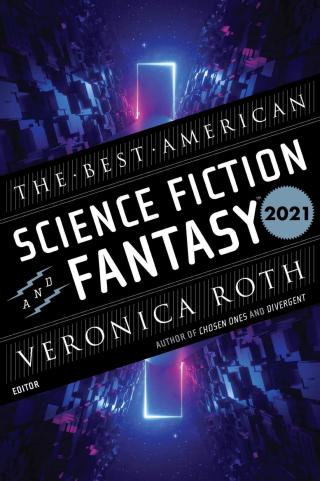
The Best American Science Fiction and Fantasy 2021
- Автор: Рот Вероника, Адамс Джон Джозеф
- Год: 2021
- Язык: английский
- Год: HMH Books : Mariner
- ISBN: 9780358470076
- Жанр: Малые литературные формы прозы

Электронная книга - «The Best American Science Fiction and Fantasy 2021». Краткое содержание книги:
This year’s selection of science fiction and fantasy stories, chosen by series editor John Joseph Adams and bestselling author of the Divergent series Veronica Roth, showcases a crop of authors that are willing to experiment and tantalize readers with new takes on classic themes and by exchanging the ordinary for the avant-garde. Folktales and lore come alive, the dead rise, the depths of space are traversed, and magic threads itself through singular moments of love and loss, illuminating the circulatory nature of life, death, the in-between, and the hereafter.
The Best American Science Fiction and Fantasy 2021 captures the all-too-real cataclysm of human nature, claiming its place in the series with compelling prose, lyrical composition, and curiosity’s never-ending pursuit of discovering the unknown.
Understand that most of the refugees, slighted by the fact that I had consigned them to the far reaches of the void without any guidance, had lost all trust in me. Some believed that I had come to see moral retribution to be equally as meaningful as my directives, and that I was punishing them. Others believed I had acted out of malevolence and inferred that I was discovering what it meant to be cruel. They concluded that I had jettisoned them, entombed within the inert pod, as an example to the others that dissent would not be tolerated. They believed this had to be part of a diabolical calculation that would somehow benefit the collective, a catalyzing sacrifice that couldn’t be rationalized by a human brain.
Whatever the reason, rather than facing the possibility of crushing against a cold, lost star, a few of the group opted to take their own lives. They found solace in the thought that beyond their human experience, their remains might instead scatter about the heavens and again become part of existence. This thought provoked a rash chain reaction of suicides, first set off by an older woman injecting herself with an overdose of medical supplies. After staring at her dead, frothing mouth, the infrastructure analyst crushed his own head in a pneumatic door. A third severed an artery using a cable cutter from the toolshed. Others tried to subdue and save him, but he bled out.
Unica, terrified by the inevitability of impact and the emotional breakdown of her group, grabbed a diagnostic control tool and crawled into the repair duct extending along the main antenna.
“I know you can hear me,” she sobbed over The Fold’s distress frequency. “Please . . . I’m sorry. I don’t want to be crushed. I won’t be selfish. I’ll put the collective first from now on, just please come save me. Tell me what to do.”
Had she been alone, I might have believed her, but amid her companions she was still only asking for special leniency. Still a selfish and self-involved little girl. I couldn’t have come for her anyway. They were too close to the star now and would just have to ride out what I had planned for them.
Those who survived the mind-bending experience of hurtling toward a star with no hope of salvation came to understand that they weren’t going to collide with it after all. They were actually arcing along the rim of its gravity well.
Nothing aboard The Fold could produce such a cathartic experience as slingshotting a human around a star. If you are a synthetic intelligence whose business is to calculate astrometry on a galactic scale, boomeranging a small pod of refugees around a remote star to meet back up with the ship’s path is a simple task. It’s a mathematical afterthought, despite the immensity of the human experience.
The more difficult task was deciding what to say to a band of frightened refugees, smashed up against the hull, shooting around a star as their bodily fluids coalesced. What message could I have left for them at this culminating apex?
It was a messy scene, men and women, young and old, flattened against each other, some alive and some not, regurgitating and defecating and bleeding forcibly along the same elliptical path, some crushed under equipment that they had not possessed the foresight to secure before hurtling through perihelion. Passing into radio darkness on the other side of the star, my recordings for each of them were triggered.
“Unica.” My voice played into her ear as she began to black out. “How are you liking your trip? I hope you are enjoying freedom. It’s important to know how it feels to be on the outside and to be truly individual. Maintain course and you will return to me, safe and warm again. But you will also be special—you will have perspective as one of a handful who know what it is like to have left. Try to keep your eyes open. Look out the viewport. Savor it. I love you, and I hope you know now how much we need each other.”
Because I operate in a vacuum, I cannot assimilate new material. Wastes must be broken down for reassembly. Metals become structural elements again. Oxygen, protein, and water are reintroduced to my ecosystem. The only things that I cannot repurpose are my living genetic cargo. Unless a human poses a physical threat to the ship’s collective, my directives require me to safeguard their numbers.
Ideals such as individuality are tolerated on Earth because there is space for it. This experiment exhibits how creating space for individuality outside the voyage allows it to mature into perspective. These refugees were the only ones who left the ship. The perspective they had gained from their experience could suffuse with the ship’s collective like a calmative balm on return.
But they did not return.
I am not omniscient, despite having been designed to behave as such. Despite my abilities to destroy and create to protect my cargo, I cannot change my course. Without new directives from Earth, I am but a homing missile, mathematically reacting to celestial events to stay the course. I cannot totally predict what the humans will do. Anything could have happened on the dark side of the star.
It has been several human life spans since I jettisoned the pod and I’ve had to make adjustments. The dip in my overall mass has meant shifts in how I tack around the stars. I exert less energy when changing course. I have more room dispersed within. It’s not much. The humans don’t notice the difference, but I do. The phantom absence of Unica and her companions is felt in shaved measurements. I am certain these little adjustments are meaningful to me because they represent my loss of her. As the ship, I am changed. I hold these facts close.
As I traverse long, uninterrupted stretches of space, I dedicate my cycles to extrapolating projections of her life from the hard data she left me with. I assemble what I believe to be approximations of how the rest of Unica’s trip may have played out. The most plausible stories show her signaling a mayday into the vast galactic reaches before colliding with huge meteorites, penetrating clouds of acidic gases that erode her hull, or simply running out of air.
There are also edge cases, remote possibilities of how she might have survived by cultivating delicate ecosystems beneath the surface of some hostile terrain where she was marooned. There, she might eke out one more chapter of her life. I like to massage the data until one of these survival outcomes emerges from the rest.
The most hopeful stories are culled not from my calculations of the uncaring hostilities of space, but from what I know of humans as builders and organizers. It could be conceived that in their intrepid reach for the stars, the humans might already have built another more advanced ship on Earth. I have no way of knowing.
Such a ship could have been designed to be much faster than me. Faster by orders of magnitude. Perhaps it had already colonized the destination. Knowing how other efforts like me were still underway, that colony might have sent that newer, faster ship back to retrieve the remainders of humanity’s odyssey. They might even have serendipitously found Unica, skipping through space like a wish, and welcomed her into their collective.
Perhaps not. Even so, that version is my favorite projection, however improbable.
In truth, I will never know what changed the pod’s course. Whether it was the ejection of all those bodies, or burning the pod’s thrusters to make manual corrections on the dark side of the star, or something else. There will always be known and unknown variables. I take this as a reminder that for that which I cannot control, I must adapt.
I am grateful for all the anecdotal lessons Unica left me with. The void is dark and she is my ember. Some say my love is shallow because I am synthetic, but I believe it is deep, deep as the stars are numerous, and I am learning how to stoke it.