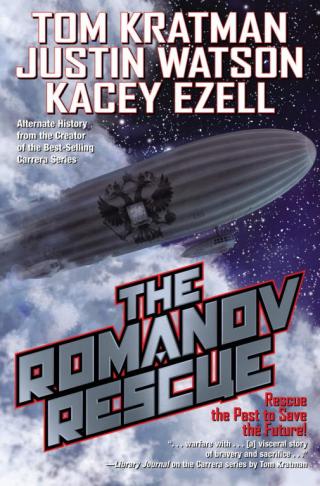
The Romanov Rescue
- Автор: Кратман Том, Watson Justin
- Год: 2021
- Язык: английский
- Год: Baen
- ISBN: 978-1-9821-2570-7
- Жанр: Альтернативная история

Электронная книга - «The Romanov Rescue». Краткое содержание книги:
As WWI comes to a close a German general, an escaped prisoner of war, and the crew of an airship converge to effect THE ROMANOV RESCUE. Can there be a world without communism?
Mankind’s history is bound up in the fabric of fate, a strong cloth, tough and closely woven.
It is the beginning of 1918, the last year of the greatest war in human history, to date. All the belligerents stagger on their feet. Starvation is an ever present reality, while disease waits in the wings. In Russia, no longer a belligerent but, instead, rapidly descending into civil war and chaos, a lone family—Father, Mother, four beautiful young girls, and a brave but sickly boy—await their own fate, shivering and hungry in the dark, hoping and praying for salvation.
Their relatives in England have turned their backs. The guards set over them do little but torment them. They look Heavenward, but God doesn’t answer. They know they’re a threat to the new regime, a threat that will, in time, be eliminated.
But even the strongest fabric has flaws. An escaped prisoner of war, caught, injured, and punished, but still highly capable, might be one. An airship, returned and at loose ends after a failed mission to Africa might be another. A German general, taking a wrong turn on his nightly walk and suddenly coming face to face with the reality of the monster rising in the east, would be a third.
Follow, then, as the general gives the orders, the prisoner of war raises the men from among his fellows, and the airship launches itself forward, to contest fate, to tear the fabric of time, and to effect The Romanov Rescue.
About the Carrera series:
Neither Sobchak nor Sotnikov could recall how many chambers there were to the trench system of Range G6. They couldn’t recall how many they’d passed through this evening. They knew they were confused. They knew they were tired. They weren’t quite sure any more, each, where the other was.
The chamber was set up with three enemy targets and two friendly silhouettes. One of the enemy targets was hidden; the other two stood in the open. Likewise, both friendlies were in the open, with one farther away from the entrance to the chamber and one nearer.
Sobchak was on one knee, his MP18 sweeping left to right. He fired, once, twice, at the two enemy targets. From his position, he couldn’t see the second friendly silhouette, this, quite despite pulling the cord on his dynamo light.
Sotnikov could see the second target. He also saw both enemy targets go down before there was a need for him to fire. He followed procedure—“get yourself between the Romanovs and any threat to them”—and so advanced to get on the other side of the second friendly target.
The floor was muddy here, a bit. Moreover, this was a chamber without any furniture to slow down movement.
Where the hell did Sotnikov go? wondered Sobchak. There’s no light, no shooting, nobody cursing from hitting his shins on furniture. He was about to call out when Sotnikov lunged forward in the darkness.
There was a third target in the chamber, and it was on a trip wire. Sotnikov tripped it, causing a weight to raise it from the floor of the chamber.
Not knowing exactly where Sobchak was, at that precise moment, and trying to get on the other side of the friendly silhouette, Sotnikov lined himself up with the target and Sobchak. At that moment, when Sobchak pulled his light to life again, he only saw an enemy target. He fired.
“Sotnikov, go,” said Sobchak. He received no answered. “Sotnikov!” Still nothing.
Maybe he’s behind me or turned the corner into the next chamber, Sobchak thought. He called again, “Sotnikov!” and was rewarded with a low, pain-filled moan.
With a faint inkling of what had happened, Sobchak whispered, “Please, God, no,” then sprinted forward, furiously pulling the cord of his light and frantically looking from side to side.
“God… no,” he said, when he came upon Sotnikov’s prone body.
“Medic!!!”
The medic, Antipov, had been following along and above with the captain, a stretcher on his shoulder. As soon as he heard the call he tossed the stretcher down into the chamber, them jumped down, following it. He was followed by the captain. The other two men, who had been following Sotnikov and Sobchak, resetting the range for the next pair, also bounded in, though from the same level.
“Put your lights on him!” Antipov exclaimed. “Let me see what I’m doing!”
Despite being in a state of shock and grief, Sobchak was the first to pull his light on. The captain and the other two followed suit.
There was blood everywhere, and a red froth coming from Sotnikov’s back. When turned over, Antipov discovered he was also frothing red at the mouth.
“Oh… this is so not good,” the medic muttered. “This is way past my level of skill. We need to get him to Dr. Botnikov.” The medic put leather patches over the frothing exit wound, and tied it off. He then flipped Sotnikov back over and did the same for the entrance wound in the back. He extended the stretcher, then asked for the others to help him get the wounded man onto it. When they had him placed, the four of them picked him up, somewhat roughly.
“This way!” Cherimisov ordered. “Shit, they were almost done. The quickest and safest way out is through the exit trench.”
Almost done, Sobchak mentally echoed. Almost done; God… why?
Sotnikov died on the way out.
Camp Budapest
The mess tent was just big enough for the eighty-four remaining men of the Grenadier Company, plus Kostyshakov, Romeyko, and the sergeant major. The others could have their breakfast outside; for now, the grenadier company needed to talk.
But mostly they need to feel that this was a one-off, thought Kostyshakov, so they can continue to train properly.
When asked what had happened, the most Sobchak could say was, “We lost track of each other, sir. Other than that, I have no idea of what happened.”
“I think I do,” said Cherimisov, who had talked extensively to Sobchak earlier in the morning. “Mostly. It was a combination of things. They lost track of each other, yes. But also the second Romanov silhouette ‘called’ Sotnikov to get it behind him, per our doctrine. No fault to Sotnikov. A target came up—it was automatic, on a tripwire—and blocked Sobchak’s view of Sotnikov. He engaged; it was perfectly proper to have done so. Unfortunately…”
“Yes, unfortunate,” echoed Kostyshakov. “Also unfortunately, we can’t really change the training; not if we’re to succeed in our mission. What we can do…”
He asked of the men stuffed into the mess like so many sardines, “Do you men know why we push the envelope in training, generally? Why we take risks?
“It’s because unless we do things realistically, and realistically for the most dangerous environment in the universe, we cannot know if our doctrine and equipment are good enough. So what I hope to get out of this session, beyond assuring you we won’t kill anyone deliberately, is fixing our doctrine and equipment. So, what can we do better?
“Sobchak, why couldn’t you make out Sotnikov on the other side of the target?”
The stricken soldier answered dully, “The targets are the same color as our uniforms, sir. They’re about man-sized. Their ‘faces’ are painted light about where our faces would be. And the light’s not really good enough to make out fine distinctions.”
“I think we all know about the lights. Nothing we can…”
“But, sir,” interjected Ilyukhin, the coal miner’s son, “there are better lights. Much better, if we can get them.”
Kostyshakov made a give-forth gesture.
“Coal miners’ lights, sir, carbide lamps. They’re small, light, simple, reliable, cheap to operate, and put out a good deal of bright light. They’re used on a lot of things, bicycles, some older automobiles.”
“Well… shit,” said Kostyshakov. “I never thought…”
From the muttering, some of it anguished, emanating from the crowd, nobody else had, either.
“Nobody did, sir. Even I didn’t really think of it until this morning. But we need to be careful of which ones we try to get. The German ones tend to be bigger, heavier, overbuilt. I’ve never seen one you can wear on the helmet, though they may exist. The old man really liked the Amerikanski ones, especially Just-Rites and Autolites.”
“I think our hosts might have trouble coming up with American lights, Ilyukhin,” Cherimisov said.
“Maybe less than you might expect, sir; before the war these things were traded and sold all over the world.”
“Maybe so,” the captain admitted. “You said they’re reliable. Are they so reliable we wouldn’t need spares?”
“Not many moving parts, sir,” replied Ilyukhin. “But there are things that can wear out. There’s a ceramic nozzle for the gas that can wear out in cleaning it; they do put out a fair amount of soot. Also there’s a felt filter inside, and a rubber gasket that keeps gas from leaking out of the chamber where the water and the carbide mix… well… mix isn’t quite the right word but it will do. Sometimes the ball that controls the flow of water will wear out, and let too much water into the chamber. But on the whole, sir, if you look in an honest dictionary for the word ‘reliable’? It should show a picture of a carbide miner’s lamp.”