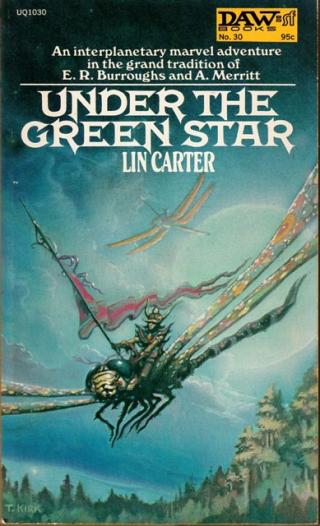
Under the Green Star
- Автор: Картер Лин Спрэг
- Серия: Green Star Rises #1
- Язык: английский
- Жанр: Научная фантастика

Электронная книга - «Under the Green Star». Краткое содержание книги:
We had descended a coiling staircase of carven alabaster and were about to enter a long, high-roofed corridor lined with an honor guard of bejeweled and beplumed Laonese chivalry, when I stopped short, my gaze caught by a most imposing monument.
There was a huge rotunda at the base of this spiral stairway from which the corridor branched off, and rising from the exact center of this rotunda was a colossal statue of a heroic youth shielding his breast with an arrow-studded buckler, lifting his face defiantly to heaven, thrusting skyward with the hilt of a broken sword.
The substance from which some Laonese Michelangelo or Canova had carved this heroic colossus was a sparkling crystal which resembled diamond in its purity and multicolored fire, but which was in fact, as I later learned, organic. The crystalline substance, however, was enormously rare and valuable, in that respect also not unlike diamond.
And the statue was thirty feet high!
I stared up at it in amazement, struck not only by the fabulous richness of the thing, but by the brilliance of its artistic genius.
As I paused, old Khin-nom halted, and eyed me shrewdly and with a touch of humor in the sly expression of his eyes as I stood gaping.
“Does my lord recognize the figure?” he purred.
I admitted that I did not—which must have amused the wise old philosopher, although he was too clever to show it.
“It is yourself, my lord, in the fourteenth of your Deeds, the time you battled against and slew the Great Ythid of Diompharna,” he said casually.
I knew enough of the language of this strange, mist-veiled world of the Green Star by now to recognize the word. To the Laonese, the ythid is a monster so dread as to have become symbolic and mythological, save that such reptiles, though rare, do indeed exist.
We walked on in silence. As for myself, I was somewhat shaken. It is, after all, not every day that a man finds out he is a dragon slayer!
I began to entertain doubts as to the wisdom of continuing my imposture of a legendary hero miraculously returned to life. It is all very well to be the reincarnation of a famous dragon killer of yore, but what if my royal hostess suddenly called upon me to repeat my celebrated deed?
Part II
THE BOOK OF NIAMH THE FAIR
Chapter 6
THE SHADOW OF AKHMIM
The banquet to which we were bound on that particular evening was one of the frequent ceremonial functions tradition required of the Jewel City monarch.
The life of the princess was bound to every side by centuries-old patterns of enormously complicated tradition and ritual. Periodically, the Princess of Phaolon was required to feast representatives of the several aristocracies of her realm; I have no idea as to the reason why. It may have been something in the nature of a renewal of the aristocrats in their rank, or a symbolic token of the interdependency of the sovereign and the aristocracies, ritualized by their sharing of a common meal, or something to do with the national religion, which as yet I understood imperfectly.
At any rate, such occasions were a crashing bore, interminable evening—long meals of thirty or forty courses, interspersed with flowery speeches, ceremonial dances and poetry recitals, elaborate courtesies, and obscure traditional gestures, such as the pouring of three drops from every wine-cup into silver salvers borne around the banquet hall by an endless succession of pages, for no conceivable reason or purpose.
Certain different incenses were burned during certain courses by Laonese priests in elaborately different robes and accouterments stationed at small altars situated here and there. Something like spruce gum was burned during a course of small cubes of beef-like meat in cream sauce, skewered with tiny silver forks; a thickly odorous incense like myrrh was sizzled in golden pans during a course of breaded fish; a sharp and pungent perfume, like pine needles, was poured on braziers of coals during yet another course consisting of small slivers of sweet white meat cooked in sugary wine.
The elaborately artificial aspects of these interminable banquets was unendurable. Nobody knew why or how these customs had arisen, but arisen they had, and, once hallowed by a few centuries of tradition, a facet of behavior became crystallized in Laonese society and was there to stay.
Luckily for me, during the early phases of my education when I was still largely unfamiliar with the language, no one required me to deliver any of the lengthy speeches, flowery compliments, or recitals of national poetry, which droned on more or less constantly during the succession of courses. I was politely ignored during these banquets, for it was thought that a ritual period of acclimatization was required of one who had but recently returned from the World Above, as the Laonese conception of heaven is termed. So I just nibbled at the various courses, guzzled wine, and tried to ignore the so-called festivities.
Custom, ritual, precedent, and tradition rule the Laonese aristocracies and, to a lesser extent, the common folk, and this endlessly complicated code of ceremonial behavior controlled and governed virtually every phase and detail of everyday life. In this, as in certain other things, it resembled the Chinese civilization of the imperial periods.
I use the plural, “aristocracies,” because the Laonese society was an hierarchical one, made up of a number of different ranks. There were, for example, what might be called the landed gentry—members of ancient families with an hereditary claim to certain territories of the realm. Members of this aristocracy were known as the thurkuz. Their highest ranking member and most vocal spokesman was a stiff-necked old woman, the Kyra Vaonica du Kaikoos, which translates as Lady (or Dame) Vaonica of Kaikoos; she was a sort of duchess.
The second aristocracy was made up of those families descended from Laonese patriots or heroes who had been ennobled for their services to the throne, just as English monarchs have bestowed titles on their war heroes like Lord Nelson or the Duke of Wellington. The custom of honoring outstanding heroes with ranks and titles was popular among earlier Laonese sovereigns, but had died out somewhat lately. However, these honors were of a different kind and nature from those of the thurkuz, the landed gentry. This second aristocracy was called the aophet, which means something like “sprung from the heroes.” In my incarnation as Lord Chong, I belonged to this particular aristocracy myself. In fact, I now took precedence as highest ranking peer and spokesman of the aophet, displacing a suave baron named lohom who had been senior lord of the aophet before my revivification.
There was a third aristocracy whose differences from the others was a subtle one, so subtle I never quite managed to grasp the difference. It consisted of those with titular honors, some exceedingly fanciful, others thoroughly devoid of meaning as far as I could see. This particular aristocracy, the iophua, held hereditary honors such as Lord Custodian of the Nine Ivory Batons, or Privy Guardian of the Silver Book of Hshan, or High Steward of the Scarlet Flask, and so on.
A tradition-encrusted people, the Laonese! For never once did I see the Lord Custodian with a baton of any kind, much less an ivory one. The High Steward had a noticeable fondness for the wine flask, all right, but I never saw him with a scarlet one. And as for the Privy Guardian, from the way he usually snored through the poetry recitals, I cannot conceive of him as possessing interest in any book, much less Hshan’s.
There was one thing that could be said for these formal banquets, and that was that they gave me a chance to see Niamh.
At these functions, the Laonese dine from low taborets while seated cross-legged on cushions. But the princess and I, as only befitting our superior degree, sat in regular chairs at opposite ends of a dais. I thus had the pleasant opportunity to feast my eyes on her while feasting my belly.