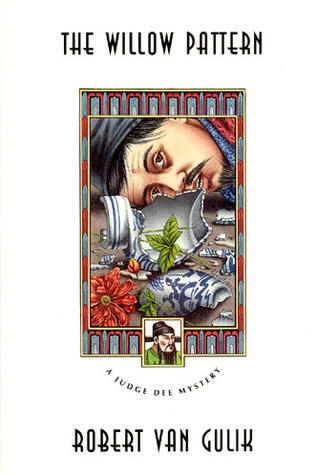
The Willow Pattern
- Автор: ван Гулик Роберт Ханс
- Серия: Judge Dee #11
- Год: 101
- Язык: английский
- Жанр: Другие детективы

Электронная книга - «The Willow Pattern». Краткое содержание книги:
As Judge Dee copes with the administration of the plague-ridden Imperial Capital, he must also bring his skills to bear on the mystery of two seemingly unconnected murders that could mean the extinction of the city's oldest, most aristocratic families.
Judge Dee shrugged his shoulders. 'A nice romantic tale. I can't see anything in it that would frighten a distinguished lady. However, she is very upset about her husband's accident, of course. What is your hurry, Ma Joong?'
Ma Joong, who had been coming up the marble stairs three at a time, quickly stepped on to the terrace.
'Mr Yee has been murdered, sir!’ he announced. 'In his own house. Chiao Tai is there now.'
'Yee? Do you mean the so-called Marquis Yee?'
'Indeed sir. Brother Chiao and I met his doorman on our way downtown.'
'I shall change and go there at once, with Tao Gan. You wait here for Chiao Tai, Ma Joong. Then you two see about those sewers, that is urgent too. Get me a thin cotton robe, Tao Gan.'
VIII
The four soldiers put Judge Dee's sedan chair down in front of the towering gatehouse, and the judge and Tao Gan descended into the dead quiet street. At the head of a flight of broad stone steps they saw an enormous iron-studded double gate. In the right panel was a narrow door, barely broad enough to let through one man.
'When passing by here,' Judge Dee told Tao Gan, 'I often wondered why this mansion, located in the centre of the town, is built like a fortress.'
'In the olden days, sir, about a century ago, this place marked the entrance to the city. The Marquis Yee, then the self-styled ruler of this part of the country, exacted toll from every vessel passing underneath the Halfmoon Bridge. The canal was then the outer moat of the city.'
The small door in the iron gate opened and Chiao Tai appeared, the young doorman behind him.
'It was murder all right, sir,' Chiao Tai reported. 'Yee was struck down in the gallery that runs all along the back of the house, overlooking the canal. This boy's mother found him, she is the old lady's maid. I searched the whole place, but there wasn't a trace of the murderer. He must have come in and slipped out again, all by this same door. For there's no other exit.' Pointing at the high, crenelated wall that loomed above them, he went on: 'This wall surrounds the property on three sides. The fourth is protected by the canal.'
He led them on to a spacious paved courtyard. It was lit by a single lantern suspended over the gate of the doorman's lodge, on the right.
'The small door in the gate,' Chiao Tai resumed, 'is closed by a latch. From the outside it can only be opened by using a special key, but on the inside you can lift the latch with your finger. And when you pull the door shut behind you, the latch falls into place and the door is locked.'
'Which means that the murderer had to be admitted by someone inside,' Judge Dee remarked, 'but that he could leave all by himself.' He asked the youngster: 'What visitors did you admit tonight?'
'None, sir! But I was in the kitchen most of the time. The master might have let somebody inside himself.'
'How many keys are there to the door in the gate?'
'Only one, sir. And that I always keep with me.'
'I see.' In the dim light the judge could not see the young doorman's face clearly, but he seemed ill at ease. He decided to question him closely later. 'Lead us to the scene of the crime!’ he told Chiao Tai.
His lieutenant hesitated a moment or two before he said:
'I think, sir, that it might be better if you first saw Mrs Yee. Her maid told me that the old lady is very upset, and eager to talk to you.'
'All right. The doorman shall take us to her. You may go back to the office now, Chiao Tai. Ma Joong is waiting for you there.'
The doorman fetched a lampion from the gatehouse and took the judge and Tao Gan into a large, dark hall. The light threw erratic flashes on the rows of halberds and spears that stood in red-lacquered racks against the walls on left and right. At the end stood a large portable signboard with the inscription 'Clear the way!' in big black letters.
'Those symbols of authority ought to be removed,' Judge Dee remarked peevishly to Tao Gan. 'It is more than a century since the Yee family had executive power — and usurped power at that!'
'They are just relics of the past, sir.'
'That's what they ought to be, at least!' the judge muttered.
They went through a number of winding corridors, their footsteps echoing hollowly under the high, vaulted roof.
'Ordinarily there are nearly eighty servants here, sir,' the young doorman said dejectedly. 'When the sickness came, many wanted to leave, but the master would not allow it. But after ten servants had died, the master became afraid and sent them to the mountains, all of them. Except my mother and me, that is.'
They crossed a small walled-in garden, planted with flowering shrubs; their sweet scent mingled with the dank smell of the hot, still air. The boy raised his lampion and knocked softly on the intricately carved panel of the gold-lacquered door.
A tall, bony woman of about fifty opened it. She was dressed in a long, dark-brown gown. Her untidy grey hair was done up with a blue band. While she was making a stiff bow the judge asked her:
'When did you discover the murder?'
'About one hour ago,' she replied in a harsh, grating voice. 'When I went up to the gallery with the tea-basket.'
'Did you touch anything there?'
She gave the judge a steady look from deep-set, glittering eyes.
'Only his wrist. He was dead, but his body was still warm. This way, please.'
Judge Dee and Tao Gan followed her into a narrow passage. Her son stayed behind, at the garden door.
The maid ushered them into a dome-like hall, dimly lit by a tall candelabrum of wrought silver in the back, and by the glowing coals in a large copper brazier in the corner; on the coals stood an iron tripod carrying a steaming medicine jar. The hot, moist air, saturated with the pungent smell of drugs, was nearly suffocating.
The judge stared, astonished, at the raised platform of carved ebony in the rear, near to the silver candelabrum. On the platform stood a colossal throne-seat of gilded wood. Among the red-silk cushions a thin woman was sitting, stiffly erect, motionless but for her emaciated white hands, which were playing with the amber rosary in her lap. She wore a sumptuous robe of yellow brocade, embroidered with green and crimson phoenix birds. Her grey hair was done up in a high, elaborate chignon, bristling with long golden hairpins ending in jewelled knobs. On the wall above the throne hung a painted silk scroll nearly six feet high, representing a pair of phoenixes in full colours. The platform was flanked by two fans mounted on high, red-lacquered stakes.
Judge Dee cast a meaningful look at Tao Gan. The phoenix was the sacred symbol of the Empress, just as the five-clawed dragon symbolized the Emperor. And the two standing fans were the privilege of persons of the Imperial blood. Tao Gan pursed his lips.
The maid went hurriedly across the marble floor and whispered something to the still figure on the throne.
'Come nearer,' a cracked, toneless voice spoke.
The judge went to the platform. He now noticed that Mrs Yee's eyes had a strange, remote look. She could not be much older than fifty, he thought, but sickness and sorrow had ravaged her once handsome face. He now also saw that the colours of her robe had faded and that here and there large tears had been clumsily patched. The scroll painting was disfigured by ugly stains, covered with mould, and the cracked lacquer of the throne was peeling off.