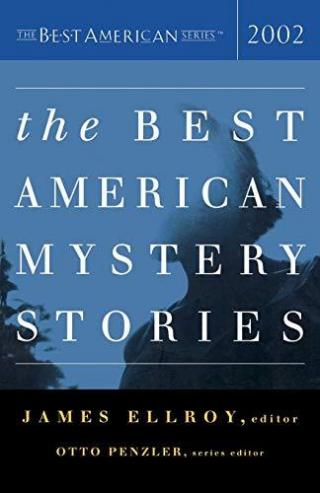
The Best American Mystery Stories 2002
- Автор: Грейди Джеймс, Камински Стюарт Мелвин
- Год: 2002
- Язык: английский
- Год: Houghton Mifflin Harcourt
- ISBN: 978-0-618-12494-7
- Жанр: Другие детективы

Электронная книга - «The Best American Mystery Stories 2002». Краткое содержание книги:
In the summer at the end of Sarah’s sophomore year a grumbling Greyhound Bus gave us Jake Fiess.
Uncle Keven and I were out tending his horses the evening Jake Fiess strolled down the gravel driveway. The horses’ ears twitched at the sound of the rocks crunching beneath his steps. Jake Fiess looked like a walking scarecrow. And he was missing an eve.
“Lookin’ for work,” he announced.
“Around here, a man introduces himself. I’m Keven Armstrong.”
“Jake.” He propped his foot on the fence.
“Got a last name?”
“Fiess.”
Purple veins sprawled across Jake’s sinewy forearms. A pack of Camels rode high on his left biceps beneath his tattered T-shirt. His Adam’s apple bobbed like a cork on the front of his willowy neck when he swallowed, and a crude mustache couldn’t hide the several missing teeth. Jake cocked his head to the side when he spoke, as if he’d heard something over his right shoulder.
“This is Amp. My nephew.”
Jake stared at me for a moment, then turned back to Uncle Keven. “Got any work?”
“Suppose so.” Uncle Keven leaned around and glanced behind Jake’s shoulder. “That all you got? Just a knapsack?”
“Suppose so.”
“You’ll find a bunk out in the barn.”
Later that evening, I sat at Uncle Keven’s kitchen table with a glass of iced tea glistening in my hands. I poured in another heaping tablespoon of sugar and watched the crystals drift in the amber color.
“You’re gonna rot out those new teeth, Amp.”
I held the glass up to my face and mentally measured the sugary mound on the bottom. “I’ll get more.”
“Not at eleven years of age, you won’t.”
“Will too.”
Uncle Keven laughed. “Hand me another hanger.”
“Why do you like to iron so much, Uncle Keven? Even all your old overalls?”
“Thinkin’ time.”
“Thinking about what?” I sprinkled more sugar across the melting ice cubes and looked over at him.
“Thinking about people, generally.” The black iron hissed, then slid the length of the ironing board like a miniature tugboat. Uncle Keven’s fingertips traced the straight edges of the denim. “I mostly think about people. Their lives. How wrinkled they are. How I wish they could just be ironed out.”
“I iron sometimes, Uncle Kev. But mostly I just iron right over all the wrinkles. Makes ’em worse.”
“You don’t say.” He chuckled. “At least it shows you cared. That’s what I like about ironing — you get credit for trying.” He pressed the iron down so hard the ironing board’s metal legs squeaked. He lifted the iron, turned toward me, smiling, and said, “But, then again, wrinkles aren’t so bad, really.”
I watched him for a few more minutes.
“Do you like girls, Uncle Kev?”
“Sure.”
“How come you never married one?”
“Planned on it.” He folded the overalls against his waist, making sure the legs were equal length, then sat down with them in his lap and fumbled with the brass buttons. “But she made other plans when I went off to war. I got the letter a month before I was shipped home.” His fingertips stopped moving. “I thought goin’ off to war would be” — he sighed — “the hardest thing a man could do.” He stood back up, put the overalls neatly against the pile of folded wool socks, and reached for a cotton shirt. “Sometimes,” he nearly whispered, “coming home is worse than anything you’ll ever do.”
I watched him fiddle with the buttoned-down collar for what seemed like minutes. Uncle Keven finally turned around. “But, maybe...” He winked. “... ironing’s worse.”
“You think this Jake’s ever been married?”
“Can’t say.”
I stepped over to the sink and turned on the hot water. I scraped at the mound of sugar with my spoon, licked the end of it, and rinsed the glass. “He’s kind of scary. That one eye and all.”
Uncle Keven’s iron hissed again. “Ain’t a one of us that’s perfect, Amp.”
“Do you ever get scared, Uncle Keven?”
Uncle Keven smiled at me. “Count, Amp. Just count anything when you’re scared. Remember?”
“Like you said you did in the war, right?”
Uncle Keven’s smile faded. “Count the number of times you breathe if nothing else.” The iron stopped moving. “At least that way you’ll know you’re still alive.”
“S’pose he can see out of it? That one eye, I mean.”
“Can’t say, Amp.”
“I’m goin’ to bed.”
“See you bright and early.”
As I turned the corner, I stopped and said, “Can I sleep in your room tonight? Just tonight?”
Uncle Keven smiled. “Go ahead.”
I didn’t see a lot of Jake those first two weeks. I stuck to the side of Uncle Keven like a newborn foal to its mother. Nearly every morning Uncle Keven would let me make coffee while he fried up crackling bacon and the sun still slept. I’d beg for his homemade biscuits — tell him I’d do the dishes if he’d make them. “You’ll do them anyways,” he answered, shaking his head. “That’s our agreement for you staying here this summer. Remember? But first, go out there and fire up that old truck.” I bolted out the door, hearing him shout, “Hustle makes muscle.”
I sat in the idling flatbed Ford and pretended I was the sole owner of Uncle Keven’s farm. The sun’s rays gilded the three grain silos sitting up on the hill, just above the barn. They stood like monstrous metal paladins guarding the house. Each held more than 500,000 bushels when full, and rose stories high. Horizontal augers rested across the bottoms of the silos, waiting to corkscrew the tons of wheat into empty trucks come fall. Uncle Keven told me that his neighbor to the south, Forrest T. Manly, once had a distant cousin who accidentally fell into a half-empty silo and was buried there for over two years beneath the wheat before anybody suspected what had happened to him. “If the auger hadn’t spit out that flattened boot, he’d have never been found,” Uncle Keven told me.
He called his three silos “The Holy Trinity.” Said they were the Father, the Son, and the Holy Mother of God watching over him. Over us. Years later, he’d tell me, “Don’t ever empty the Holy Mother. She keeps us out of the jailhouse.”
After the last chipped coffee cup was set upside down in the drainer, we’d drive the miles of dusty roads cutting past the fields. Uncle Keven would often stop and point out the whitetail deer. They always turned their proud heads our way, their ears flickering, their tails at attention, for one last look before trotting over the horizon. We’d listen to the radio man’s scratchy voice read the latest weather forecast as we bounced along in the Ford. Most days Uncle Keven would let me ride in the back as long as I promised two things: to hold on like my life depended on it and to never tell my mother. I’d close my eyes and fill my nostrils with the sweet summer air as we topped the hill coming home. This was how I wanted to live my life forever, with my Uncle Keven.
One cool evening after a light summer rain, when the damp wheat smelled of wet rope and the scent hovered like an invisible mist, Jake found me feeding the chickens out in the corrals. I sat on the top rail, perched above the busy feathered heads, and scattered the seed like rice at a wedding, then watched the pointy beaks bobbing and pecking, beady eyes darting. I had a couple of favorites I saved bread for while the scrawnier chickens scratched furiously at the soft dirt for their meal.