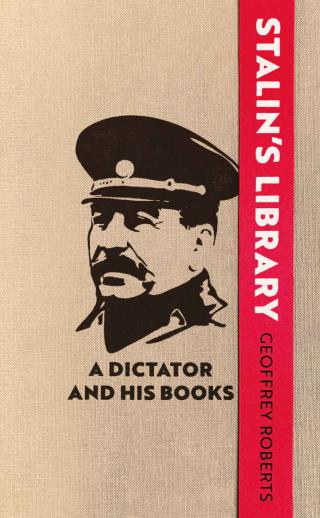
Stalin's Library: A Dictator and His Books
- Автор: Робертс Джеффри
- Год: 2022
- Язык: английский
- Год: Yale University Press
- ISBN: 9780300265590
- Жанр: Культурология

Электронная книга - «Stalin's Library: A Dictator and His Books». Краткое содержание книги:
28. Barbusse letter of February 1934. Cited by K. Morgan, ‘Pseudo-Facts and Pseudo-Leaders: Henri Barbusse and the Dilemmas of Representing the Pre-War Stalin Cult’ (forthcoming article).
29. H. Barbusse, Stalin: A New World Seen Through One Man, Macmillan: London 1935 pp.175–6.
30. Sobanet, ‘Henri Barbusse’, pp.86–7.
31. S. Davies & J. Harris, Stalin’s World: Dictating the Soviet Order, Yale University Press: London & New Haven 2014 pp.149, 158–9.
32. Cited by D. Brandenberger, ‘Stalin as Symboclass="underline" A Case Study of the Personality Cult and its Construction’ in S. Davies & J. Harris (eds), Stalin: A New History, Cambridge University Press: Cambridge 2005 p.261.
33. The relevant documents may be found here: RGASPI, F.558, Op.11, D.1509. They are also published in I.V. Stalin, Istoricheskaya Ideologiya v SSSR v 1920–1950-e gody, Nauka-Piter: St Petersburg 2006 docs 226–9. This episode was brought to my attention by Davies & Harris, Stalin’s World, pp.152–3.
34. The unfortunate Moskalev seems to have come to Stalin’s notice again in 1942 as a result of a book he wrote about the dictator’s period of exile in Siberia. Stalin apparently didn’t like the book and it was withdrawn from publication. According to Simon Sebag Montefiore (Young Stalin, Weidenfeld & Nicolson: London 2007 p.241), Moskalev was commissioned to write the book by the then Krasnoyarsk party secretary, Konstantin Chernenko, who was destined to be the Soviet Union’s penultimate leader. In the late 1940s Moskalev, who was Jewish, fell victim to the anti-cosmopolitan purge and was arrested. Rehabilitated after Stalin’s death, he resumed work as a historian and published a number of books about early Bolshevik and Soviet history, including one about Lenin’s exile in Siberia.
35. RGASPI, F558, Op.1, D.3226; Brandenberger, ‘Stalin as Symbol’, pp.262–3.
36. RGASPI, F558, Op.11, D.905, doc.4. This is the key file on the history of the publication of Stalin’s Works. Many of the documents have been published in I. V. Stalin, Trudy, vol.1, Prometei Info: Moscow 2013.
37. Ibid., doc.6.
38. Many details may be found in S. Yu. Rychenkov, ‘K Istorii Podgotovki Pervogo Izdaniya Sochinenii I. V. Stalina’ in Stalin, Trudy, pp.274–302. On the purge of IMEL: Mosolov, IMEL, pp.312–41.
39. Stalin’s selections and corrections may be viewed in RGASPI, F.558, Op.11, Dd.907 ff.
40. RGASPI, F.558, Op.11, D.941, doc.1. This twelve-page document, which IMEL sent to Stalin at the end of December 1945, concerned editorial changes to his writings for 1917–1920. It had three columns: in the left-hand column was the original text, in the middle column was the text proposed for publication, in the right-hand column there was space for explanation of the changes, though in the cited case no comment was deemed necessary. Most of the proposed changes were minor. The document was brought to my attention by Mosolov, IMEL, pp.442–3. The 1918 text as published may be found in J. Stalin, Works, vol.4, Foreign Languages Publishing House: Moscow 1953 pp.155–7.
41. Stalin, Trudy, pp.376–84.
42. Ibid., pp.385–406.
43. Ibid., pp.485–7.
44. Ibid., pp.506–11.
45. Stalin is referring to a strike and demonstration in Batumi in March 1902 that resulted in bloodshed when the authorities opened fire and killed thirteen protesters and wounded many more.
46. ‘Na Priemu u I. V. Stalina: Zapis’ V. D. Mochalova’ in Stalin, Trudy, pp.512–22. It is not clear when Mochalov wrote up his report. The time, place and duration of the meeting recorded by Mochalov is confirmed by Stalin’s appointments diary: Na Prieme u Stalina p.465. Post-IMEL, Mochalov, who died in 1970, had a distinguished academic career, including serving as chief editor of one the top Soviet history journals, Istoriya SSSR.
47. Konushaya’s memoir may be found in I. V. Stalin, Sochineniya, vol.16, Pisatel’: Moscow 1997 pp.231–6.
48. Cited by Mosolov, IMEL, p.439.
49. RGASPI, F.558 Op.11, D.906, Ll.7–8, 25ff.
50. J. Stalin, Works, vol. 1, Foreign Languages Publishing House: Moscow 1952 pp.xvii–xxi.
51. RGASPI, F.558, Op.11, Dd.1221–5; Brandenberger, Propaganda State, p.255.
52. Stalin’s response to Ribbentrop was specifically listed for exclusion from his works: RGASPI, F.71, Op.10, D.170, L.162.
53. See G. Roberts, ‘Stalin, the Pact with Nazi Germany and the Origins of Postwar Soviet Diplomatic Historiography: A Research Note’, Journal of Cold War Studies, 4/4 (Fall 2002), and V. Pechatnov, ‘How Soviet Cold Warriors Viewed World War II: The Inside Story of the 1957 Edition of the Big Three Correspondence’, Cold War History, 14/1 (2014).
54. R. H. McNeal, Stalin’s Works: An Annotated Bibliography, Hoover Institution: Stanford CA 1967 p.16.
55. See RGASPI, F.558, Op.11, Dd.1100 ff.
56. O. Edel’man, Stalin, Koba i Soso: Molodoi Stalin v Istoricheskikh Istochnikakh, Izdatel’skii Dom Vysshei Shkoly Ekonomiki: Moscow 2016 p.74.
57. McNeal’s Introduction to J. F. Matlock, An Index to the Collected Works of J. V. Stalin, Johnson Reprint Corporation: New York 1971 p.v. Matlock was US ambassador to Moscow, 1987–91.
CHAPTER 3: READING, WRITING AND REVOLUTION
1. R. G. Suny, Stalin: Passage to Revolution, Princeton University Press: Princeton 2020 pp.26–7.
2. R. G. Suny, ‘Beyond Psychohistory: The Young Stalin in Georgia’, Slavic Review, 50/1 (Spring 1991) p.52.
3. R. Brackman, The Secret File of Joseph Stalin: A Hidden Life, Frank Cass: London 2001. For a summary: R. Brackman, ‘Stalin’s Greatest Secret’, Times Higher Education Supplement (26 April 2001).
4. R. C. Tucker, ‘A Stalin Biographer’s Memoir’ in S. Baron & C. Pletsch (eds), Introspection in Biography, Routledge: New York 1985.
5. ‘Rech’ Stalina I. V. na Soveshchanii Komandnogo Sostava’, 22 March 1938, Rossiiskii Gosudarstvennyi Arkhiv Sotsial’no-Politicheskoi Istorii (hereafter RGASPI), F.558, Op.11, D.1121, Ll.49–50. Stalin told another version of his father’s story in an early article as an illustration of how a former shoemaker fallen on hard times could acquire working-class consciousness (J. Stalin, Works, vol.1, Foreign Languages Publishing House: Moscow 1952 pp.317–18).
6. S. Kotkin, Stalin: Paradoxes of Power, 1878–1928, Allen Lane: London 2014 pp.21, 26.
7. My Dear Son: The Memoirs of Stalin’s Mother (Kindle edition).
8. R. H. McNeal, Stalin: Man and Ruler, Macmillan: London 1988 p.4; I. Deutscher, Stalin: A Political Biography, Penguin: Harmondsworth 1966 p.36. The informant was G. Glurdzhidze, who was a teacher in Gori at the time he was interviewed about Stalin’s childhood in 1939.
9. RGASPI, F.558, Op.4, D.5; O. Khlevniuk, Stalin: New Biography of a Dictator, Yale University Press: London & New Haven 2015 p.15.
10. R. Service, Stalin: A Biography, Macmillan: London 2004 p.35.
11. RGASPI, F.558, Op.4, D.600. The texts (in Russian) may also be found in I. Stalin, Sochineniya, vol.17, Severnaya Korona: Tver’ 2004 pp.1–6. For translation of some extracts, including the one cited here, see Suny, Stalin: Passage to Revolution, pp.57–9.
12. Suny, ibid., pp.64–6.
13. Deutscher, Stalin: A Political Biography, p.37.