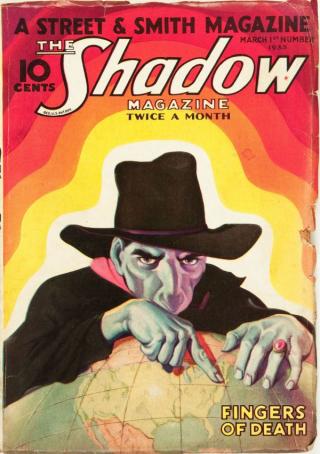
Fingers of Death
- Автор: Грант Максвелл
- Серия: The Shadow #25
- Год: 1933
- Язык: английский
- Год: The Shadow Magazine
- Жанр: Крутые детективы

Электронная книга - «Fingers of Death». Краткое содержание книги:
“Within the past week,” said Saybrook quietly. “He is dead and forgotten — even by the Holmsford newspapers of the past few days. His death, however, was a severe blow to me. Josiah Bartram was the uncle of the girl whom I am engaged to marry.”
Harry Vincent heard the statement with sympathetic surprise. Willard Saybrook tossed the newspaper aside.
“I just mentioned it,” he said brusquely, “because I wondered how much of a stir is actually created by a short flurry of newspaper publicity.”
“Not much, in my opinion,” remarked Harry Vincent.
In the conversation that followed, Harry Vincent learned that Willard Saybrook was living at the dead contractor’s home. Saybrook, in turn, discovered that Vincent was stopping at the Elite Hotel; that he would be in and out of Holmsford during the next few weeks. Both men were cordial, and a real acquaintanceship was formed.
Owing to Saybrook’s present circumstances, it was scarcely possible to make arrangements for another meeting outside of office hours; but Saybrook extended a future invitation for Harry Vincent to call at the Bartram home after the affairs of the late contractor had been adjusted.
THAT evening, following dinner in the gloomy old Bartram dining room, where Mahinda silently stalked about the table, serving food, Willard Saybrook mentioned to Grace Bartram that he had made a very interesting acquaintance in the person of Harry Vincent.
To himself, Saybrook extended congratulations upon the manner in which he had discussed, with Vincent, the matter of Josiah Bartram’s death, without the slightest mention of any apprehensions concerning the cause of the death.
At precisely the same time, Harry Vincent, in his room at the Elite Hotel, was congratulating himself upon his tactful visit to Willard Saybrook’s office. For Harry Vincent, too, had veiled his thoughts.
His pretended guise of construction representative had been assumed purely to form contact with Willard Saybrook. In reality, Harry Vincent was engaged upon another mission. He was the agent of a strange personage known as The Shadow; and tonight he had just completed and dispatched a full report of his findings to date in Holmsford.
For some reason, The Shadow was interested in the demise of Josiah Bartram. Why? Harry Vincent did not know. As an agent of The Shadow, it was his duty to follow instructions to the letter, and to leave The Shadow’s purposes to The Shadow himself.
Even to Harry Vincent, long his trusted agent, The Shadow was a being of mystery. One night — long ago — The Shadow had stepped from the swirling mist of a fog-blanketed night to draw Harry back from a maddened attempt at self-destruction. Since then, Harry had served The Shadow faithfully; but never had he met The Shadow face to face.
Time after time, The Shadow had appeared at crucial moments to rescue Harry Vincent and others from what seemed certain death; but always, The Shadow disappeared as mysteriously as he had arrived.
Tonight, Harry had sent The Shadow a report, written in code, inscribed in special ink, which would disappear after it had been read. That note, however, had not been sent directly to The Shadow. It had gone to Rutledge Mann, an investment broker, who served as contact man between The Shadow and his agents. Mann would forward it to The Shadow.
By to-morrow night, somewhere in New York, The Shadow would be perusing Harry Vincent’s report.
From it, he would learn the details that Harry had uncovered regarding the career of the late Josiah Bartram.
Meager details they were. In his report, Harry had named Hurley Adams as Bartram’s lawyer; Felton Shores as his physician; and Willard Saybrook as the fiance of the old contractor’s niece.
He had also added one other name to the list — that of Maurice Pettigrew, a Holmsford architect, who had been employed at intervals by Josiah Bartram.
Yet Harry, accustomed in The Shadow’s service to size up the men he met, was convinced that he had scored an important point by picking Willard Saybrook as the one person with whom an acquaintanceship would be most logical. Saybrook’s actions in the office had made Harry sure that the young man was still thinking deeply about the death of Josiah Bartram.
Murder? Further crime?
These theories were in Harry Vincent’s brain tonight. For Harry knew that The Shadow, strange phantom of darkness, was a lone wolf who battled sinister crime. When Harry, as The Shadow’s agent, had been sent upon a mission, it was only to seek for signs of crime and to serve as The Shadow might require.
Once crime threatened, The Shadow’s purpose was to thwart it; then stalk it to its evil lair!
Such was the method of The Shadow!
CHAPTER V. FINGERS AND A FACE
HARRY VINCENT had visited Willard Saybrook on one afternoon. On the evening of the next day, he cruised past the Bartram mansion for want of a better plan.
It was nearly midnight when The Shadow’s agent returned to the Elite Hotel. He wrote a brief report of his barren trip, and decided that there was nothing else to do until the morrow. Then, perhaps, it would be wise to study either Hurley Adams or Maurice Pettigrew.
Harry had driven by two houses: one the home of Adams, the other the residence of Pettigrew. Both places had been deserted. Harry had decided that the occupants were out.
In this surmise he had been correct. But had he made a midnight visit to the home of Maurice Pettigrew, he would have seen the glow of newly lighted lamps. For, at midnight, Maurice Pettigrew arrived at his house after visiting some friends in another part of Holmsford.
Maurice Pettigrew was not alone. He came in with a party of persons who had brought him home in their car. At the architect’s suggestion, these people came into the house to indulge in liquid refreshments. Dim lights that glimmered from a room with drawn shades indicated the location of Pettigrew’s study.
This room was Pettigrew’s pride. It was on the second floor of the house, and the visitors admired it as they entered. The room was adorned with many curios. Its walls were lined with artistic bookcases.
Thick draperies hung in the corners. The place was furnished with heavy chairs and couches.
Maurice Pettigrew, an elderly dilettante, let a twisted smile wreathe his dry features as he noted the admiration displayed by his friends. There were half a dozen in the group, and the men as well as the women were highly interested in the furnishings of the large, commodious study.
With a sophisticated grin, Maurice Pettigrew opened an ornate cabinet at the side of the room, and brought forth a bottle and set of glasses. He poured cordials for his visitors, and, as his friends sipped their drinks, the old architect became sourly philosophical.
“We understand life more when we grow old,” he declared. “We appreciate its values; we realize its shortcomings. We are capable of deciding when life is no longer useful. Then, if we are wise, we take steps to complete it.”
“You are not tired of life?” observed one of the visitors.
“I?” Pettigrew’s tone was scornful. “My life is like this glass. Nice to look at — enjoyable when it’s full — worthless when empty — capable of long existence if carefully watched — but ready when the moment comes—”
The old architect let the glass fall from his hand. It struck the slab of a marble-topped table, and shattered to fragments.
REGRETFUL murmurs came from Pettigrew’s friends as they realized that the beautiful crystal object had been so ruthlessly destroyed.
“What is a glass?” queried the architect. “What is a life? Particularly one’s own? I broke the glass because I had that inclination. I would end my life just as willingly — if the desire seized me.”