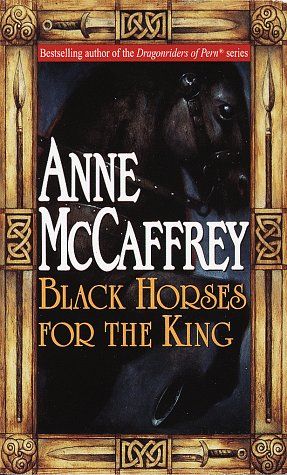
Black Horses for the King
- Автор: Маккефри Энн
- Язык: английский
- Жанр: Научная фантастика

Электронная книга - «Black Horses for the King». Краткое содержание книги:
After his father's death, young Galwyn Varianus is apprenticed to his uncle, who puts the boy to work on the high seas. But horses, not ships, are Galwyn's passion. Luckily, a passenger aboard, Lord Artos (later to rule as the legendary King Arthur), is bound for the great horse fair at Septimania. Risking his life, Galwyn abandons his uncle to serve the gallant leader. Galywn's calming way with horses quickly impresses Lord Artos and his men. But what no one expects is how crucial Galwyn will be to their upcoming battles--as he masters the secrets of the iron shoes that will protect the exotic horses' delicate hooves. . . .
"You are from afar?" Paphnutius asked courteously, when we were all seated. I felt uncomfortable until I imitated his cross-legged posture.
"We are," Lord Artos said, looking amazingly dignified upon his cushion. "From Britain."
"Ah!" and Paphnutius's eyes went round with pleasure at such a revelation. "You have journeyed far indeed to see our poor horses."
Bericus gave a snort, because it was obvious to us all that the horses were far from poor.
Just then the woman returned with a beautiful brass tray and served us a thick, sweet beverage in tiny cups. One almost had to spoon it into the mouth, but this was evidently part of a bargaining ritual, similar to some I had seen my father perform with alien traders. I could almost think myself a child-and carefree-again in such an atmosphere.
"May I ask what this is we are drinking?" Lord Artos said, his tone one of surprised pleasure.
"It is called qahwa, and comes from a bean that is ground and then diffused in boiling water. The taste pleases the effendi?" Paphnutius was all concern that the drink might not please us.
I found it odd but certainly tasty: better than small beer or watered wine.
"It pleases me greatly," Lord Artos said, and paused to take another sip, smiling broadly. I caught him glancing about us to be sure we were also displaying pleasure. Which we all were. Odd the drink was, but I liked it.
Just then the woman reappeared, and this time her tray contained dates, pieces of ewe's cheese, and other sweet-tasting small cubes that were unknown to me.
"Was your journey arduous?" asked Paphnutius; and so we discussed that topic, and then the weather, and the situation of the camp, and only finally the vast number of horses that were on display.
At that point, Lord Artos rightly judged that business could be discussed, and with the sort of gracious reluctance that dealing with the Egyptian required, he explained his requirements. The mares should be proven fertile, preferably already in foal to Libyan stallions, and the stallions should be no more than four years of age and of proven virility. All the horses should be broken to saddle and bridle.
Paphnutius never asked why such breeding horses would be required by this foreign lord. Perhaps he could understand without explanation. After all, Lord Artos and all his companions were tall men; clearly they would need large mounts.
When we had finished our pleasant repast, Paphnutius guided us outside again and, clapping his hands, began the parade of the horses he had for sale.
"The mare is but four years old, and as you see by the foal at foot, she is fertile. This is her second foal." Then, from a parchment scroll he produced from somewhere in his voluminous robes, he rattled off a long pedigree that seemed to deal more with the performance of the dams than the sires. "She is in foal again, to the same sire."
This mare was big, wide hipped; and the foal at her foot was certainly five months old, for he had lost his fuzzy foal coat and was strong and lively. And nearly black. Both animals had good confirmation and a fine sheen to their hides.
Paphnutius then gave us the stallion's pedigree, speaking as fast as he could for some time. "Is he among those you have for sale?" "Oh, no," and Paphnutius looked almost shocked. "He is renowned for his speed, and much in demand."
Lord Artos nudged me briefly as the mare and her energetic foal were taken back to the picket line.
"When will she foal, Paphnutius?" he asked as he watched her movements.
"In your springtime. I have the date …" And he consulted his parchment roll. "Ah, yes, she was covered in the third month and then confirmed in foal. Yes, yes, she is a fine mare to breed from." He looked a little wistful and I wondered why. I didn't know then that the Egyptians and Arabs preferred mares to stallions. On the other hand, Bwlch looked concerned. "What's wrong?" I asked discreetly, in our own tongue, lowering my voice so that the Egyptian didn't hear us.
"Spring at Deva, where Artos plans to send the horses, can be a cruelly cold season. We breed so that the mares will have their foals in late spring. The later the better. At least that one is well enough in foal so she'll be all right on the sea journey." Bwlch shook his head, already worried about that leg of the way back to Deva.
The parade of mares, some with foals at foot and others guaranteed in foal, continued. I tried to figure out which ones met with Lord Artos's approval; his expression remained the same, pleasant, smiling, outwardly favorable, throughout the entire display.
The stallions were shown next, and worked in circles on long lines to show their proud paces. The second one, not much taller than the first, displayed himself with just that little extra flick of his feet, a prouder carriage of his head and tail, an assurance that caught the eye, and a blue gleam to his silky black hide.
"Now, that's just the one for me," Lord Artos murmured to Bericus, although he kept his expression bland. "I would name him Cornix."
"What else, Artos!" Bericus whispered back, and winked at me. Cornix means "raven." I did not then know that ravens are the birds of good omen for the Comes Britannorum.
Paphnutius had nine stallions, more than were needed; but not all measured up to the criteria in Lord Artos's mind. Finally the parade ended, and then Lord
Artos singled out his choices of mare and stallion. I missed out on only one mare and one stallion in my private selection.
"Ah, but come into my humble abode, Lord Artos," Paphnutius said then, bowing and scraping as he led the way, "for you must surely be thirsty. And one cannot discuss matters of such importance out here, where there are so many distractions."
So we retired again. More of the thick sweet qahwa did indeed moisten a throat made dry by the dust the parade of horses had swirled up around us. I did justice to the sweetmeats, too, and more exotic ingredients were served this time. I don't remember half of the subtle combinations that passed into my mouth and down my gullet, because I had to concentrate more on the nuances of bargaining.
Memory of my father's tactics returned to me, and if I say so myself-and Lord Artos was very kindly complimentary that evening-I did very well at this business. Better than I ever did for Uncle Gralior; beatings do not encourage as surely as praise. I also wanted to prove to Lord Artos how indispensable I could be. I did not aspire to become a Companion, for I was too young and would never be of that size, but surely I could serve my lord in many other ways that could further his ends. My instruction in the short Roman swords still favored by soldiers had ended with my father's death, but perhaps I could retrain and join Artos's cohort.
When the deals had been completed, Paphnutius himself took us to a compatriot, Nicetus the Elder, several tents away to secure the remaining few horses that were needed. And there, with appropriate ceremonies, view-ings, and bargainings, the remaining Libyans were purchased.
I was so excited that I could not sleep that night. I kept creeping out of our shelter to see if the Libyans were still picketed. Bericus was on watch.
"We won't lose them, Galwyn," he reassured me, and pointed out his sentry companion on the other side of the line. "Get your rest. You've earned it."
THE NEXT DAY Lord Artos sold off the now-unneeded ponies, for he would mount his men on some of the new acquisitions and lead the others. Spadix was not among those sold, because, he said, "I have no right to dispose of Captain Gralior's property."
I contrived not to look in his direction at that. Spadix was not my uncle's but truly mine, bought with the gratuities I had earned. However, this was not the time to mention that fact. And there was another reason to keep my pony. Cornix was the most unbiddable of the stallions-so wild he had had to be roped, tied, and twitched before a round bit could be inserted between his snapping jaws and a stout bridle attached to his head. Yet he was unexpectedly calm in Spadix's company. The sight of that little bay imp, who could easily stand beneath the stallion-and did so during the worst of the rains-was as ludicrous as it was beneficial.