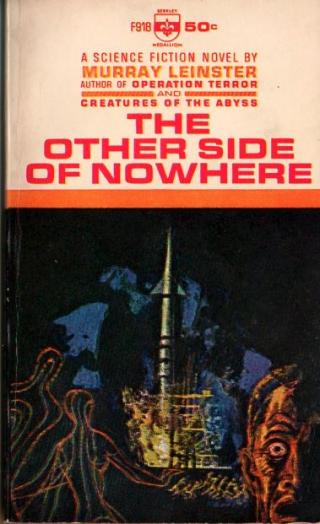
The Other Side of Nowhere
- Автор: Лейнстер Мюррей
- Год: 1964
- Язык: английский
- Год: Berkley Medallion
- Жанр: Научная фантастика

Электронная книга - «The Other Side of Nowhere». Краткое содержание книги:
For centuries space travelers had dreaded a place they called the Other Side of Nowhere — a place in the universe where up was down, where right was wrong, and where all direction was lost...
To save the RIM STAR Braden had to bring the ship to the place of nightmare, the Other Side of Nowhere...
Braden scowled as he loosed the draw-cord of his bag and put his hand inside.
Within a minute, he had the bag empty. His clothes were folded as neatly as when he'd put them in. There was only one sign that his bag had been touched.
His blaster was gone.
His jaw clamped and he went cold with rage. He could report the theft to the skipper, for it was a distinctly ominous matter. The actual purpose of the voyage included taking a risk that had never deliberately been taken before, but the skipper was apparently welcoming trouble in addition. He was no ordinary merchant-ship skipper. Braden had been challenged by his manner. To report within half an hour after lift-off that his blaster had been stolen would probably amuse the skipper.
There was, plainly, only one thing to do, and that was to say nothing about it. A blaster in the forecastle would call for action under any circumstances. Braden must take that action before it could be expected. Meanwhile the ship rose and rose. Braden should check the items assigned to the steward to do - against all reason. He must go on as if he did not know about the blaster's theft until the time came for violent action to recover it.
He ground his teeth as he repacked the ship-bag. He put it where it had been before. As he went out of the cabin, his hands were clenched into fists.
He started the check-over that should have been made while the ship was still aground. Outside, the planet just left would be a distinct ball, with seas and continents and polar icecaps. It would hang unsupported in space, which was unbelievable even to a man who saw it from a ship that was leaving it. It dwindled and dwindled, which seemed equally improbable. It was no less inconceivable that the Rim Star had lifted and was lifting from the planet on fields of force projected from a spaceport which was not even a speck on the now-minute world.
Outside, of course, the huge ship did not even look like anything made by men. She was bulbous, ungraceful. Floating in emptiness, she looked like a preposterous shape in preposterous motion.
Presently she swung, aimed herself, and moved visibly in a new direction. Now, from close by, her meteor-detectors could be seen to twinkle, scanning the arcs of emptiness before her. Her drive produced no external effect - no wake, no plume of rocket-smoke. She was driven by the Lawlor units that are not used for lift-off from a planet because of the monstrous winds they create. But they'd been used to cross interplanetary distances in the first solar system. When overdrive was developed and a ship could be enclosed in a force-field which changed the physical constants of interstellar space, the same conservative Lawlor drives continued to operate. But the speed attainable in overdrive increased beyond imagining.
It was not wise, though, to go into overdrive in the ecliptic plane of a solar system. A ship had to get well away from the most probable orbit of celestial debris before building up to so high a velocity.
The Rim Star drove on and on and on. Since she had aimed herself to leave the plane populated by comets and celestial debris, she seemed to be imbued with purpose. She still did not look like anything man had created, but rather like some monster creature swimming abstractly toward some destination of its own choosing.
It was two hours out from lift-off before Braden had completed the check of those last items he should have seen to before leaving ground. He'd found each member of the crew at his post. He regarded each one with a bristling disapproval which was expected. Each one answered such questions as Braden put with precision and apparent respect, but the feel of things was wrong. The five blank-faced crewmen said nothing and did nothing that he could cavil at, but they shared an air as of hidden amusement, of secret laughter. Braden suspected that they knew about the theft of his blaster, but didn't know he knew it yet.
He'd left the last of them and was on his way to the passengers' quarters when he realized what was really basically wrong about the way the crew acted. A ship's crew scatters when she ends her voyage. Men do not sign on together for long voyages out of friendship. When a ship leaves port, the members of her crew are usually strangers, bringing neither personal hatreds nor personal loyalties to their joint imprisonment in a spaceship's metal hull.
But these men were difterent. If they were the same ones who'd jumped him in the spaceport, they formed a unit - organized and tested and confident of each other. Their solidarity did not come from membership in the same ship's crew. They'd waylaid Braden by mistake - it was almost certain - and then waylaid another man but not by mistake, after him. That man was now in the hospital instead of aboard the Rim Star. Somebody, too, had jumped the man who'd been mate before Braden. Probably these same men.
When Braden went into the passengers' quarters he'd added things up. He looked like a thundercloud. The passengers weren't yet as settled as they'd be presently. The steward smiled brightly at Braden when he walked into the passengers' saloon.
"Ah, Mr. Braden!" he said warmly. "The passengers want to talk to you, sir! I told them my authority is limited to doing things to make them comfortable. But you can pass on their idea, sir."
Braden said unpleasantly:
"What is the idea?"
"Just a moment, sir. You'll want to talk to... Ah, here he is! Mr. Duckworth, this is Mr. Braden, mate of our ship. Second in command, you'd say. He'll hear your request, Mr. Duckworth, and at least take it up with the captain."
The man called Duckworth was small and bustling, with an air of fretful impatience. He gave Braden a professional smile.
"We want to take pictures on the Rim Star, Mr. Braden," he said crisply. "While we're traveling. That is, we are a production unit going on location to Handel's Planet to take background shots and some action, set-pictures and so on, for a broadcast tape story about the Other Side of Nowhere. Miss Derr Carmody is the star. Mr. Fortescue plays opposite her. And the Rim Star's a splendid set. We can use her interiors for a good many scenes before we get to Handel's Planet and have a good lot of footage all wrapped up. I asked the steward to explain this to the captain and arrange things so I can look the ship over and plan my shots. I might want members of the crew - off duty-time, of course - to act as extras. Possibly we could work you and the skipper in."
His manner was assured, confident. There was a stirring, and one of the two women passengers came out of a cabin. Braden recognized her. There'd been a pin-up of her long ago in the Hansford's control-room. But that was a picture of her when she was young. Now, Braden knew detachedly, she'd had a rejuvenation job and probably persuaded herself that nobody guessed it. It wouldn't show under tape make-up, though.
"Derr," said Duckworth confidently, "meet Mr. Braden. He's first officer of the ship. He'll arrange for us to shoot the scenes we need on the ship. Mr. Braden, Miss Carmody."
Braden nodded acknowledgement. Derr Carmody gave him a warm and luminous but completely professional smile.
"Oh, yes!" she said. She tended to coo. "It's so good of you, Mr. Braden!"
Another passenger popped into view - a middle-aged man with a harried look and disconsolate expression. Still another young man, with the expression of someone who knows he will take a good picture if somebody aims a camera at him. Then a girl - quiet, not happy, not glamorous. At another time Braden would have excepted her from the category of women he'd rather not bother to talk to. Now, though, he had a lot on his mind. He nodded curtly when introduced to the disconsolate middle-aged man, a cameraman named Hardy. He nodded again, impatiently, when the young man who looked like an actor was introduced. His name was Fortescue. The quiet girl's name was Diane. She wasn't an actress, but a cameraman, like the harried Hardy, and Duckworth explained proudly that they were specialists of a very high order in camera work. They could get incredible pictures under conditions most cameramen would find impossible. They could make tape cameras sit up and beg. Hence the small location-party for a big picture. But they needed to make some scenes on the Rim Star.