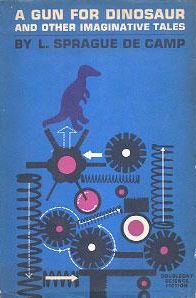
A Gun for Dinosaur and Other Imaginative Tales
- Автор: Де Камп Лайон Спрэг
- Год: 1969
- Язык: английский
- Год: Curtis Books
- Жанр: Научная фантастика

Электронная книга - «A Gun for Dinosaur and Other Imaginative Tales». Краткое содержание книги:
Constant went right through the camp. He shouted something and kept on towards the ship. O'Sullivan stopped long enough to say to May: "Naupredas coming — come to the ship — lock ourselves in ..." Then he ran on too.
We looked at one another. If this were another of Constant's jokes we didn't want to be taken in. But, if naupredas were on the way, we didn't want to abandon the camp to them if we could help it. Even if we got to the ship, they'd swarm over everything and eat our specimens, and what they didn't break or upset they'd cover with slime. The electrified fence wouldn't stop a swarm like that.
Before we could make up our minds — not more than a couple of seconds, really — Fish ran into the camp. This time he jumped over the electrified fence. He ran to the equipment tent, skidded on the mud, and came out with his arms full of the carton of phosphorus grenades.
We weren't looking at him because a swarm of minor slimy things had come out of the woods. Some plunged into the lakes while others scuttled and hopped along the isthmus towards us. Behind them came the column of naupredas, wriggling along like some horrible living carpet. Whenever a naupreda caught one of the little wigglers it would halt to gulp it down while the others flowed .over and past it. The column followed the isthmus towards the camp.
The camp burst into action. All the scientists ran for the specimens and instruments they most valued. The crewmen lit out for the ship. May and Sander rushed into the equipment tent and lugged out the flame thrower.
Meantime Fish, leaping over the fence again, ran back to the isthmus, yelling: "Gaw damn sissies! I'll show 'em!"
He got to where it narrowed, so the naupredas couldn't get past him unless they took to the water; In their marching stage they prefer land. May, lugging one end of the flame thrower, yelled:
"Winthrop! Come back! You'll be killed! You're in our way!"
For May couldn't spray jellied gasoline from the flame thrower with Fish right between him and the column. Fish gave no sign of hearing. Instead, he set down the carton and picked up a grenade. He threw it at the naupredas, about thirty feet away. The little hoppers and crawlers scuttled past his legs.
The grenade didn't go off. He threw another, which didn't go off either. May groaned: "He's not pulling the pins!"
And so he wasn't, because May had never shown us how to
work the grenades. He hadn't shown us for fear Fish would start experimenting. Some of us had an idea how these bombs worked without having to be told, but not Winthrop Fish.
When his second bomb failed to explode, I guess he knew something was wrong. While the naupredas swarmed nearer, he picked up another grenade and turned it over. He had his back to us so nobody got a clear view. MacAuliffe, the meteorologist, was off to one side. He says he saw Fish pull the pin from the grenade, fumble with the bomb, and drop it into the box at his feet.
Some thought he might have done it on purpose, as the naupredas were so close that a phosphorus burst on the head of the column would have gotten Fish too. But I think he was just being his usual disorganized self.
There was a terrific explosion, not all at once, but taking maybe half a second, br-r-r-oomp!, like that. The whole isthmus and Winthrop Fish disappeared in a huge white cloud of phosphorus trails. Some of the burning phosphorus fell inside our perimeter, though nobody was hit.
The wind carried the cloud away, and the sputter of burning particles of phosphorus that covered the ground from the camp to the other end of the isthmus died down. The far end of the isthmus was covered with burned naupredas, some writhing and others dead. At the edge of the woods, where the rest of the column was still streaming out, the leaders halted at the smell, so they piled up in a great writhing mass. Then the column turned and streamed off along the far shore of one of the lakes.
We never did need the flame thrower. The naupredas kept on away from the camp, and we never saw that swarm again.
There was hardly enough left of Winthrop Fish to bury. Sander said that, while a phosphorus burn is one of the most painful injuries, Fish probably didn't have time to know he was hurt.
Constant and O'Sullivan came down the ship's ladder and back to camp. To give them credit, they at least acted ashamed. They'd run, while the poor nitwit they'd been baiting died like a hero. I'm sure we all thought somebody ought to beat the tar out of them, or at least out of Constant. But, as he was the biggest and strongest man in the party, nobody did.
For that matter, I think some of us wouldn't have minded a little quiet murder. But, without the pilots, how could we get back to earth? We couldn't even fire them when we got home, as their contracts ended then anyway, though the official reports of the expedition did ruin their careers as space pilots.
As Kurt Maier remarked in Constant's hearing: "Even if he was a looney, I likedhim. Better than some saner people."
And Radek added: "But can a man be sane who plays a joke on a psychotic, after he's been warned?"
Anyway, darling, that's why I won't take a practical joke. Ever. You see, they're not really practical at all.
In-Group
Ali Moyang was leading his party, gun ready, when he saw the bundle of clothes lying on the trail ahead. He held up a hand in warning and trotted forward until he stood over the bundle.
The bundle resolved itself into a man lying unconscious but still breathing in a rattling and irregular way. The man was nearly a head taller than Ali Moyang's stocky frame. He was unarmed, though a small canvas knapsack lay beside him. He obviously belonged to the white race, with a lobster-red skin, graying red hair, a close-cut red mustache, and a stubble of red whiskers covering his large red face. He bore the sagging look of a man who had been on the fat side but who had worked most of the fat off in a crucial struggle that had left him exhausted almost to death.
Ali thought, the fellow couldn't have been there long or he would have been stepped on by an uyedna or eaten by a ftom or otherwise maltreated by the unfriendly fauna of the planet Kterem, or 61 Cygni A VI.
The treasure hunter shook the recumbent man by the shoulder until the big body rolled over on to its back. Then Moyang unscrewed his canteen and dribbled a little water into the half-open mouth. The red man coughed, sputtered, and opened bleary blue eyes.
"Qui etes ..." he croaked, then changed to Anglo-Ter-ran: "Who are you?"
Moyang's slanting black eyes narrowed still further. "Suppose you tell me who you are first."
"My name is Bertin. Charles Bertin."
"What?" Moyang could not quite catch the man's mumble. "Professor Charles Bertin, of the University of Liege. Does that satisfy you?"
"How did you get here?"
"My — 'copter crashed. May I have — some more water?"
Moyang extended the canteen, asking: "What were you doing flying around the Jiltak region? You know you're stuck if you're forced down."
"I was — looking over the site of Zhovacim."
At the sound of the name of the ruined city, Moyang's hand jerked so that he splashed a little of the water into Ber-tin's face. Behind him, on the trail, his partners Ma and Peterson exchanged glances, while the four baggage-bearing Kteremians showed no legible expression on their unhuman faces.
"What were you going to do there?" said Moyang. "Scientific work."
"What kind?"
"Archeological stuff. You know, digging."
"Unh," said Moyang, staring at Bertin in honest perplexity. While he did not wish to leave the fellow to die on the trail, to have some scientific crackpot horning in on his, Moyang's, enterprise at this stage was about the most inconvenient thing that could have happened. He persisted: