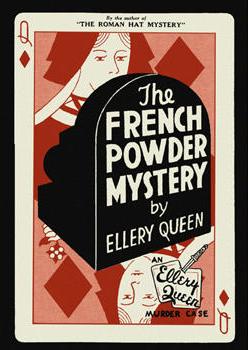
The French Powder Mystery
- Автор: Куин (Квин) Эллери
- Серия: Ellery Queen #2
- Год: 1930
- Язык: английский
- Год: Frederick A. Stokes
- Жанр: Классические детективы

Электронная книга - «The French Powder Mystery». Краткое содержание книги:
Ellery paused and referred to a sheaf of paper which he took from his breast-pocket. “We must leave for the moment our general conclusion that the person we are seeking is connected officially or semi-officially with this establishment,” he said at last. “Please bear that statement in mind while I veer off into another lane of speculation entirely...
“I brought to your attention a few moments ago four concrete evidences of the presence of Miss Bernice Carmody in this apartment on Monday night. These were, in the order in which we found them, the game of banque exclusively indulged in by Miss Carmody and her mother; the La Duchesse cigarets, violet-scented, known to be Miss Carmody’s special brand; Miss Carmody’s hat, which she was observed wearing on Monday afternoon when she disappeared from sight; and her shoes, which fit the same description.
“Now I shall show you that, far from proving that Miss Carmody was present here on Monday night, they prove exactly the contrary,” continued Ellery briskly. “The banque game contributes nothing to our little refutation; the cards lay there in a legitimate array, and we must leave them for the present.
“The cigarets, however, present a more illuminating view of my contention. These” — he held up one of the ashtrays on the exhibit-table — “these cigaret stubs were found on the table in the cardroom.” He lifted one of the stubs from the tray and held it high. “As you can see, this cigaret has been almost entirely consumed — in fact, only the small strip which bears the brand imprint is left. Without exception, each of the ten or twelve cigarets in this ashtray have been uniformly smoked to the same tiny stub.
“On the other hand, in Miss Carmody’s bedroom at the French house, we found these stubs.” He exhibited the second ashtray, picking out one of the cigarets from its cluttered, dusty depths to show to his audience. “You will observe that in the case of this stub, the cigaret, also a La Duchesse of course, has been little more than one-quarter consumed — Miss Carmody evidently having taken only five or six puffs before crushing the remainder in the tray. Every stub in this tray from Miss Carmody’s bedroom has been similarly treated.
“In other words,” he said with a bare smile, “we find the amusing phenomenon of two sets of cigarets, both presumably smoked by the same person, exhibiting distinctly opposite physical remains. On investigating, we discovered that Miss Carmody, for reasons soon to be clarified, is extremely nervous — so much so that none of those persons who know her best can recall any occasion on which she has not smoked her favorite cigarets in exactly this wasteful, convulsive manner.
“What is the inference?” A perceptible pause. “Merely that Miss Carmody did not smoke the cigarets we found on the cardroom table; that they were smoked or prepared by someone else who did not know Miss Carmody’s unvarying method of throwing away cigarets one-quarter consumed...
“Now, as for the shoes and hat,” Ellery said without allowing his auditors time in which to digest this latest pronouncement, “we found further signs of a tampering hand. The appearance of things is that Miss Carmody was here Monday night, having been wet by the rain of the afternoon and evening, and that before leaving the apartment she changed her soaked hat and shoes, putting on others from the small stock of her clothing already in the bedroom closet. But we discover that the hat had been inserted in a hat-box with its brim to the bottom. And that the shoes had been stuck into the shoe-bag with their heels projecting from the pocket.
“In testing the habituary nature of such a procedure, we considered that an overwhelming percentage of women put their hats away in hat-boxes with the crowns to the bottom and the brims to the top; also that when shoes have large buckles, as this pair has, they are put away with the heels inside, so that the buckles will not catch on the material of the bag. Yet both articles denoted this peculiar ignorance of feminine custom. Here the inference is also obvious — Miss Carmody did not put away those shoes and the hat; a man did. For it is the masculine custom to put hats away with the brim downward; and a man would not grasp the significance of the buckle. All the shoes in the rack had the heels showing, because none happened to have buckles; whoever put Miss Carmody’s shoes in the rack automatically followed suit, which a woman would not have done.
“Now these points, taken by and of themselves, are, I will confess, rather weak and inconclusive. But when you put the three together, the evidence is too strong to be overlooked — it was not Miss Carmody who smoked the cigarets and put away shoes and hat, but someone else — a man.”
Ellery cleared away a huskiness in his throat. His tone was barbed with earnestness, despite a growing hoarseness. “There is another item of considerable interest in this last connection,” he continued. “In examining the lavatory inside, Mr. Weaver and I ran across an intriguing theft. A safety-razor blade of Mr. Weaver’s, which he had used after five-thirty Monday afternoon and had cleaned and restored to the case because it was his last blade and he knew he would have to shave in the morning — this blade, I say, was missing on Tuesday morning. Mr. Weaver, who was busy Monday night and consequently forgot to put in a new supply of blades, came to the apartment Tuesday morning early — at eight-thirty, in fact, because he had to clear up some business and reports before the arrival of Mr. French at nine. He intended to shave in the apartment. The blade, which he had put away only the late afternoon before, was gone. Mr. French, let me explain does not keep a razor, never shaving himself.
“Now why was the blade gone? Of course, it was plain that the blade must have been used Monday night or early Tuesday morning before Mr. Weaver arrived here. Who could have used it? One of two people — Mrs. French or her murderer. Mrs. French could have used it as a cutting instrument of some sort; or her murderer could have used it.
“Of the two alternatives, surely the second is more tenable. Remember that the criminal was constrained by circumstances to pass the night in the store. Where could he stay with most safety? Certainly in the apartment itself! He could not roam about the dark floors, or even hide among them with as great a margin of safety as in the apartment — not with the watchmen prowling about all night! Now — we find a blade used. It suggests normally the process of shaving. Well, why not? We know that the murderer had to make an appearance in the morning as an employee or official of the store. Why shouldn’t he shave while he was temporarily occupying the apartment? It predicates a cold-blooded personality, but that is an argument for rather than an argument against it. Why is the blade missing? Evidently something happened to it. What could have happened to it? Did it break? Why not! The blade had been used a few times; it was brittle. A little extra force in screwing the parts of the razor together, and the blade might easily have snapped. Let us suppose that this happened. Why didn’t the murderer merely leave the broken blade? Because the murderer is a canny scoundrel and in his own way an excellent psychologist. If a broken blade remains it is more likely to be recalled that it was not broken at a former date than to take it for granted that the blade was broken at that former date. If the blade is missing there is no incentive to suspicion or memory. An altered object is a more vigorous mental stimulant than a missing one. At least, that is what I should have thought if I had been in the murderer’s place; and in effect I believe the person who planned this affair did the correct thing in taking away the blade — correct according to his lights. The proof is that Mr. Weaver thought little or nothing of the missing blade until I probed it out of him; and then it was only because I brought to the investigation an unprejudiced, impersonal observation.”