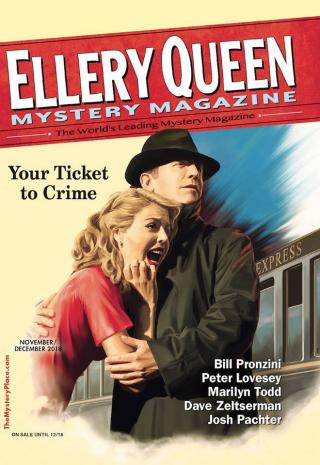
Ellery Queen’s Mystery Magazine. Vol. 152, Nos. 5 & 6. Whole Nos. 926 & 927, November/December 2018
- Автор: Ловси Питер, Зельцерман Дэйв
- Год: 2018
- Язык: английский
- Год: Dell Magazines
- ISBN: 0013-6328
- Жанр: Другие детективы

Электронная книга - «Ellery Queen’s Mystery Magazine. Vol. 152, Nos. 5 & 6. Whole Nos. 926 & 927, November/December 2018». Краткое содержание книги:
And he felt the darkness returning — the same sensation that had been ebbing and flowing in and out of him ever since he read the article the night before.
Only a few times in his life had Ray felt emotion in any extreme way. When he was sixteen, his mother died. Lying in bed at night, his grief was so unbearable that he came to imagine it as a physical thing — a long, slim, rectangular box lodged inside his ribs. At times it felt so real, so palpable, that he believed a surgeon might actually be able to remove it. He would walk past the medical centre on the main street and pause, wondering if he should go in. Maybe if he begged hard enough, he thought, the doctor would cut him open, and then he would feel normal again.
Two years later, after Jeannie’s death, he experienced something just as acute, only it manifested in his body in a different way. Whereas the grief was a singular object, stuck inside the cavity of his chest, the guilt — or was it shame? — infected every part of his body. It was in his blood, his spit, his sinew. It made his hands and legs shake and it pinched at his bowels. It was like a black, inky liquid travelling through his veins and now it was back, snaking through his body, taking over every inch.
He could feel it rising up inside him now, tentaclelike, edging towards his chest. It wrapped around his heart and squeezed and for a moment everything was still.
Terrified, Ray reached out his hand and tried to breathe, clutching at the air. And then the liquid released its grip and his heartbeat returned with such resounding force that it thrust his body forward. Standing upright, Ray looked up at the sky, but the clouds moved too quickly and the earth seemed to tilt and all he could do was shut his eyes.
He saw a kaleidoscope of faces — Patricia, Talia, and Bob, then a blur of detectives he hadn’t met yet and journalists who would no doubt come knocking on his door — and he thought about what he would say, but even the truth sounded like a bad excuse.
And with Pete dead and Shane in jail and Darren last seen sleeping on the streets of King’s Cross, what was left? The DNA evidence, which would implicate him. And he thought about what life would be like for Patricia and Talia, who would probably never speak to him again, and he let out a small cry.
In the spring of 1980, Ray got a job at the local tuna cannery and saved up enough money for his first car — a beaten-up old ute that he bought from a bloke in Bermagui. He liked the freedom it gave him and felt a liberating sense of relief that he no longer had to rely on Pete for lifts around town.
One weekend he drove all the way to Sydney — the farthest he’d ever been away from home — and it was on his way back that he saw an Aboriginal girl standing on the side of the Princes Highway, just past Ulladulla, trying to wave cars down with a long, skinny arm.
No one was stopping for her, even though it was raining. Ray wasn’t sure if he should either, but then their eyes met and she smiled and he found himself slowing down.
“Where are you headed?” he shouted.
She ran up to the car, using her hands to shield her face from the rain. “Melbourne.”
Ray hesitated. “I can take you as far as Eden,” he said.
The girl looked doubtful. She was a skinny thing and her hair was wet from the rain, which had the effect of making her eyes appear larger than they really were. “Yeah?”
Ray shrugged. “Sure, why not.”
The girl opened the car door and slid in, escorted by the fresh, salty smells of spring rain and briny air. Ray looked down and saw that her skirt was damp and clinging to her legs. He suddenly felt awkward, not sure of what to say or do. He reached for the radio and fiddled with the dial, then turned the volume up louder, hoping this would circumvent the need for conversation. The sound of AC/DC blasting on the stereo wasn’t enough to stop her from talking, though.
Jeannie, her name was, from Lismore. Eighteen years old. On her way to Melbourne to look for work. She’d been in Sydney for the last few weeks but didn’t like it — everything was too fast, too crazy. No one ever stopped to say hello. So she decided to catch the bus to Nowra and hitch her way down south.
Sitting next to her, Ray couldn’t help thinking of a whirligig on a windswept day. She spoke quickly and moved her arms a lot and every time a new thought rushed through her she became even more animated, if that was possible. When she wasn’t talking about herself, she peppered Ray with questions — was Eden like the garden in the Bible and did killer whales really kill people and what was it like working at the cannery and how did they get the tuna in the tins? And even though Ray wasn’t trying to be funny, she laughed at everything he said and soon he found himself laughing too — buoyed, uplifted by her presence.
By the time they got to Eden, night was falling. In the distance, amid the darkness, Ray could see the lights of Imlay Street, and the giddiness that had gripped him for the last few hours began to wane.
“Where are you going to stay?” Ray said.
“Dunno,” Jeannie said. “I’ll figure something out — I always do.”
“There’s the caravan park,” Ray said, “or—”
Jeannie looked at him hopefully.
“Well, my brother’s out on the trawler till the end of the month, so you could always stay at my place, I guess.”
Jeannie clapped her hands. “Thank you, thank you, thank you. I’ll be out of your hair after one night, I promise.”
But one week later Jeannie was still there. Not that Ray minded — in fact, he found himself looking forward to seeing her at the end of each day. He worked the early shift at the cannery and would leave the house at dawn. In the afternoons, he would show her the sights — Saltwater Creek, Ben Boyd Tower, and the Bittangabee Bay Ruins — quiet places where it was unlikely anyone would see them together, because he didn’t know what people would say. Sometimes they would drive to Barmouth Beach for a swim. In the evenings, Jeannie would cook Ray dinner, and they would stay up late, talking and drinking beer. And every time Ray looked at her, he couldn’t help noticing how small and delicate her face was, and he would think how gentle you would have to be to touch it, to cup it in your hands.
For Ray, those days had a lovely, languid feeling, but they were tinged with something else — some worry or concern he couldn’t quite put his finger on, like lying in bed well past the alarm, wondering if there was someplace else you had to be. But whenever the notion started to take a clearer shape, it would slip away from him again and remain floating out of grasp.
“I should think about making tracks soon,” Jeannie said one evening. “I don’t want to overstay my welcome.”
It was a warm night and she and Ray sat on the edge of the porch, their legs dangling over the side.
“Maybe you could stay,” he said. “There are always jobs going at the cannery — you could get a place of your own.”
Jeannie shook her head. “I want to give Melbourne a go. I’ve got a good feeling about it, you know?”
Ray took a sip of beer and looked up at the night sky. He wanted to put his arm around her and tell her how he felt, but he was worried it would come out all wrong.
“It looks like a storm’s coming,” he said.
Jeannie smiled and pressed her knee against his. “Have you ever thought about leaving?” she said.
“Me?” Ray looked at her in surprise. “Nah. I couldn’t.”
“Sure you could. You could come with me to Melbourne.”
And Ray, emboldened by the touch of her flesh against his, ran his finger along her cheek and kissed her.
That night, as Jeannie fell asleep in Ray’s arms, he imagined what it would be like to jump in the car with her and never come back. He felt guilty even contemplating it. Would his mother know, wherever she was now?