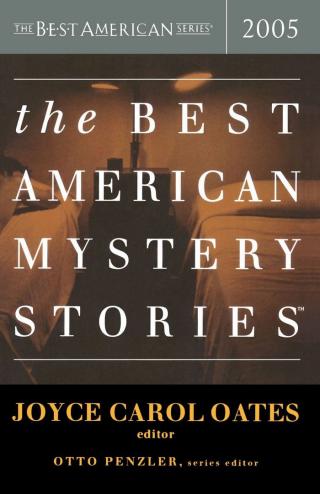
The Best American Mystery Stories 2005
- Автор: Хиггинс Джордж, Камински Стюарт Мелвин
- Год: 2005
- Язык: английский
- Год: Houghton Mifflin Harcourt
- ISBN: 978-0-618-51744-2
- Жанр: Другие детективы

Электронная книга - «The Best American Mystery Stories 2005». Краткое содержание книги:
I nodded slowly. “Lots of money. New library is long overdue.”
“You know how library costs have escalated in the last decade. We had to cut back twenty percent on periodicals this year, and ten percent on open hours. The building itself has close to a million dollars of outstanding repairs. My feeling is that this donation might be the beginning of a long-term relationship with the Belinsky Foundation.”
“What did Belinsky say?”
“Indicated that members of his board were asking questions about the appointment. Wanted me to confirm yes or no, had the new head of the German Department been a Hitler supporter? I told him that I could only report what Dr. Scheinberg had stated. But I also advised him that the appointment had not yet been made.”
“People change, Mr. President,” I said. “If every human action was held up to scrutiny, we’d all be in trouble.”
“That’s generous, Tomas, but it won’t cut much ice with the media, or with the Belinsky Foundation. This is why I needed to talk to you. The Search Committee has the prerogative to make whatever recommendation it thinks prudent. If it nominates Dr. Scheinberg, I shall have to turn its recommendation down. I will do so on the basis of her lack of recent groundbreaking scholarship. I hope it won’t come to that. It’s too late to go external now. The committee could recommend an interim head pending an external search next year, but we’d look like idiots. Or you could stand.”
“Me?”
“You, Tomas. You have an excellent scholarly record, you’re a good committee man, and you’re respected by your colleagues.”
The Scotch was a light amber, with a warm aftertaste of smoke and peat. While I appeared to consider the president’s proposal, I held up my glass against the light of the fire, lit more for effect than for warmth. The cedar logs crackled in the fireplace, and I found myself hearing the cacophony of artillery and small-arms fire on that May evening twenty years before, and seeing the smoke-reddened sunset lighting the face of the last man I killed.
“I’d have to think about that,” I said. “I have several reservations. I’m only an associate professor. I have very little administrative experience. What’s more to the point, I could be subject to the same criticism as Anna. I fought for Hider.”
“That’s the whole point, Tomas. You never freely supported Hitler. You never voted for him. You were conscripted into the Wehrmacht. You’ve always been completely open about your war service. You were very young. Served only a few months, and never rose above private. You were as much a victim as — as anyone. That is the way I shall put it to the Search Committee. And to the Belinsky Foundation. And don’t worry about your promotion, that will go through easily once you’re head.”
“Well, Alistair,” I replied. “I’m very grateful for your confidence. But I want to put two things on the record. The first is that I regard Anna Scheinberg as a friend, and if she decides to maintain her application, I shall support her completely. The second is that if I were to accept the nomination, it would be with great reluctance, and only because it was essential to the best interests of the university.”
“Duly noted, Tomas. I shall have a word with Anna in the morning. I suspect she’ll withdraw her application on her own initiative when she reads tomorrow’s papers. She’s a very decent person, always has the well-being of the university at heart. I’ll tell her I want to nominate her to a UNESCO committee. It will mean a free trip to Europe twice a year.”
He needed an answer before I left his house, and in the end I gave it to him. I would let him have my resignation from the Search Committee first thing in the morning. The next afternoon, the president would meet with the committee in camera. I spent the rest of the evening updating the list of publications in my vita.
As it happened, the next day was May 4, which was an anniversary for me. It was on that day, in 1945, that my life changed forever.
The soldier was running fast, crouched low, holding his rifle level with and barely above the ground. The Russians were on the other side of the river at the edge of the town. In the river floated the bodies of scores, perhaps hundreds, of women. They had despaired of escaping the Russians, and had drowned themselves, many with their children. Shells were exploding in the ruins of the town, and Soviet snipers had taken up positions in buildings and trees on the far bank. Hitler was already dead, and the fighting had stopped almost everywhere except here in eastern Bohemia.
I stepped out from behind the broken wall.
“Halt!” I was right in front of him, pistol in hand. He recognized me as SS immediately from my camouflage jacket, which was issued only to SS troops. He stopped, eyes fixed on me, but did not straighten up. “Drop your weapon. Hands up. You are deserting.” I raised my Luger.
“Nein, nein, herr Haupsturmfürher,” he said desperately. His face was streaked with dirt, his eyes red, his body trembling with exhaustion. Quite young. “The Feldwebel sent me back to find ammunition. We’re down to—” His next words were obliterated by a shell landing thirty meters away. I was protected by the wall on my right.
“Get under cover.” I motioned him behind the wall. He picked up his rifle. I kept the pistol in my hand. “Where is your unit?”
“About eighty meters,” he answered, pointing. “There are seven of us, holed up in a warehouse.”
“What weapons?”
“Rifles and one Spandau. A few grenades. We’ve had no food for two days.”
“There’s no ammunition or food to be had,” I told him. “You’d better wait a bit. Sit down.”
“I’ve got to get back,” he said.
“That’s an order. You’re no use to the Reich dead. You can head back when it gets dark.” I returned the Luger to its holster. He sat down on the ground and leaned against the wall. I took out my brandy flask. “You might need a shot of this.”
“Thanks.” He took a big swallow, then a deep breath, and handed me back the flask. The evening was warm and he opened his jacket.
“You look all in, kid. What’s your name?”
He told me. He was a private in a rearguard unit of Army Group Center. He relaxed when he realized I wasn’t going to shoot him. He was eighteen. At twenty-one, with more than three years of service, I was middle-aged by comparison. He was from Grossenhain, in Saxony. Father killed at Stalingrad. Mother still alive, he hoped. He prayed God the Russians had spared his mother.
I gave him more brandy. I had him describe his unit and the names of his comrades and officers, his family, his town, his school, the subjects he’d studied, even the marks he’d earned. As the May evening darkened, the firing began to slacken. I cleaned my Luger as he talked. I took the flask from him now and again, but did no more than moisten my tongue. He hadn’t slept for two days. I kept him awake with questions. The flask was almost empty. I handed it to him, and as he tilted it for the last swallow, I shot him through the heart.
I stripped his uniform fast, to avoid more blood on it than I could readily explain. He looked different in the smart boots, and with the SS lightning flashed on the helmet and the collar patch of the jacket. Within hours, the Russians would overrun his unit. He’d end in a mass grave, and no one was going to examine the body; nevertheless, I fired another bullet so that there would be an appropriate hole in the SS jacket.
I was now Tomas Landsberger. Complete with identification disk, pay book, photographs of my family, and a detailed life history. I had become three years younger. Along with the uniform, I had left behind Captain Helmut Schlosser of the SS Security Police. An officer who had worked with Heydrich, and had once shaken hands with Adolf Hitler. After the assassination of Heydrich in Prague, our assignment had been to eliminate the Czech intelligentsia — academics, clergy, journalists, artists, historians, musicians, psychiatrists. I specialized in academics. Before they died, many of them had much cause to regret their choice of career.