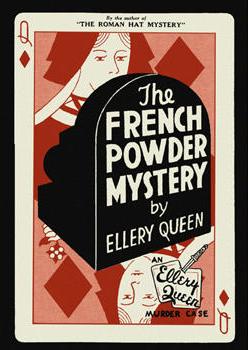
The French Powder Mystery
- Автор: Куин (Квин) Эллери
- Серия: Ellery Queen #2
- Год: 1930
- Язык: английский
- Год: Frederick A. Stokes
- Жанр: Классические детективы

Электронная книга - «The French Powder Mystery». Краткое содержание книги:
“Well, that tallies nicely,” said Queen, with a grin. “Because Mr. Zorn was here not long ago and told us about your meeting at the Penny Club.”
“Really?” Gray smiled. “Then I gather there is little left to be said, Inspector.”
“Not quite, Mr. Gray.” The Inspector clucked cheerfully. “You see, just to keep the record straight — how did you spend the rest of the evening?”
“Oh! In a commonplace manner, sir. I left the club at about eleven and walked home — I live not far from there, on Madison Avenue. Simply went home and to bed.”
“You live alone, Mr. Gray?”
Gray grimaced. “Unfortunately, being a misogynist, I have no family, Inspector. An old servant keeps house for me — I live in an apartment hotel, you know.”
“Then your housekeeper was up when you returned from the club, Mr. Gray?”
Gray spread his hands briefly. “No. Hilda had left on Saturday evening to visit a sick brother in Jersey City, and did not get back until Tuesday afternoon.”
“I see.” The Inspector took snuff. “But surely someone saw you get home, Mr. Gray?”
Gray looked startled, then he smiled again one of his twinkling smiles. “Oh, you want me to establish my — alibi, is it, Inspector?”
“That’s what it’s called, sir.”
“Then there’s nothing more to be said,” replied Gray happily. “Because Jackson, the night-clerk, saw me when I entered the building. I asked for mail and stood chatting with him for several minutes. Then I took the elevator to my suite.”
The Inspector’s face brightened. “Then really,” he said, “there is nothing more to be said. Except—” his face lengthened momentarily — “what time was it when you stopped talking with this night-clerk and went upstairs?”
“Just eleven-forty. I remember glancing at the clock above Jackson’s desk to compare it with my own watch.”
“And where is your hotel, Mr. Gray?”
“Madison and 37th, Inspector. The Burton.”
“Then I think — Unless, Ellery, you would like to ask Mr. Gray a question or two?”
The aged little director turned quickly, in open surprise. He had forgotten the presence of Ellery, who was sitting quietly in his corner listening to the conversation. Gray looked expectant as Ellery smiled.
“Thank you, dad — I have something to ask Mr. Gray, if we’re not keeping him too long?” He looked questioningly at their visitor.
Gray expostulated. “Not at all, Mr. Queen. Anything I can do to help you—”
“Very well, then.” Ellery hoisted his lean length from the chair and stretched his muscles. “Mr. Gray, I’m going to ask you a peculiar question. I rely upon your discretion to preserve silence, for one thing, and upon your undoubted loyalty to Mr. French and your concern in his bereavement to answer frankly.”
“I’m entirely at your service.”
“Let me present a hypothetical case,” continued Ellery rapidly. “Let us suppose that Bernice Carmody was a drug addict...”
Gray frowned. “A drug addict?”
“Exactly. And let us suppose further that neither her mother nor her stepfather suspected her malady and condition. Then let us suppose that Mrs. French suddenly discovered the truth...”
“I see, I see,” murmured Gray.
“The hypothetical question arising from this hypothetical case is: What do you think Mrs. French would do?” Ellery lit a cigaret.
Gray grew thoughtful. Then he looked into Ellery’s eyes. “The first thing that occurs to me, Mr. Queen,” he said simply, “is that Mrs. French would not confide in Cyrus.”
“That’s interesting. You know them both so well...”
“Yes.” Gray set his small wrinkled jaw. “Cyrus has been a lifelong friend. I know — or knew — Mrs. French perhaps as well as anyone acquainted with the French family. And I am certain, familiar as I am with Cyrus’s character and Mrs. French’s knowledge of his character, that she would not dare to tell him such a thing. She would keep it strictly to herself. She might possibly inform Carmody, her first husband...”
“We needn’t go into that, Mr. Gray,” said Ellery. “But why would she keep it a secret from French?”
“Because,” said Gray frankly, “Cyrus is hypersensitive on the subject of vice, particularly drug addiction. You must remember that most of his latter years have been devoted to wiping out as much of this sort of vice in the city as possible. To find it in his own family would, I firmly believe, unbalance him... But, of course,” he added quickly, “he doesn’t know; I’m positive Mrs. French would keep a thing like that to herself. She might try to cure the girl secretly, perhaps...”
Ellery said clearly: “One of the major reasons for Mrs. French’s silence in a case like this would be, I suppose, that she was aiming to secure for her daughter a generous slice of her husband’s fortune?”
Gray started uncomfortably. “Well... I don’t... Yes, if you must have the truth, I think that is so. Mrs. French was a calculating — not necessarily unscrupulous, mind you — but a calculating and very practical woman. I believe that, motherlike, she was determined that Bernice come in for a good share of Cyrus’s estate when Cyrus should pass on... Is there anything else, Mr. Queen?”
“That is,” said Ellery, smiling, “quite sufficient. Thank you immeasurably, Mr. Gray.”
“Then,” said the Inspector, “that will be all.”
Gray looked relieved, accepted his coat, hat and gloves from Djuna, murmured polite adieux, and left.
The Inspector and Ellery heard his light quick step on the staircase as he descended to the street.
36
“The Time Has Come...”
The Queens had dinner in silence. Djuna served in silence, and in silence cleared the table afterward. The Inspector dipped into the browned interior of his snuff-box and Ellery held communion with first a cigaret, then a pipe, then a cigaret again. In all this time no word was spoken. It was a silence of sympathy, not infrequent in the Queen household.
Finally Ellery sighed and stared into the fireplace. But it was the Inspector who spoke first.
“As far as I am concerned,” he said with a grim disappointment, “this day has been entirely wasted.”
Ellery raised his eyebrows. “Dad, dad, you grow more irascible with every passing day... If I didn’t know how upset and overworked you’ve been of late, I’d be annoyed with you.”
“At my obtuseness?” demanded the Inspector, twinkling.
“No, at the lapse of your usual mental vigor.” Ellery twisted his head and grinned at his father. “Do you mean to say that today’s incidents have meant nothing to you?”
“The raid flat, Springer skipped, nothing tangible from the alibis of these people — I can’t see any cause for celebration,” retorted the Inspector.
“Well, well!” Ellery frowned. Perhaps I’m oversanguine... But the whole thing is so clear!”
He sprang to his feet and began to rummage in his desk. He produced his voluminous sheets of notes and thumbed rapidly through them under the Inspector’s wearied and bewildered eyes. Then he slapped them back into their receptacle.
“It’s all over,” he announced, “all over but the shouting and — the proof. I have all the threads — or rather, all the threads which lead inexorably to the murderer of Mrs. French. They don’t make solid proof, such as is demanded by our venerable courts of law and our prosecuting system. What would you do in a case like that, dad?”