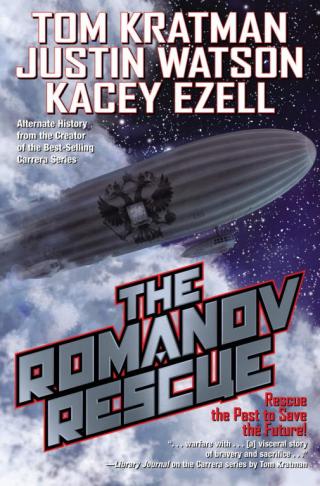
The Romanov Rescue
- Автор: Кратман Том, Watson Justin
- Год: 2021
- Язык: английский
- Год: Baen
- ISBN: 978-1-9821-2570-7
- Жанр: Альтернативная история

Электронная книга - «The Romanov Rescue». Краткое содержание книги:
As WWI comes to a close a German general, an escaped prisoner of war, and the crew of an airship converge to effect THE ROMANOV RESCUE. Can there be a world without communism?
Mankind’s history is bound up in the fabric of fate, a strong cloth, tough and closely woven.
It is the beginning of 1918, the last year of the greatest war in human history, to date. All the belligerents stagger on their feet. Starvation is an ever present reality, while disease waits in the wings. In Russia, no longer a belligerent but, instead, rapidly descending into civil war and chaos, a lone family—Father, Mother, four beautiful young girls, and a brave but sickly boy—await their own fate, shivering and hungry in the dark, hoping and praying for salvation.
Their relatives in England have turned their backs. The guards set over them do little but torment them. They look Heavenward, but God doesn’t answer. They know they’re a threat to the new regime, a threat that will, in time, be eliminated.
But even the strongest fabric has flaws. An escaped prisoner of war, caught, injured, and punished, but still highly capable, might be one. An airship, returned and at loose ends after a failed mission to Africa might be another. A German general, taking a wrong turn on his nightly walk and suddenly coming face to face with the reality of the monster rising in the east, would be a third.
Follow, then, as the general gives the orders, the prisoner of war raises the men from among his fellows, and the airship launches itself forward, to contest fate, to tear the fabric of time, and to effect The Romanov Rescue.
About the Carrera series:
“You obviously did the best you could with a terrible situation,” Kobylinsky said, his voice much firmer than Chekov had ever heard it. The incident seemed to have put some fire back in the man. “You are to be commended.”
Matveev glanced sideways at the colonel but said nothing.
“Indeed,” Nicholas said, standing up. “Feldfebel, I have misjudged you. You are, indeed, every inch the hero your war record indicates you are. I am deeply in your debt. If there is anything within my diminished power that I can do to repay you, I will.”
The former emperor thrust his right hand out at Chekov. Chekov looked at the hand, then into Nicholas’s eyes for a long moment before he grasped his outstretched hand and shook once, firmly, before letting go.
A tall, thickset man with graying brown hair receding from a widow’s peak, a beard just long enough to curl at the chin, and round spectacles walked into the study.
“Well, Yevgenny,” Nicholas said to the newcomer. “How is our other hero?”
“I set his nose as best I could. He’s likely to have noticeable scarring but he shan’t be horribly disfigured,” Dr. Botkin said. “I gave him something for the pain. I also gave Olga a mild sedative, she was very upset by the disturbance.”
“Yes,” Nicholas murmured. “My eldest has always been very sensitive.”
Tatiana made eye contact with Chekov then for first time since entering the study. The sadness and terror in the girl’s face pierced Chekov’s heart, but he clamped down on the emotion.
I killed the bastard who did it. I’m not sure what else I could’ve done.
“Very well, gentlemen,” Nicholas said. “If there is nothing else you need of us, Tatiana and I shall go speak with the rest of the family.”
“Nothing else,” Matveev said. “Thank you, Citizen Romanov. Chekov, I want to see you and Dostovalov downstairs in my office.”
Once Dostovalov joined them, face covered by thick white bandages and his eyes hazy from narcotic effect, Matveev shut the door to his office and regarded the two soldiers with a grave expression on his round face.
“Lads, you did the right thing,” he said. “But I have to tell you I’m a little worried about your relationships with the Romanovs.”
“How’s that, Comrade?” Chekov said, frowning.
“Look, men, there are rumblings the Imperialists may try to take the Romanovs,” Matveev said. “The Central Committee is sending a new commissar to take charge here, and if you are caught fraternizing with the Romanovs, they may assume you will be a liability in the event of a rescue attempt.”
To Chekov’s relief, Dostovalov said nothing in response, but his eyes, though hazy from morphine, narrowed.
“We understand, Comrade Ensign,” Chekov said.
Matveev shook his head.
“I’m not sure you do, Chekov,” he said. “The new commissar will have the authority to summarily execute men for counterrevolutionary activities—no trial. Get in his way and I will not be able to save you. If you cling to the Romanovs, you will likely be buried with them.”
“This isn’t right,” Dostovalov said. Chekov glared at him, but Matveev nodded.
“It isn’t right,” he said. “But it is nonetheless.”
Interlude
Tatiana: Olga is indisposed
Olga woke late into the next day, disoriented and confused. I had brought up her meals and helped her bathe and change while Maria helped Madame Hendrikova take care of Mama, and Anastasia helped Madame Schneider with Alexei.
My sister stared at the bruises on her wrists as if she didn’t know how they got there. Her hands were shaking too badly when she tried, so I had to button up the sleeves for her. For a moment I thought she would break into tears but she didn’t.
I mixed some of Mama’s medicine into her tea, made her drink it, and tucked her back into bed. She nodded and closed her eyes.
And so it went for the next few days. I did her chores, giving her apologies to Mama and Papa who came to see her, but thankfully she was asleep both times.
Mama returned to painting little icons on paper to send as thank you notes to the people of Tobolsk who had sent us food, while my father received a guest. An old staff member, a monarchist from Petrograd arrived. He brought books and tea and also delivered clothes that Mama’s best friend, Anna Vyrubova, had sent.
I wasn’t supposed to know, but a gift of twenty-five thousand rubles also arrived. Papa used the money to pay the servants who had stayed on without pay. He meant for them to use it to pay for their way back home out of Tobolsk and gave the money to Prince Dolgorukov to distribute in secret. I overheard him say that it wouldn’t be enough, but that he’d see it done.
After dinner while Papa read from a book that Madame Tolstay had sent us, I slipped out to find Chekov. He was standing outside the guard house smoking a cigarette. I gave him a look and he frowned back at me, but put out the cigarette and followed me into the kitchen.
He looked over his shoulder as he took his cap off. As always he kept as far away from me as possible.
I reached into the pocket of my apron and pulled out a strand of pearls. Mama had a matching set made for each of us girls.
“See what you can get for this, please.”
I thrust my hand out at him but he didn’t move. He just stared at me, at my hand, at the pearls.
Finally I set them down on the table between us.
He approached with enough caution to make me think he wasn’t seeing a necklace at all, but perhaps a snake.
Chekov picked the pearls up and ran a dirty thumb across them. It was almost obscene, the way he caressed them, but when he looked up I didn’t see greed.
“You’d trust me with these?” he asked.
Didn’t he realize how much power he already had over our lives?
I gave him a nod. What else could I do?
“There’s something I want to tell you,” I said to him. “Something I need to tell you.
“You’ve always treated me as if I were very innocent. Oh, yes, surely, I am. But I think you have no idea just how innocent we all are.
“Once, when Olga and I were serving as nurses for the wounded—oh, yes, we did, and Mama, too—we decided to go into a store when our shift was over. We’d never been in a store in our lives, you see, not even once, either of us. So we went in and looked and, oh, it was wonderful. The choices people could make, choices neither of us had ever been able to.
“But then we realized it took money to make those choices and, not only didn’t we have any with us, we’d never even used money in our lives. Neither of us had the first, tiniest clue of how money even worked.
“In that moment I realized that, wherever we lived, however we lived, in this one way, at least, we were poorer than the poorest citizens of the empire. We were simply so ignorant.”
Chapter Twelve
Barquentine Loredana, Black Sea
Natalya was the de facto skipper of the ship now. A bright lass, she’d paid close attention to ship’s handling and seamanship under Vraciu. Whatever his myriad other failings, Bogdan Vraciu had been a competent seaman. Now, the crew followed her orders, those orders backed up by the frightfully ruthless set of Russian demons striding the decks.
Progress wasn’t appreciably slower under the reduced crew than it had been with a full crew, at least it wasn’t after Mokrenko clubbed one of them with a belaying pin and tossed his body to the deep. After that, little Natalya’s commands were obeyed with stunning promptness. Notwithstanding this, though, the moon had set just after ten in the morning. It was, if calm, the most pitch-black night Mokrenko could even remember.