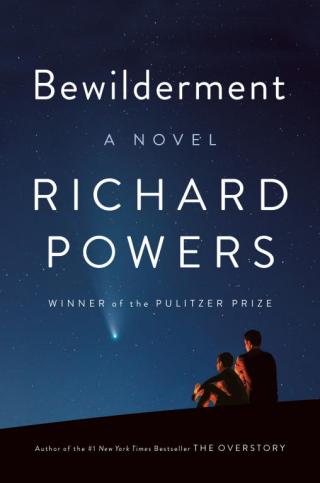
Bewilderment
- Автор: Powers Richard
- Год: 2021
- Язык: английский
- Год: W. W. Norton & Company
- ISBN: 978-0-39388-114-1
- Жанр: Современная русская и зарубежная проза

Электронная книга - «Bewilderment». Краткое содержание книги:
Longlisted for the 2021 National Book Award for Fiction
A heartrending new novel from the Pulitzer Prize–winning and #1 New York Times best-selling author of The Overstory.
Named one of the Most Anticipated Books of 2021 by Newsweek, Los Angeles Times, New York Magazine, Chicago Tribune, BuzzFeed, BookPage, Goodreads, Literary Hub, The Millions, New Statesman, and Times of London
The astrobiologist Theo Byrne searches for life throughout the cosmos while single-handedly raising his unusual nine-year-old, Robin, following the death of his wife. Robin is a warm, kind boy who spends hours painting elaborate pictures of endangered animals. He’s also about to be expelled from third grade for smashing his friend in the face. As his son grows more troubled, Theo hopes to keep him off psychoactive drugs. He learns of an experimental neurofeedback treatment to bolster Robin’s emotional control, one that involves training the boy on the recorded patterns of his mother’s brain…
With its soaring descriptions of the natural world, its tantalizing vision of life beyond, and its account of a father and son’s ferocious love, Bewilderment marks Richard Powers’s most intimate and moving novel. At its heart lies the question: How can we tell our children the truth about this beautiful, imperiled planet?
Was Mom a Buddhist?
I laughed, and he slugged my arm through two sleeping bags. “Your mother was her own religion. When she said something, it was worth saying. When she spoke, everybody listened. Even me.”
Half a vowel trickled out of him, and he hugged himself. Some large forager snapped twigs on the slope above our tent. Smaller creatures rooted through the leaf layer. Bats mapped the canopy in frequencies beyond our ears. But nothing troubled my son. When Robin was happy, he had all the Four Immeasurables covered.
“She once told me that no matter how much bad stuff she had to deal with during the day, if she said those words before bed, she’d be ready for anything the next morning.”
-
ONE MORE QUESTION, he said. What exactly do you do, again?
“Oh, Robbie. It’s late.”
I’m serious. When somebody at school asks me, what am I supposed to say?
It had been the cause of his suspension, a month before. The son of some banker had asked Robin what I did. Robin had answered, He looks for life in outer space. That made the son of a brand executive ask, How is Redbreast’s Dad like a piece of toilet paper? He circles Uranus, looking for Klingons. Robin went nuts, apparently threatening to kill both boys. These days, that was grounds for expulsion and immediate psychiatric treatment. We got off easy.
“It’s complicated.”
He waved toward the woods above us. We’re not going anywhere.
“I write programs that try to take everything we know about all the systems of any kind of planet—the rocks and volcanoes and oceans, all the physics and chemistry—and put them together to predict what kind of gases might be present in their atmospheres.”
Why?
“Because atmospheres are parts of living processes. The mixes of gases can tell us if the planet is alive.”
Like here?
“Exactly. My programs have even predicted the Earth’s atmosphere at different times in history.”
You can’t predict the past, Dad.
“You can if you don’t know it yet.”
So how do you tell what kind of gases a planet has from a hundred light-years away when you can’t even see it?
I exhaled, changing the atmosphere inside our tent. It had been a long day, and the thing he wanted to know would take ten years of coursework to grasp. But a child’s question was the start of all things. “Okay. Remember atoms?”
Yep. Very small.
“And electrons?”
Very, very small.
“Electrons in an atom can only be in certain energy states. Like they’re on the steps of a staircase. When they change stairs, they absorb or give off energy at specific frequencies. Those frequencies depend on what kind of atom they’re in.”
Crazy stuff. He grinned at the trees above the tent.
“You think that’s crazy? Listen to this. When you look at the spectrum of light from a star, you can see little black lines, at the frequency of those stairsteps. It’s called spectroscopy, and it tells you what atoms are in the star.”
Little black lines. From electrons, a gazillion miles away. Who figured that out?
“We’re a very clever species, we humans.”
He didn’t reply. I figured he’d drifted asleep again—a good end to a fine day. Even the whippoorwill agreed and called it a night. The hush in its wake filled with the bandsaw buzz of insects and the river’s surge.
I must have dropped off, too, because Chester was sitting with his muzzle on my leg, whimpering as Alyssa read to us about the soul recovering radical innocence.
Dad. Dad! I figured it out.
I slipped upward from the net of sleep. “Figured out what, honey?”
In his excitement, he let the endearment slide. Why we can’t hear them.
Half asleep, I had no clue.
What’s the name for rock-eaters, again?
He was still trying to solve the Fermi paradox—how, given all the universe’s time and space, there seemed to be no one out there. He’d held on to the question since our first night in the cabin, looking through our telescope at the Milky Way: Where was everybody?
“Lithotrophs.”
He smacked his forehead. Lithotrophs! Duh. So, say there’s a rocky planet full of lithotrophs, living in solid rock. You see the problem?
“Not yet.”
Dad, come on! Or maybe they live in liquid methane or whatever. They’re super-slow, almost frozen solid. Their days are like our centuries. What if their messages take too long for us to even know that they’re messages? Like maybe it takes fifty of our years for them to send two syllables.
Our whippoorwill started up again, far away. In my head, Chester, infinitely long-suffering, was still struggling with Yeats.
“It’s a great idea, Robbie.”
And maybe there’s a water world, where these super-smart, super-fast bird-fish are zooming around, trying to get our attention.
“But they’re sending too fast for us to understand.”
Exactly! We should try listening at different speeds.
“Your mother loves you, Robbie. You know that?” It was our little code, and he abided it. But it did nothing to calm his excitement.
At least tell the SETI listeners, okay?
“I will.”
His next words woke me again. A minute, three seconds, half an hour later: Who knew how long?
Remember how she used to say: “How rich are you, little boy?”
“I remember.”
He held up his hands to the moonlit mountain evidence. The wind-bent trees. The roar of the nearby river. The electrons tumbling down the staircase of their atoms in this singular atmosphere. His face, in the dark, struggled for accuracy. This rich. That’s how rich.
-
WHEN HE FINALLY LET ME SLEEP, I couldn’t. The two of us were doing fine, camping in the woods with a few cooked beans and a sketchbook. But the minute we returned to civilization, I’d be neck-deep in work and Robin would be back in a school he hated, surrounded by kids he couldn’t help spooking. Eden would be clear-cut again, back in Madison.
Everything about parenting terrified me, long before the day Alyssa burst into my office in Sterling Hall and shouted, “Ready or not, Professor—company’s coming!” I hugged her, to an ovation from my amused colleagues. But that was the last time I executed my paternal responsibilities with unambiguous success.
I could no more raise a child than I could speak Swahili. The prospect terrified Alyssa, too, in her own ecstatic way. But somehow the collective wisdom of family, friends, doctors, nurses, and Internet advice sites sufficiently emboldened us to ignore everyone and muddle through on our own best guesses. Tens of thousands of generations of clueless humans had managed to work out the kinks in child rearing well enough to keep the game in play. We wouldn’t be the worst, I figured. As it turned out, Alyssa and I never had time to keep our parenting score. Life became a fire drill from the moment Robin came out of the incubator.
But it turns out children have a tolerance for mistakes that I never imagined. Who’d have believed a four-year-old could pull a grill full of hot charcoal down onto himself and walk away with no lasting harm beyond a brand like a shiny pink oyster on his lower back?