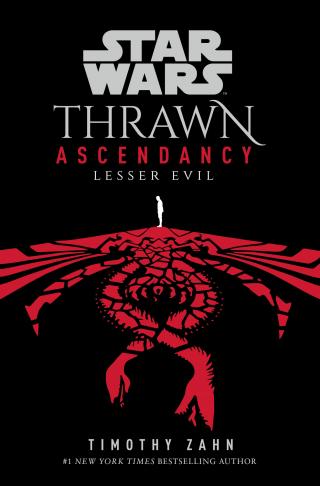
Thrawn Ascendancy Book 3: Lesser Evil
- Автор: Зан Тимоти
- Год: 2021
- Язык: английский
- Год: Random House
- ISBN: 9781473596580
- Жанр: Боевая фантастика

Электронная книга - «Thrawn Ascendancy Book 3: Lesser Evil». Краткое содержание книги:
“Obviously, the aliens didn’t know much about you,” Ba’kif commented.
“No, their knowledge of the Chiss was quite limited,” Thrawn said, apparently missing the subtle compliment completely. “What intrigued me was the fact that the feigned attack was already in progress when we emerged from hyperspace. That suggested to me that the aliens had a way of predicting when and where a ship would arrive.”
Ba’kif looked over at the skeletal artifact, an odd tightness settling into the pit of his stomach. “And this is what allowed them to do that?”
“We believe so, yes,” Thrawn said. “The lattice was built into the space between the freighter’s inner and outer hulls and was attached to the equipment boxes via those cables.”
Ba’kif nodded as he belatedly spotted the rolling tables off to the side with oddly shaped boxes and neatly coiled wires resting on them. “Was the entire lattice like this?” he asked.
“The parts we were able to investigate were,” Thrawn said. “Unfortunately, the time we had to devote to our analysis was severely limited.”
“Any idea how much warning the device gives before the incoming ship arrives?” Ba’kif asked.
“Based on the state of the false attack as it appeared to us, I estimate they had at least ninety seconds to prepare,” Thrawn said. “Possibly more.”
“Ninety seconds,” Ba’kif murmured, his mind spinning with the possibilities. Put a couple of picket ships equipped with such early-warning devices in orbit at the combat edge of each Chiss world, and sneak attacks would be all but impossible.
Even better, if the lattice could detect all ships moving through hyperspace even if those vessels weren’t preparing to return to space-normal, the Defense Force could monitor the most common lanes through the Ascendancy. And if the device could not only detect passing vessels but also give an estimate of how many were involved …
“Easy, Supreme General,” Lamiov warned.
Ba’kif blinked away the string of thought. “What?”
“I know that look,” Lamiov said. “I’m bound to caution you that just because we have one of these devices doesn’t mean we’ll be able to reverse-engineer it.”
“I know,” Ba’kif said, his excitement fading somewhat. So far both of Thrawn’s major contributions to Vault Four—the Vagaari gravity-well generator and the Republic advanced shield technology—had resisted the UAG’s best efforts to tease out their secrets. Ba’kif had no doubt that, sooner or later, the Ascendancy’s techs would succeed, but it was clearly going to continue to be an uphill climb.
Unfortunately, there was no reason to believe this advance-warning detector would deviate from that pattern.
“I just wish I knew why every item the Defense Force could find an immediate use for takes forever to crack,” Ba’kif added.
“That does seem to be the way of the universe, doesn’t it?” Lamiov conceded. “That high-density electronics memory unit that was brought to us a hundred years ago was being utilized in questis storage bars within twelve months. The specialized cooking system someone found thirty years ago was on the market in five months.”
“But something that could upgrade a warship’s electrostatic barrier defenses by a thousand percent or more …” Ba’kif shook his head.
“Perhaps we’ll have better luck with this one,” Lamiov said, nodding to the lattice. “It’s a shame you couldn’t bring back the entire freighter.” He raised his eyebrows slightly in silent question.
“Yes,” Thrawn said simply. Either he’d missed the invitation in the Patriarch’s tone and expression, or he’d already decided not to provide any further details about what had happened to the freighter.
“We removed what appeared to be all of the equipment, plus as much of the lattice as we could,” Samakro added, also ignoring the unstated request. “Hopefully, it will be enough for you to work with.”
“We’ll do our best,” Lamiov assured him. “Is there anything more the techs should know?”
“I don’t believe so,” Thrawn said. “Mid Captain?”
“Nothing major that I can think of,” Samakro said. “I’ll note in passing that even though the freighter was part of an ambush, and therefore might be considered a type of warship, its hull was standard civilian design. No nyix, not even a nyix-alloy inner shell.”
“That could be significant,” Lamiov said.
“It could,” Samakro said. “My inclination is to put it down to the designers preferring to maintain the freighter illusion, and that it has nothing to do with the detector itself.”
“Probably,” Ba’kif agreed, his thoughts heading off in a new direction. Still, nyix had some unique characteristics, which was one reason it worked so well for warship hulls. If one or more of those features interfered with the advance-warning detector, that might provide some clues as to how the device worked.
“Regardless, I’ll make the techs aware of that,” Lamiov said. “And now, I believe the Council is expecting you on Csilla.”
“Yes,” Thrawn said. “But before we leave, Supreme General, I request your presence aboard the Springhawk. There’s another situation we need to discuss.”
“Can it wait?” Ba’kif asked.
Thrawn and Samakro exchanged looks. “Yes, sir, I suppose it can,” Thrawn said reluctantly. “For a time.”
“Then it waits,” Ba’kif said firmly. “I have only a few hours to discuss some pressing matters with Patriarch Lamiov before I also have to return. And as the Patriarch said, the Springhawk is already overdue back at Csilla for examination and whatever refitting and rearming are necessary.”
He raised his eyebrows toward Samakro. “At which point you, Mid Captain, are on my list of officers to speak with about the Hoxim incident. You’ll have until then to prepare your statement and organize any documents you might wish entered into the record.”
“Understood, Supreme General,” Samakro said. “Though if I may—” He glanced at Thrawn. “—I would urge you not to delay your trip to the Springhawk any longer than necessary.”
“I’ll take your suggestion under advisement,” Ba’kif said, frowning. Samakro’s expression was the standard neutral of an officer addressing a superior.
But there was also an unusually strong layer of tension beneath it. Whatever Thrawn wanted to discuss with Ba’kif, Samakro wasn’t looking forward to the conversation.
Even with that added level of intrigue, though, it would have to wait. Right now, Hoxim and its fallout were Ba’kif’s priority.
“I’ll see you back at Csilla, then,” he said, gesturing the two officers back toward the vault door. “Get started on the refit, and I’ll call when I’m ready for your interviews.”
CHAPTER ONE
The Vigilant was three minutes from its destination, and Admiral Ar’alani was starting to wonder if her ship would be ready when they arrived when Senior Captain Kiwu’tro’owmis finally returned to the bridge. “Sorry about the delay, Admiral,” Wutroow said as she crossed to Ar’alani’s command chair. “Breacher One really didn’t want to be fixed. But we persuaded it.”
Ar’alani looked over at the weapons status board. The number one breacher missile launcher still showed red … flicked to green. “Excellent,” she told Wutroow. “Be sure to log a commendation to the repair team. It’s never a good idea to head into a situation with one hand stuck in your pocket.”