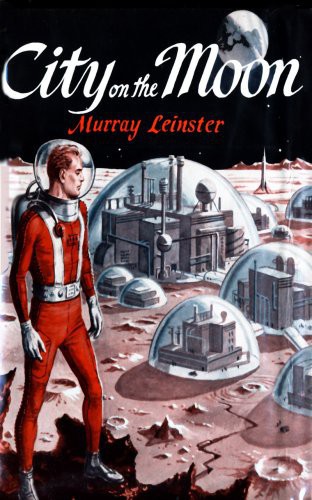
City on the Moon
- Автор: Лейнстер Мюррей
- Серия: To the Stars #3
- Язык: английский
- Жанр: Научная фантастика

Электронная книга - «City on the Moon». Краткое содержание книги:
"Excellent," said Moreau gravely. "It is most promising!"
CHAPTER IV. ARELENE GRAY
KENMORE crowded into the small airlock. Moreau followed to its outer door and grasped the outer catch. But when Kenmore closed the inner seal so that the outer could open again, Moreau was taken unaware. The lock-door swung open; he lost balance, and it slammed shut again. Its cycle would be automatic; it was locked until the inner door was opened and closed again.
The jeep started off instantly, and Moreau was left dangling on the ladder. He swore violently in his own language and banged on the lock as the speed of the jeep increased. There would be other bangings audible to Joe Kenmore, inside. The dented wheel made a rhythmic bumping at each revolution. The speed increased yet more, and Moreau swore still more violently. He banged in a pattern: three deliberate bangs, three quick ones, and three deliberate ones. SOS. He repeated it.
The jeep hit its maximum speed of forty miles an hour over the undulating, dust-covered sea-surface. The earthshine made it look like a snowfield, save that the jeep's wheels splashed up the whitish stuff like a liquid. With no air to scatter its particles, the stuff settled down again, slowly, also like a liquid. The jeep left twin, nonspreading wakes behind its wheels; they looked like double furrows, slowly subsiding behind.
Moreau achieved unsuspected eloquence in his profanity as he was flung about. To fall, now, might mean to be thrown beneath those giant wheels. In any event, to walk back to the City was hardly practical, and might be impossible. With no lights to guide him, and only the ramparts of the Apennines for markers, he could pass the City by without seeing it. And he had not topped his air tanks lately.
Moreau hung by one hand and both feet to the whipping rope ladder. He fumbled behind his shoulder and brought out a signal rocket. He tapped off its guard cap against the solid, wildly swaying cabin overhead, and squeezed the rocket's tail when he thought he had it aimed just right. It erupted lurid, red sparks and leaped out of his hand. It struck the ground, bounced up, and bounced again. It flew ahead of the jeep; Kenmore could not possibly fail to see it and be reminded of Moreau's existence.
The jeep slowed to a stop, and its inner lock-door clanked. Moreau heard it when his helmet pressed against the outer one. He opened the outer door, crawled inside, and thankfully shut the outer door behind him.
The jeep was already in motion again when he wormed himself up into the cabin. Then emotion overcame him. He took off his helmet and expressed himself at furious length—but unintelligibly to Joe Kenmore.
"I'm sorry," said Kenmore tonelessly, when he was out of breath. "I heard the lock and thought you were inside. Then I stopped thinking about you. I'm trying to think straight, and it's not easy. Arlene is down somewhere on the moon. With luck, she may be out here. But if the ship came down in the Apennines . . ."
His voice cut off with a click. He drove, staring out where the rays of the jeep's lights brightened the surface. But he could not see far; the surface of the Mare Imbrium here was almost perfectly level, the horizon two miles away. Moreover, earthlight on the moon—like moonlight on the Earth—is vastly deceptive, If the Earthship was down on the Mare Imbrium, it would show up by daylight, true—but daylight was a hundred and fifty hours away. The ship had to be found now!
So Kenmore drove straight ahead, staring desperately to either side, until he was sure he'd gone past where he'd seen the light. Then he drove out . . .
He made circles. He made loops. He tried frantically to organize his efforts; yet when it came time to make a turn, he felt desperately certain that if he only kept on a little farther . . .
And over and above his own and Arlene's disaster, there was a greater one in prospect—even for them. Because Civilian City and the Space Laboratory were, after all, the ultimate strivings of civilization to make itself secure and strong, and to establish a new dynamism in the overall activity of humankind. War would end all civilization, but war was impossible only because of the missile bases on the moon. So long as they stood, the world and humankind was safe from its own folly, because they were in hands which recognized war as a form of suicide and would not permit it.
But there had been one man in the City who knew the position of the nearest missile base. Directions for reaching it had been entrusted to him—directions tightly sealed, for use only in the direst of emergencies. That man had panicked and opened the sealed memorandum; now he led the City's population to a missile base which could not possibly shelter all the refugees. Presently, there would be citizens of the City in each of the missile bases.
Some of the refugees could know and remember their locations—which would thereupon no longer be secret. Then it would be possible for someone to send up pods of bombing rockets, radar-masked, to blast the defenders of the world's peace and all its hopes. Once that happened, the Space Laboratory would hold no more promise, and Earth would soon be racked with war.
But Kenmore put these facts and speculations aside. Arlene was somewhere on the moon.
After a long time, Moreau heard him trying to swallow. His throat made sounds, but his swallowing apparatus did not work. "It—couldn't have been more than twenty miles out," he said. "We saw it, only I didn't notice the bearing. It's good astrogation to land on the dark side of the moon, within twenty miles of one's target, when there's no ground-radar to help. It's too good to expect, but it's not too much to hope for . . ."
Moreau said detachedly, "You feel frustrated, Joe— the way I did when I could not make you notice my bangings on the airlock. Ha! I used a signal rocket to catch your attention!"
Kenmore was tense and strained past endurance. He said violently, "We fire signal rockets! Now!"
He plucked at the cover of the firing buttons for the signal rockets mounted in the jeep-cabin roof. Moreau said, "Wait until I climb to where I can look out of the observation-blister!"
He went behind the driver's seat, up the cleats on the wall. Moreau stared out of the ceiling port, which was shaped like a goldfish bowl and presented direct vision to the sides and the rear, as well as above and ahead. Kenmore brought the jeep to a halt.
His hand shook as he stabbed a firing button. There was a growling, and then silence. In Kenmore's eyes the powdery surface of the lava sea took on a reddish tint. Signal rockets for moon use leave a long-lasting trail of red fire, because a line of light is always artificial, and really vivid red is the rarest color among stars. It shows best against the lunar sky.
The signal rocket went away and up and up. It rose much faster than one shot from Earth, and many times higher; but it would not reach to the top of the Apennines against the horizon.
The jeep was still; Kenmore heard his own harsh breathing. The signal rocket dwindled and dwindled ... It went out.
Five minutes later a thread of red light rose from below the horizon to the north.
"Take bearings!" said Moreau urgently. "Joe, take bearings!"
Kenmore took a bearing; his hands shook. He fired two more signal rockets, branching away from each other, in conventional acknowledgment that the previous signal had been seen. Then the jeep swung into its highest speed, bumping over the Mare Imbrium.
It was a long way, and to Kenmore it seemed a longer time. Once again a signal rocket rose. It seemed to be a call for haste, and Kenmore's heart was pumping; he could not seem to go fast enough. He said jerkily, "I've half a mind to dump the load we're carrying!"