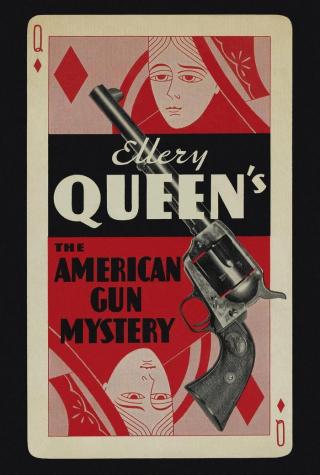
The American Gun Mystery (Death At the Rodeo)
- Автор: Куин (Квин) Эллери
- Серия: Ellery Queen #6
- Год: 1933
- Язык: английский
- Год: Frederick A. Stokes Company
- Жанр: Классические детективы

Электронная книга - «The American Gun Mystery (Death At the Rodeo)». Краткое содержание книги:
I threw up my hands.
“Shall I stop?” asked Ellery.
“Lord, no! I’m just genuflecting to the god of reason. If you stop now I’ll brain you. Go on, for heaven’s sake.”
He looked embarrassed. “I shall stop,” he said sternly, “if you spout any more bilgewater like that... Where was I? Yes! The next question was inevitable: Why had Buck Horne secretly re-engaged his old-time double to take his place in the rodeo performance without mentioning it to either Grant or Kit? — for their stupefaction and grief at sight of Horne’s supposedly dead body could not have been anything but genuine. Well, there are two innocent reasons conceivable: one, that Buck had become suddenly ill, or worse; that he did not wish to disappoint his audience, and furthermore was too proud to confess his condition to Kit, to his best friend Grant, or to Mars the promoter; or two, that his performance included some feat or feats which Buck was unable to perform. But Buck had not become suddenly ill; he had been examined by the rodeo doctor the day of the performance and pronounced fit, according to Kit Horne and the doctor himself. Had he possibly taken ill between the doctor’s examination and the performance itself? This would mean that he would have had to arrange for the deception on the spur of the moment, very shortly before the performance. Yet everything indicated that the deception was planned not the day of the performance, but the day before. For one thing, he had had a mysterious visitor to his hotel room the previous night. For another, he had withdrawn from his bank the previous day most of his balance. It seemed fairly clear that he had, then, called in his double the night before the opening, and turned over to this man one of the twin guns plus a payment for the man’s services — all of the three thousand dollars which Horne withdrew that very day, or part. His clothes, too, in all probability — remember Grant said that at the last rehearsal before the opening Buck had performed not in costume, despite the fact that all the others were in costume... The fact that everything was planned at least a day in advance of the doctor’s examination eliminated the theory that the double had been engaged because Horne was taken ill after the examination.”
“Sounds reasonable,” I muttered.
“Is reasonable. Now, as for Buck’s routine during the show being too difficult for him — just as untenable. The last rehearsal was held the afternoon of the opening and it was unquestionably Horne himself who performed. Why do I say that Horne himself was at the rehearsal, not the double? Well, he had actually spoken to many intimates that afternoon: Woody, Grant, Kit — who no matter how remarkable the double’s resemblance would not have been deceived in any prolonged tête-a-tête conversation. For another, he had actually written out a check, before Grant’s eyes, immediately after the rehearsal, Grant cashing it for him; and I found that the check had been passed through the bank. The signature, ipso facto, then, was genuine; from all these things it was apparent that it must have been Horne himself who went through the rehearsal. But since a rehearsal is a duplicate of the real thing, and since Horne went through the rehearsal without a hitch, as Grant and Curly both testified, then obviously there was nothing in the performance beyond Horne’s capacity.
“Now, if Buck hadn’t taken ill suddenly, and there was nothing in his rodeo routine which he could not, or was afraid to, do — why had he summoned his old movie double out of the past and paid the man to substitute for him? Even aside from that — why, when his double was murdered, didn’t Horne come forward and reveal himself, offering an explanation and his services to the police? If he were innocent of implication in the crime, he would feel dutybound to come forward.
“Two explanations came to mind for Horne’s not coming forward — providing he were innocent. The first is that he had an enemy of whose intentions he was aware in advance, that he hired the double to take his place, knowing that an attempt would be made on his life and thereby offering up the double as a sort of sacrifice; that after the murder he refrained from coming forward to insure his continued safety, since as long as Horne’s enemy believed Horne dead, Horne was secure. But in this case, wouldn’t Horne have managed to notify his own closest kin, Kit, or his best friend, secretly? This was one of the reasons that prompted me to insist upon Grant’s and Kit’s being watched every moment, their letters intercepted and read, and their phones tapped. But nothing came of it — no message from Horne, as far as could humanly be discovered. The apparent failure of Horne to get in touch with his foster-daughter or friend made me discard the theory of a voluntary disappearance because of a known enemy; and suggested the only other possible theory of innocence that would account for Horne’s disappearance and the death of a man taken to be Horne. That was that on the eve of the opening Horne had been kidnaped by his enemy or enemies, that Horne’s place had been taken by the double for some purpose unknown; that the double was murdered, either by his own gang or a friend of Horne’s who had somehow discovered the deception. But this was such a loose and unsatisfactory theory, there was so little to bolster it — no communication from the kidnapers, for example, no apparent motive (for if it was to extort money from Horne’s daughter or friends wouldn’t there have been a communication?) — that, although I could not definitely discard the theory as impossible, it was so weak that I could justifiably drop it to work on a more promising tack. At the same time, it was the vague possibility of the truth of this theory or the other that kept me from disclosing what I knew about the dead man; had I done so prematurely, without a definite decision as to the facts, I realized that I might be wrong and might bring about the death of Horne. I could not, of course, foresee the murder of Woody.”
He was silent for a long moment, and from his frown I could see that the entire Woody incident was distasteful to him. I knew how incensed he always became at the blithe practice of detective-story writers who permitted their detectives to sit by being suave and witty while characters fell dead all about them.
He sighed. “At that stage, then, I raised the pertinent question: Since innocent explanations of Horne’s disappearance and the murder of his double were barren, was it possible that Horne himself had killed the double that night? And now I come to the four other major clues which were apparent to me the first night of the investigation. They not only narrowed the field of possibilities but placed upon the murderer two definite qualifications which Horne, if he were the murderer, had to satisfy.
“The first two concerned the topography of the Colosseum amphitheatre, and the nature of the death wound. The arena is the lowest part of the bowl, naturally; even the first tier of seats, the boxes, are higher by ten feet than the floor of the arena. Now the bullet in both murders had penetrated the victims’ torsos, according to Dr. Prouty, on a distinctly downward fine. On the surface this would indicate that the shots in both instances were fired from above — that is to say, from the seats, the audience. But while this, was accepted as verity by everyone concerned, I saw that there was one question which had to be settled before we could say with positiveness that the murderer had shot from above. And that was: What was the exact position of the victim’s body at the instant the bullet pierced his flesh? For the conclusion that the shot came from above would be correct only if the victim’s torso at the instant of the bullet’s entry were in a normally erect position; that is, normally at right angles to the floor — erect on the horse’s back; that is, not slumped forward obliquely or tiled obliquely backward or sideways.”