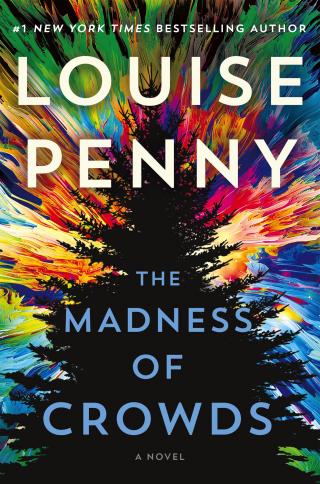
The Madness of Crowds
- Автор: Пенни Луиза
- Серия: Chief Inspector Gamache #17
- Год: 2021
- Язык: английский
- Год: St. Martin's Publishing Group
- ISBN: 9781250145284
- Жанр: Другие детективы

Электронная книга - «The Madness of Crowds». Краткое содержание книги:
You're a coward.
Time and again, as the New Year approaches, that charge is leveled against Armand Gamache.
It starts innocently enough.
While the residents of the Québec village of Three Pines take advantage of the deep snow to ski and toboggan, to drink hot chocolate in the bistro and share meals together, the Chief Inspector finds his holiday with his family interrupted by a simple request.
He's asked to provide security for what promises to be a non-event. A visiting professor of statistics will be giving a lecture at the nearby university.
While he is perplexed as to why the head of homicide for the Sûreté du Québec would be assigned this task, it sounds easy enough. That is, until Gamache starts looking into Professor Abigail Robinson and discovers an agenda so repulsive he begs the university to cancel the lecture.
They refuse, citing academic freedom, and accuse Gamache of censorship and intellectual cowardice. Before long, Professor Robinson's views start seeping into conversations. Spreading and infecting. So that truth and fact, reality and delusion, are so confused it's near impossible to tell them apart.
Discussions become debates, debates become arguments, which turn into fights. As sides are declared, a madness takes hold.
Abigail Robinson promises that if they follow her, ça va bien aller. All will be well. But not, Gamache and his team know, for everyone.
When a murder is committed, it falls to Armand Gamache, his second-in-command Jean-Guy Beauvoir, and their team to investigate the crime as well as this extraordinary popular delusion.
And the madness of crowds.
“You said it’s important.”
Reine-Marie introduced her companions. “This is Myrna Landers. Dr. Landers is—”
“A prominent psychologist, yes, we’ve met,” said Dr. Hague-Yearl, taking Myrna’s hand.
“I’m sorry, I don’t remember.”
“It was at a cocktail party in the library to celebrate the naming of a chair in Women’s Studies,” said Dr. Hague-Yearl. “It’s wonderful to see you again. I’d heard you’d retired to the country but didn’t realize you knew the Gamaches.”
“Neighbors. Friends,” said Myrna.
Reine-Marie introduced Inspector Jean-Guy Beauvoir, of the Sûreté.
“So this’s about the attack on Abigail Robinson at the Université de l’Estrie a few days ago,” said Dr. Hague-Yearl, leading them up to the third floor of the modern building.
“And the murder last night,” said Inspector Beauvoir.
Dr. Hague-Yearl paused in the corridor outside the entrance to the Osler Library. “Murder? Someone killed her?”
It was impossible not to see the mix of disgust at the violence and relief at the victim.
“You haven’t seen the news?” Reine-Marie asked.
“No. I try not to on holiday. What happened?”
“It wasn’t Professor Robinson who was killed,” said Beauvoir. “It was her assistant and friend. A woman named Deborah Schneider.”
They’d paused in front of the closed doors that led into the library.
They were immense, more suited to a fortress than a library. Fifteen feet tall at least, and made of heavy, worn wood. They were in stark contrast to the rest of the concrete-and-glass building.
This was, Beauvoir knew from watching movies late at night, how most horror stories began. With naïve people standing in front of huge, old, locked doors.
How often had he whispered at the screen, Don’t go in, don’t go in?
But of course, they always did.
Dr. Hague-Yearl unlocked the doors, and in they went.
The Asshole Saint sat back in his chair and pressed his bony knuckles against his lips.
Armand had paused the video and lowered the phone. Dr. Gilbert stared past him and out the leaded glass window, to the forest and hills spread out before them.
“Finished, Dr. Gilbert?” The waiter startled Vincent, bringing him back to the present. He looked down at his empty plate.
“Oui.”
When the young man took their dishes away, Vincent Gilbert refocused on Gamache.
But he said nothing. Not because he was waiting for his companion to speak, but because he didn’t know what to say. Where to start.
He opened his mouth, took a deep, deep breath, sighed. Then closed it again.
Finally, when the coffee had been poured, he spoke.
“I was there.”
It was, Armand knew, not said to state the obvious. It was the pause before the leap.
“What I said earlier was true. I didn’t go to her talk with any particular agenda. Certainly not to cause harm.”
Do no harm. For years Armand had thought that the phrase was part of the Hippocratic Oath all doctors swore. It was only recently he learned that wasn’t true at all.
Do no harm was part of Hippocrates’s writing, but from a different text. On epidemics.
“You know what the video shows,” said Gamache. “Not just that you were there.”
“Yes.”
The video that Jean-Guy had discovered, taken by the lighting technician in his booth above the floor of the old gymnasium, showed quite clearly what had happened.
They could see Vincent Gilbert, Canadiens tuque shoved far down his head to hide his identity as much as possible. When the fireworks went off right next to him, he ducked. Clearly surprised.
Then he stood back up and looked at the stage, along with the rest of the crowd, as Gamache calmed them, reassured them it was not gunfire.
And then those telltale few seconds.
The man beside Gilbert raised his arm. Slowly. And in his hand, seen clearly on the video, was a gun.
Everyone else was still staring at the stage. At Gamache.
Except Vincent Gilbert. He was looking at the gun. Then he turned his head, to look at the man holding it.
Aiming it. Taking his time before he pulled the trigger.
And firing.
The Asshole Saint had seen it all. Been close enough to reach out and knock the hand up. So that the shot missed.
“It’s not that you did no harm,” said Armand. “It’s that you did nothing.”
CHAPTER 30
On the drive into Montréal, Reine-Marie and Myrna had talked about the Osler while Jean-Guy drifted in and out of the conversation. Taking in some details.
Basically, what he heard was that the library was named after some long-dead prominent Anglo doctor who had donated his papers and books to McGill more than a century ago.
Blah, blah, blah.
Jean-Guy Beauvoir hadn’t much seen the use of libraries, though he’d never have said that to Annie or her parents, who saw les bibliothèques as sacred places.
He hadn’t grown up going to one, and now, with the internet and easy access to information, he couldn’t imagine why libraries still existed. That is, until he’d gone with Annie and Honoré to a children’s hour at their local library. He’d seen the wonder in his son’s eyes as the librarian read to them.
He’d seen Honoré’s excitement at getting to choose books himself to take out. How he clutched them to his chest, as though he could read with his heart.
Through his infant son, Jean-Guy discovered that libraries held treasures. Not just the written word, but things that couldn’t be seen. Like le Petit Prince said, in the book Jean-Guy had first read as he’d read it to Honoré.
What is essential is invisible to the eye.
Knowledge, ideas, thoughts. Imagination. All invisible. All lived in libraries.
But few knew better than the homicide investigator that not all ideas and thoughts, not everything imagined, should be held tight to the chest.
As the great doors to the great library swung open, Jean-Guy’s jaw actually dropped.
Dr. Mary Hague-Yearl stepped aside so he could take in the soaring ceiling and oak paneling. The tall glass-fronted bookcases and stained-glass windows and quiet corners, and long tables with reading lamps. They’d stepped out of the twenty-first century and into the 1800s.
“Sir William Osler was a McGill grad,” said Dr. Hague-Yearl, leading them through the vast room. “He’s considered the father of modern medicine. This’s been reconstructed from his original library.”
Beauvoir could believe it. It was like walking into a Victorian gentleman’s home.
Dr. Hague-Yearl nodded toward a long oak table.
“If you stay here, I’ll see what I can find on Vincent Gilbert. We should have some documents. He’s quite prominent.”
All three grinned, knowing how annoyed the Asshole Saint would be at the qualifying “quite.” Within minutes they each had a pile in front of them.
“All this?” asked Beauvoir.
“Yes.” Dr. Hague-Yearl seemed surprised herself. “We have some files going back a long way, to his residency. I didn’t bring those, but can if you’d like.”
“Non, merci,” said Beauvoir. “This is more than enough.”
He squirmed on the hard chair and resigned himself to a long, dull afternoon. Though he remained alert. In case something, unseen, emerged from the files.
Isabelle Lacoste had spoken to Dominique and been given a list of staff members.
She’d had a thought.
Édouard Tardif had a son and daughter, Simon and Félicité. They’d been interviewed, along with Tardif’s wife. All had alibis for the day of the event, and could add nothing to the investigation. According to the investigator conducting the interviews, they seemed stunned and naturally upset.