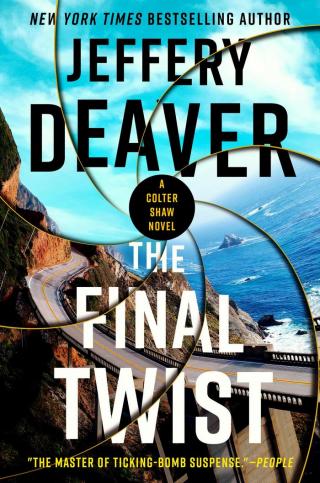
The Final Twist
- Автор: Дивер Джеффри
- Серия: Colter Shaw #3
- Год: 2021
- Язык: английский
- Год: G.P. Putnam's Sons
- ISBN: 978-0-525-53913-1
- Жанр: Триллеры

Электронная книга - «The Final Twist». Краткое содержание книги:
Following the enigmatic clues his father left behind, Shaw plays cat and mouse with the company’s sadistic enforcers, as he speeds from one gritty neighborhood in the City by the Bay to another. Suddenly, the job takes on a frightening urgency: Only by finding the courier bag can he expose the company and stop the murder of an entire family — slated to die in forty-eight hours.
With the help of an unexpected figure from his past, and with the enforcers closing the net, Shaw narrows in on the truth — and learns that the courier bag contains something unexpected: a secret that could only be described as catastrophic.
“All right.”
A variation on “Okay.”
Shaw shrugged. The cuffs jingled.
Barnes asked Connie, “Where?”
She pointed to the end table beside the couch, where she’d sat earlier. “The drawer.”
Barnes jerked his head toward another patrolman, an underling, a short, uniformed cop with a shaved head and the complexion of mixed races. He fit the description of Roman, Tessy’s stalker former boyfriend. The man opened the drawer. “Got something.” After donning blue latex gloves, he removed the bag and set it on the table, near Shaw’s accessories.
The woman’s look of vindication was smug.
“About eight ounces, Quentin,” the woman officer said, eyeing the bag. “Way over felony.”
Barnes sized up Shaw, assessing the offense not of drugs but of failure to cooperate. He nodded to the underling who’d discovered the bag. The officer removed a folding-blade knife and cut a small slit in the top of the bag. From one of the many pockets in his service vest he extracted a small bottle. He broke a liquid capsule inside and added a bit of the white powder. He shook it. There was no color change.
“More,” Barnes said.
The young officer added powder. It still didn’t turn blue or green or red, whatever it was supposed to.
“What?” Connie whispered. Her expression registered a minor Richter number of concern.
Shaw said, “It’s not drugs.”
Barnes asked, “No? What is it?”
“Chalk. I rock climb. This is just a misunderstanding. I appreciate her concern. Drugs are terrible.” He looked into her lovely eyes. “I see why you’d think that, of course, but I’d never have anything to do with narcotics.”
Barnes took the knife and sniffed. He handed the blade back to the other officer. He looked from one to the other. “Whole room,” Barnes ordered. “Search it.”
The others — four cops in total — began searching. They were good. Every place where a four-by-eight-by-two-inch pouch of cocaine could be hidden was examined.
After the dining room came the kitchen then the two bedrooms, the living room. All of the closets, of which there were a fair number, and they were big ones. For a last-minute safe house, it really offered some nice features.
Barnes was frustrated. He snapped, “Dog,” to the patrolman who’d searched Shaw’s wallet.
A moment later the canine made his appearance with a young Latina handler. He was a lithe and focused Malinois, one of the four Belgian herding breeds, the others being the Tervuren, Laekenois and the Belgian sheepdog. The Malinois was smaller and wirier than the German shepherd and had largely taken over law enforcement duties from the latter around the country.
The dog — whose name was Beau or Bo — zipped up and down the floor twitchily. Nose up, nose down, turning corners fast, sticking the lengthy muzzle into cushions and the gap between cabinets. Everywhere.
But he never once sat. Sitting is the signal that police K9s learn to indicate that they’ve found what they were searching for: the drugs, the explosives, the body. They don’t point or bark and they never bring a treasure back to their handler in their eager and powerful jaws.
They sit.
But Beau or Bo didn’t.
Barnes was no longer relaxed. And he definitely wasn’t happy.
The handler gave the dog a dried meat treat. His confirmation that the suite was drug free was as much a win for the muscular animal as if he’d found a thousand pounds of smack.
“Officer Barnes?” Shaw asked.
The man continued to scan the residence, then finally looked toward Shaw. His massive, round face displayed no expression whatsoever. “Yes?”
“In your experience how many people who have CCPs are involved in criminal activity?”
To get a concealed carry permit you undergo an extensive background check. If a criminal past shows up, you’re disqualified. If you can legally carry a sidearm — especially in California, where the requirements are more rigorous than in any other state in the union — that means you’ve been vetted about as well as a civilian can be.
Barnes looked at Connie. “Ms. Ramirez?”
“I’m sorry. I saw the package. I just thought...”
Barnes stepped away to make a radio call. This left Shaw and Connie in the living room, standing near each other. The woman officer with the taut hair was nearby, keeping an eye on them but she was out of earshot.
Shaw whispered, “Here’s the deal, whoever you are. You come back here later. Alone. If you don’t, I give the cop the video of you planting the real drugs in the drawer when I was getting you that tissue. I saw you wipe it, so it may not have your fingerprints on it, but it still has your DNA. Roll you up for felony possession.”
The tears had been real, but a little Tabasco on the fingertips does the same thing as true sorrow or method acting.
“Do you understand?”
Silence. Her lip trembled. A nod.
Barnes and the others returned. The blond male cop took the cuffs off Shaw.
“Chalk,” the big officer muttered. As the men and women in blue left, he added, “You should leave too, Ms. Ramirez.”
“I’m sorry,” she said. “I was worried. All those drugs... I did it for the children.”
Which, Shaw reflected, was rather a nice touch.
62
Shaw opted for an Altamont Beer Works IPA and drank long.
Typically, he’d been cautious about the Maria Vasquez reward offer.
From Teddy Bruin’s starting the conversation with “coincidence” to Mack McKenzie’s assessment — “probably legit” — he had remained wary. There were too many people in the San Francisco area — from a video gaming exec in Silicon Valley to BlackBridge — who were not pleased with his recent visits here.
He was always skeptical of those posting rewards and he generally spent hours, sometimes days, researching the offerors. It was not unheard of, for example, for a murderer to post a reward for the “loved one” they themselves had dispatched, in a numb-headed attempt to appear blameless. Tessy’s disappearance, though, had happened fast. He was no less cautious than on any other job but he didn’t have the luxury of in-depth research. And, if her mother was telling the truth, she could have been in real danger from her abusive ex, Roman.
Of course, the girl’s disappearance and the reward offer turned out to be one hundred percent genuine.
The “dear friend,” though? He just didn’t quite trust that scenario. Why hadn’t Maria given him her name as someone whom Tessy might contact?
So he’d simply ignored the keep-it-between-us plea and called Maria, asked her about Tessy’s godmother.
Alarmed, Vasquez had said, “Dios mio! Did something happen in Guadalajara?”
Answering his question.
Then he’d inquired: Had anybody called and asked her about the reward? Yes, a woman had seen the offer and called her and said that she too had a missing child, a son; did someone answer Maria’s ad?
Yes, someone named Colter Shaw, Maria had explained to the woman. She had given her Shaw’s number and address. “I’m sorry. I shouldn’t have... I thought, maybe she has more money to pay you than I do.”
“It’s all right.”
“This person, is she a problem?”
“I’ll handle it.” Shaw had told her, “It’s probably nothing, but I’d recommend you go stay someplace else for a few days.”
“Yes, of course. Okay, we’ll leave now. And, Mr. Shaw, again, bless you!”
Immediately after disconnecting, he’d called up the security camera recording and watched “Connie” planting the drugs. Using a plastic bag, to avoid transferring his fingerprints, he’d collected the coke and put it, and the necklace, in another bag and hid them some blocks away in a vacant lot. Then on the way back from Hunters Point, he’d stopped at a sporting goods store and bought a bag of hand chalk. He returned to the Pacific Heights safe house and awaited the law. He was sure officers would descend at some point. What he didn’t know was what the woman’s game was.