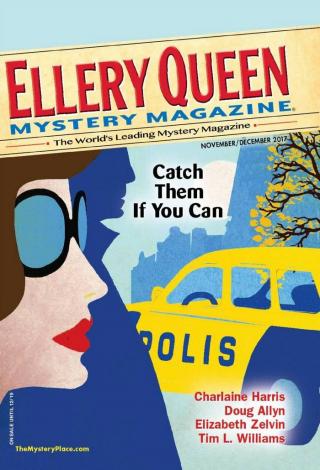
Ellery Queen’s Mystery Magazine. Vol. 150, Nos. 5 & 6. Whole Nos. 914 & 915, November/December 2017
- Автор: Фузилли Джим, Харрис Шарлин
- Год: 2017
- Язык: английский
- Год: Dell Magazines
- ISBN: 0013-6328
- Жанр: Другие детективы

Электронная книга - «Ellery Queen’s Mystery Magazine. Vol. 150, Nos. 5 & 6. Whole Nos. 914 & 915, November/December 2017». Краткое содержание книги:
Any reminiscing about her father only ever seemed to make her mother cry.
“Do you think she should talk to a therapist?” Deena asked her friend Lilly.
“Do I think she should talk to a therapist because she’s sad her husband died? No, Dee. I don’t think you need to jump to that.”
“I’m serious. I don’t break into tears every time I talk about Dad.”
“Yeah, but you let all your fish die. People respond to grief differently.”
Years later, after her mother had passed away too, Deena thought about that: about grief, and differing responses. She took the loss of her mother more easily — perhaps loss was something you got better at with practice, or maybe she’d always been that way, and it was just the confusion around her father’s death — with a flash, she remembered the patch of blood on her mother’s damp blouse, the scratchy 911 recording — that had made it so difficult to bear. Cassell had been right, she could finally admit that. In the end, it had been better to know for sure.
She’d inherited the house but didn’t want it. Maybe it was superstitious of her, but she couldn’t think of using the master bedroom where her mother had died in her sleep, or the master bathroom where her father had slipped; the house didn’t feel cursed or haunted, but it felt full of death, with no room for her. She’d list it and clear out, let the real-estate agent handle everything. She would even sell it furnished, she decided, after she picked through the valuables and sentimental childhood remnants: her mother’s jewelry, her father’s collection of hunting lures, their shared library of everything from poetry to pulp science-fiction novels.
The house had stored the history of them like stripes of rock and geologic eras: here a drawer full of hand-knitted tea cozies, there a box of old Christmas ornaments that had only looked good on their white aluminum tree from when she was ten. Her old school projects, even a little self-sculpture of herself made out of painted clay. She actually laughed — personal nostalgia was poignant, cultural nostalgia was funny — when she came across the spare closet off the laundry room that held a neatly boxed Super Nintendo and cassette player. But her parents had been slow adapters: Her father had painstakingly taped whole seasons of British comedies off PBS over the course of several years and had refused to give them up to DVD, instead labeling the tapes with masking tape and Sharpie by season and episode. The VCR was still hooked up in their bedroom, bulky and anachronistic.
Deena found the boxes of tapes next to the Nintendo and ran her finger down a peeling Fawlty Towers label. Nothing to be done with them, really, but she didn’t want to get rid of them, either. She hoisted the box and the contents shifted and for the second time that day, all thoughts of death left her. Underneath the sitcoms were their old home movies, taped diligently, first by her mother and then by her father (who claimed he’d “developed an eye”) over the first ten years, at least, of her life; a handful of them even before that. She wouldn’t dig too deeply into those old ones — her parents had been remarkably uninhibited, and it wasn’t impossible that she might see more than she wanted to see.
But she plucked out one, Deena, Halloween, 6, and, settling the box down on top of the washing machine, went upstairs. She loaded the movie into the wheezing VCR.
It started midstream: She was little, six years old, dressed as a tiger with a long, curly orange-and-black striped tail, as if she’d confused “Tiger” and “Tigger” and no one had stopped her. She had jumped into her father’s lap. Her mother, the hand behind the camera, was laughing, the camera shaking slightly, something Deena now associated most with horror movies. She rewound the tape a little, watching frames slowly flicker in and out, thinking again about Stu and the summer of movies. She played it again to watch herself creep low into the kitchen, moving on all fours, surprising no one because there was nothing more conspicuous than a kindergartner in bright orange accompanied by a low look-how-frightening-I-am growl. When she got close to her dad’s place at the kitchen table, she sprung up, half beast of the jungle, half Tigger again, and bounced and pounced into his lap shouting, “Grr! Grr!”
Her dad’s face shimmered slightly with a look of love so deep it brought tears to Deena’s eyes. His mouth was shaking from suppressed laughter. He put his hand on her back, between her shoulder blades.
“Don’t eat me, tiger! Don’t eat me! Fierce man-eating tiger.”
“Grr, grr,” little Deena growled, mushing her face against his shirt.
The tape started to roll a little and Deena tapped the tracking button on the ancient remote to try to still it, but the quality was shot: garbage technology, the vinyl of no one’s generation. She looked at her dad’s face as the static pitched it to and fro. On the screen, she was attacking him with all her little-girl fierceness and he was trying hard to pretend she was a monster. Sharing the joke of it with her mother. He looked up, his eyes meeting the camera. His gaze was so bright.
“Oh, I’m scared,” he said. “I’m so scared. Oh, honey. Honey, hold me.”
Deena’s breath caught in her throat. She rewound the scene, played it again. She watched the way the video seemed to crumple under the weight of the memory, under the weight of the scrutiny. Her scrutiny. And—?
“Oh, honey,” her father said, from the depths of the battered tape. “Honey, hold me.”
© 2017 by Zoë Z. Dean
Tombstone
by Doug Allyn
Doug Allyn is one of the most highly regarded crime short story writers of his generation. He’s also a noted novelist. This year he tried his hand at work of a different length when he collaborated with James Patterson on his BookShots novel The Lawyer Lifeguard (June 2017). The BookShots series is Patterson’s brainchild, and its novels are of no more than 150 pages.
“Wilson! Hack Wilson! I know you’re in there, damn you. Step out or I’ll come in and drag you out!”
Flinching at the anger in Miller’s voice, I glanced quickly around the seedy saloon, looking for a friendly face. Didn’t see one. No one even met my eyes.
Drinkers looked to their whiskey, gamblers looked to their cards, the whores just looked bored. I’d be making this fight alone.
Tossing back my bourbon with a single swallow, I slid my short-barreled Colt Peacemaker out of its holster, spun the cylinder to make sure it was free, cocked the hammer and eased it off, twice. Perfect. Slick as an oiled eel.
“Wilson!”
“Gimme one for the road,” I said, pushing my shot glass toward the bar-keep. He was a scrawny galoot with a wispy moustache, thinning hair combed sideways, slicked down to cover his naked scalp. His jaw was quivering. Looked like a scared rabbit.
“Please, Mr. Wilson, take it outside. I don’t want no trouble in here—”
“You’ve already got trouble!” I roared, hurling my shot glass at the mirror behind the bar, shattering it into a million splinters. “I said gimme another!”
He pushed a full bottle across the bar towards me, then backed hastily away, getting out of the line of fire.