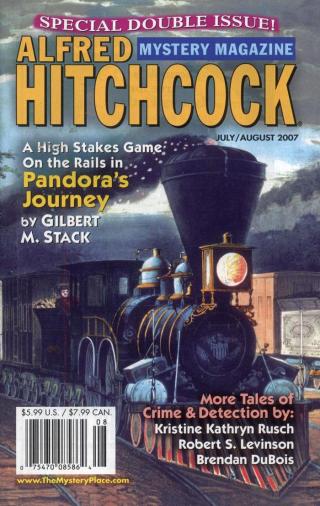
Alfred Hitchcock’s Mystery Magazine. Vol. 52, No. 7 & 8, July/August 2007
- Автор: Baldwin Barry, Campbell Melodie
- Год: 2007
- Язык: английский
- Год: Dell Magazines
- ISBN: ISSN:0002-5224
- Жанр: Другие детективы

Электронная книга - «Alfred Hitchcock’s Mystery Magazine. Vol. 52, No. 7 & 8, July/August 2007». Краткое содержание книги:
“Those were the days. Minnie Scooder there out front in the ticket booth, the Gilmore girl handling the concessions. We called her the glamour girl, did you know that? A little joke we had. And Oddlot and me up in the projection booth. I learned so much from him. How to trim the arc, how to do a changeover. You do a changeover every twenty minutes on the 35s. On the 16s, every forty-four minutes. That’s how long a reel of film lasts.”
“I didn’t realize that.”
“Oh yes. And Oddlot, when I told him how much Mom liked it, had the idea of reporting the movie stolen. The distributor yelled, but what could he do about it? We were going out of business. He had to chase the insurance company.”
Bulwer chortled mirthfully. Robideau got slowly to his feet.
“Of course,” Bulwer went on, more seriously, “a reel of film doesn’t last forever.” His head had tilted all the way back; it gave a curious view of him from under the chin. “It gets brittle, scratched. The sprocket holes wear. So we store our 35mm copy in the fridge behind the concession stand — keep it at forty degrees — and most of the time we use 16mm prints. You can still buy those for a few hundred dollars.”
Robideau wanted another look in the den. He began to edge in that direction.
“Of course,” Bulwer droned on, “the movie’s printed on safety film. If it was the old film, that nitrate stuff, it might have turned to powder or exploded by now. Oddlot made me remove all the old nitrate film from the Palace. He thinks it’s dangerous. Starts on fire if you look at it. It even burns under water; you can’t put it out.”
Robideau reached the den and slipped his key chain Mag-Lite from his pocket. There were the fish tanks. And the wicker chair. The electric heater glowing on the floor.
“To understand what a nitrate fire can do, you should go and see Cinema Paradiso,” Bulwer droned. “Not that I’ve seen it. But Oddlot recommends it.”
Robideau edged forward. The large fan-back chair was pushed up hard against the wall. There was a lot of shadow here, and...
Damn!
Robideau had dropped the Mag-Lite. It bounced on the carpet, rolled, and lay at his feet, its tiny light directed under the chair.
He hunkered down and groped for it. Its bisected beam revealed a pair of ankles. Ankles that looked impossibly thin. The nylon tights around them drooped loosely from skinny shanks. Below, a pair of lady’s oxfords had a layer of dust on them a quarter of an inch thick.
Taking hold of the Mag-Lite, Robideau stood back up. He felt a tingling and sickly presentiment. As he slowly raised the torch he saw a pleated skirt that seemed to have nothing under it but sticks. A pair of clenched, white-gloved hands in the lap. A once-satiny blouse between the lapels of a jacket. A tarnished pendent. The face...
The face before him was hollowed and shrunken. The brow had an onionskin tautness. The hair, a washed-out blond, stood out from the scalp in hideous clumps. The mouth hung open, slack jawed and fleshless, revealing a bone-white section of dental bridgework in a bank of yellow and twisted teeth.
Robideau tried to move but couldn’t. His feet seemed rooted to the floor. He saw that Bulwer Onager had jumped the rails, had swung as far from the tracks of normality as it was possible to go.
“Esta Onager,” Robideau whispered. “You ran the flower shop. You’re Bulwer’s mother.”
The light clicked on.
“Noooooo!” Bulwer hollered, and the cricket bat whistled through the air. Robideau saw it coming, but it never connected because he was struck from the side and bowled over, his aching head crashing into one of the fish tanks. He had a sense of two men struggling, and suddenly Pete was hauling him to his feet.
“Come on, Chief. You’ve outwore your welcome. Don’t worry about those two. I gave Butts a call.”
Gripping Robideau by the shoulders, Pete rushed him quickly back through the cluttered house. A last glance showed Bulwer trying to shake off Oddlot, who was hanging onto the cricket bat with both hands. The light above the men careened crazily. The stacks of film canisters teetered and then crashed down around their legs. Coils of film and an ugly brown powder spilled out of the cans and across the floor and the heater.
Pete and Robideau burst from the house, struggled over the garbage bags, and stumbled into the yard. There was an ominous thump at their backs, and the windows of the den blew out, scattering shards of glass across the lawn. This was followed by a burgeoning flicker, and suddenly the den was shooting flame like a fireworks display. Horrified, Robideau tried to rush back in, but Pete Melynchuk held him back.
Police Chief Butts pulled up with his siren wailing, jumped from his car, and stalked toward them. Heavy, low-hanging, acrid smoke gushed from the shattered windows of the house.
“Damn it, Robideau, I only asked you to talk to the guy. Now I got a murder investigation on my hands and a house on fire. What is it with you?” He squinted. “Did you know your head is bleeding?”
The rain began to fall with such ferocity it drove Butts back into his car at a run.
Oddball had been right. You couldn’t put out the fire by pouring water on it. This was confirmed by none other than Chuck Lang, once a member of the End of Main volunteer fire brigade. He polished off a beer and let out a gaseous belch. “What was he thinking, storing old films there?”
Pete and Robideau were at the table in the Netley. Wilmer and Wolverton were just sitting down.
Robideau touched the bandage on his head and winced. “Oddlot made him remove the film from the theater. There must have been quite a stock of them. They found even more in the wing of the house that didn’t burn. Silents and old newsreels. Even a pile of ancient Russian films that he scrounged from God knows where.”
“He should’ve known better,” Chuck said unsparingly. “Got rid of them. But he wouldn’t part with anything, would he? Not even his poor dead mother.”
“He couldn’t stand to part with food wrappers,” Pete said, as if this explained it. “Why wouldn’t he keep his mother around?”
Wilmer signaled for more beer. “I seen that young fella works at the video rental store this morning, and he told me that ever since this hit the newspapers they can’t keep that Psycho movie on the shelves. They’re ordering more copies from the city. Bullet would’ve liked that.”
“I don’t think so,” Robideau said.
“To think of him in that old theater,” Wilmer continued, “showing his mom that movie over and over again! It’s like I said. OCD. Your Compression Repulsive Disorder.”
Pete rolled his eyes.
“So Bullet killed her too?” Chuck said frowning. “His own mother?”
“No.” Pete shook his head. “He didn’t. Esta died — I think it was lung cancer got her. Smoked like a stove full of sawdust, that old gal.”
“But he kept her around,” Chuck persisted. “Kept her at the Palace. He kills the girl because he thinks she might’ve seen something. He kills the detective when he comes looking for the girl. As for Oddlot...”
They thought about Oddlot.
Had he played any part in the murders? He’d sworn to Pete he hadn’t known anything about them, and Robideau believed that was probably true. On the other hand, Esta Onager had been pretty spry for a dead woman. She hadn’t walked from the Palace Roxy to Bulwer’s house all by herself. Or walked away from the embalming table, for that matter. And it was a fact that the Onagers had owned the funeral home before Prancing Al Evans got his hands on it, and a fact that Bulwer’s pal Oddlot had done the fetch-and-carry jobs there.
“It’s amazing the things you don’t notice when they’re right under your nose,” Robideau said.
Pete nodded. “You got that right.”