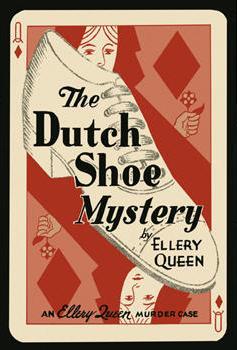
The Dutch Shoe Mystery
- Автор: Куин (Квин) Эллери
- Серия: Ellery Queen #3
- Год: 1931
- Язык: английский
- Год: Frederick A. Stokes
- Жанр: Классические детективы

Электронная книга - «The Dutch Shoe Mystery». Краткое содержание книги:
The Inspector leaned back. “Hulda Doorn, hey? All right. Stick around, Bill. It’ll only take a minute.”
The detective reëntered almost at once with Hulda Doorn. The girl was dressed in black — an attractive supple figure pink-cheeked with excitement. Her fingers trembled as she grasped the Inspector’s coat-sleeve.
“Inspector Queen!”
Djuna dutifully rose and Ellery uncoiled his length from his chair, still munching his apple.
“Sit down, Miss Doorn,” said the Inspector kindly. “I’m glad to see you looking so well... What can I do for you?”
Her lips quivered. “I wanted to — I mean I—” She stopped in confusion.
The Inspector smiled. “I suppose you’ve heard the news?”
“Oh, yes! I think it — it’s all so ghastly,” she said in her clear girlish voice, “and so wonderful that you’ve caught that — that awful, terrible woman.” She shuddered. “I can hardly believe it yet. Why, she used to come to our house with Dr. Janney sometimes, to help him treat mother...”
“She’s guilty, Miss Doorn. Now what...”
“Why — I hardly know where to begin.” She fumbled with the gloves in her lap. “It’s about Philip. Philip Morehouse, my fiancé.”
“And what about Philip Morehouse, your fiancé?” asked the Inspector gently.
Her lids flew wide, and the large liquid eyes pleaded with the Inspector. “I’m worried about — well, about the way you threatened Philip the other day, Inspector Queen. You know — about those papers he destroyed. You don’t really intend, now that you’ve got the real criminal...”
“Hmm! I see.” The old man patted the girl’s hand. “If that’s what’s worrying your pretty head, my dear, forget all about it. Mr. Morehouse acted — let’s say injudiciously, and I was very angry. I’m not any more. We’ll let it go at that.”
“Oh, thank you!” Her face brightened.
The door burst open and the detective called Bill was propelled into the room by a violent shove from without. Philip Morehouse ran in, his eyes searching. On seeing Hulda Doorn, he stepped to her side, put his hand on her shoulder, and glowered fiercely at the Inspector. “What are you doing with Miss Doorn?” Morehouse growled. “Hulda — they told me you’d come here — what are they doing to you?”
“Why, Philip!” She twisted out of the chair and his arms tightened about her waist. They looked into each other’s eyes, and suddenly both smiled. The Inspector frowned, Ellery sighed and Djuna’s mouth flew open.
“Excuse me if I—” There was no immediate response. The Inspector barked, “Bill, get out of here! Can’t you see the young lady’s well taken care of?” The detective tramped out, rubbing his shoulder. “And now, Miss Doorn — Mr. Morehouse — as much as we thoroughly enjoy seeing you two young people happy, and all that, please remember that this is a police-office...”
Fifteen minutes later the Inspector’s office presented a different picture.
Chairs had been set around the desk, and in them were seated District Attorney Sampson, the Police Commissioner and Pete Harper. Djuna perched on the edge of a chair directly behind the Police Commissioner; surreptitiously he was touching the Commissioner’s coat as if it were a talisman.
Ellery and Dr. Minchen stood by the window talking in low tones. “I suppose the Hospital’s a good deal of a bedlam, John?”
“It’s awful.” Minchen seemed dazed. “Nobody knows what to do, or what to say. The place is thoroughly disorganized... Lucille Price, of all people! It’s — why, it’s incredible.”
“Ah, but that’s the unhabitual murderer’s greatest psychological defense,” murmured Ellery. “Rochefoucauld’s epigram: ‘Innocence finds not near so much protection as guilt—’ was based on a universal truth... By the way, how did our metallurgical friend Kneisel take the news?”
The physician grimaced. “As you might expect. The man’s not human. Far from showing elation at the thought that now he’s got more than enough to finish his damned experiments, or feeling badly about his co-worker’s death, he simply goes about his business, locked up in that laboratory, as if neither murder nor sympathy existed. He’s as cold-blooded as a — as a snake.”
“Not in the grass, I hope?” chuckled Ellery. “Nevertheless,” he continued, half to himself, “I’m willing to wager that he’s relieved that a certain theory of his was proved erroneous. I wonder if his alloy theory isn’t just as fantastic... Incidentally, I hadn’t realized before that the ophidians are cold-blooded. Thanks for the information!”
“I want to go on record,” said Ellery a short time later, when Minchen was seated and the Inspector had waived his right to take the floor, “with the blanket-statement that, in all the years in which I’ve taken a more or less active interest in my father’s cases, I’ve never encountered a more thoroughly planned crime than the murder of Abigail Doorn.
“It’s a little difficult to know where to begin... I suppose the same unbelieving thought has crossed all your minds — how it was possible for Lucille Price, whose presence in the Anteroom was attested by a number of reliable witnesses — Dr. Byers, Grace Obermann the nurse, and the doubtful gentleman known as ‘Big Mike’ — witnesses who at the same time vouched for the presence of Dr. Janney’s impersonator — I say, how it was possible for Lucille Price to have been two distinct personalities at apparently the identical moment.”
There was a vigorous nodding of heads.
“That she was, you now know,” continued Ellery; “how she accomplished this spiritistic feat I’ll tell you by analysis.
“Consider the amazing situation. Lucille Price was Lucille Price, the trained nurse, dutifully watching over Abby Doorn’s unconscious body in the Anteroom. Yet she was also the seemingly masculine figure of Dr. Janney’s impersonator in the same period. Unimpeachable witnesses swore that two people occupied the Anteroom (I mean omitting Mrs. Doorn) — a nurse and a doctor. The nurse was heard talking. The doctor was seen going in and coming out. How could any one dream that both nurse and doctor were one, that Lucille Price’s original story concerning herself as the nurse, and the impostor as the doctor, was anything but the absolute truth? Now that it’s all over, and we know what actually happened, we can put our finger on the significant feature which makes a seemingly impossible series of circumstances not only possible but plausible — that is, that while the nurse was heard she was not seen; and that while the impostor was seen, he was not heard.”
Ellery sipped at a glass of water. “But this is beginning the wrong way. Before telling you how Lucille Price accomplished this apparent miracle of duality, let me go back to the inception of the case and describe the deductive steps by which we finally arrived at that blissful state in which vincit omnia veritas.
“When the clothing of the impostor was found on the floor of the telephone booth the face-gag, gown and surgical cap proved unproductive of clews. They were ordinary samples of such wear, without interesting characteristics.
“But three items — the trousers and the two shoes — were rather startlingly illuminating.
“Let’s dissect — if I may use a laboratory word — the shoes. On one of them a scrap of adhesive had been wrapped about a torn shoelace. What did this mean? We went to work.
“In the first place, it was patent after a little thought that the lace must have broken during the crime-period. Why?
“This was a carefully schemed murder. We had ample evidence of that. Now, if the lace had snapped during the preparatory period — that is to say, some time before the crime-period, when the clothes were being assembled by the criminal at some place other than the Hospital — would a piece of adhesive have been used to patch up the tear? Hardly. For it would have been more in keeping with the general method of the murderer to procure a new, unbroken lace and insert it in the shoe, in order to prevent another breaking during the crime-period to come, when seconds were precious and any delay would be fatal.