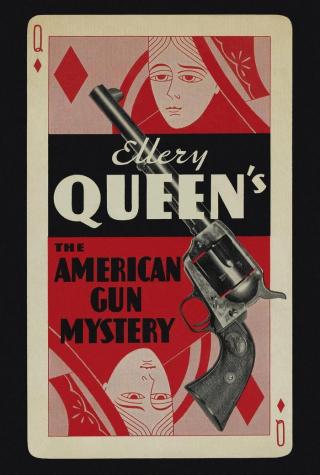
The American Gun Mystery (Death At the Rodeo)
- Автор: Куин (Квин) Эллери
- Серия: Ellery Queen #6
- Год: 1933
- Язык: английский
- Год: Frederick A. Stokes Company
- Жанр: Классические детективы

Электронная книга - «The American Gun Mystery (Death At the Rodeo)». Краткое содержание книги:
“What was put in Miller’s pants?” growled Velie.
Calmly, with the certainty of omniscience, Ellery wrapped a handkerchief about his right hand and slipped his hand into the pocket. But he did not withdraw it at once. He said sharply: “Who’s been inside the Colosseum today, Sergeant, besides the rank and file, and Grant?”
Velie licked his lips. “Grant’s son. Kit Horne. I think I saw Mars and Black, the pug.”
“Not Hunter or Mara Gay?”
“No.”
Ellery drew his hand out of the pocket of Miller’s jeans.
Whereupon a veritable miracle occurred. For his hand emerged holding a very tangible little piece of reality — an object for which he, Sergeant Velie, Inspector Queen, and the assembled detective strength of the New York City Police Department had been searching for weeks. It was something moreover which had not been found in Boone’s room until this moment for the remarkably simple reason that it had not been in Boone’s room during previous searches. Obviously, then, it had been brought to Boone’s room and Miller’s jeans after the last thorough search.
And the last thorough search, on the authority of Sergeant Velie, had been conducted the night before, directly after the murder of Woody.
That much, at least, was clear.
Dan’l Boone uttered a gasping little cry. And Sergeant Velie stiffened.
Ellery’s hand lightly held a small, flat, innocent-looking little .25 automatic pistol.
24: The Verdict
“Well, i’ll — be — damned,” breathed Sergeant Velie gustily. “What the hoppin’ hell do you know about that!”
“Let’s not be too sanguine,” said Ellery, gazing almost with fondness at the little weapon. “There’s a mathematical possibility that this isn’t the right one. On the other hand...” He fell silent, and began with scrupulous care to swathe the automatic in the folds of his handkerchief. Then he dropped it into his pocket.
“Now, boys,” he said genially, and his eyes glinted in the direction of the silent Boone, “I want one thing understood at once.”
“Yeah?” whispered Boone, licking his lips. Sergeant Velie said nothing.
“Boone, old horse-nurse,” said Ellery, “do you value your carcass?”
“Huh?”
Ellery crossed the floor and placed his hand on the little cowboy’s shoulder. “Can you keep your mouth very tightly shut?”
“I — uh — guess so, Mr. Queen.”
“Let’s see you try.”
Boone goggled, and his mouth slowly closed.
“Excellent for a beginning,” said Ellery crisply, and there was no mirth in his eyes. “Boone, I give you my word. If you so much as breathe a solitary syllable about this — about our finding this automatic — I swear I’ll see you behind bars. Do you understand?”
Boone licked his lips again. “Got ya, Mr. Queen.”
“Good.” Ellery straightened. “You may go back to the others now.” Boone rose and wobbled to the door.
“Remember what I said, Boone,” said Ellery...
The little cowboy nodded once, and disappeared.
“I don’t have to warn you, Sergeant,” went on Ellery quickly, “that I don’t want this to get about.”
Velie looked hurt.
“To anyone.”
“Not the Inspector, either?”
“No, no.” Ellery frowned. “I think that’s best. Let me do the talking. This little affair is entirely between you and me. I’m certain Boone will keep quiet... By the way, what was the procedure today with visitors to the Colosseum? They weren’t searched on their way in, were they?”
“Only on the way out.”
“I see. Yes, of course. Very convenient, I must say.” Ellery poked his elbow affectionately into Sergeant Velie’s laminated ribs and marched, humming, from the dressing room.
He made his way quickly to Grant’s office. The old showman was still there, staring at the wall in the falling gloom.
He looked up. “Huh. Back again, hey?”
“Back in the approved frontal position,” chuckled Ellery. “Sorry to intrude. May I use your telephone?”
“Go ahead.”
Ellery consulted a directory, then called a number. “Connect me with Major Kirby, please... Major? Ellery Queen again... No, no more previews, Major... Ha, ha — yes!.. Uh— Major, are you very busy?... I see. Then perhaps you can make it. I should very much like to have you meet me in the lobby of Police Headquarters in half an hour... Good of you. Hop on it!”
Ellery hung up, faintly smiling. Wild. Bill Grant’s chair creaked a little.
Ellery said: “Thanks, Mr. Grant,” with the utmost cheerfulness, and left the office.
A half-hour later he confronted two silent men in the laboratory of the Bureau of Ballistics at Police Headquarters. Major Kirby was breathing hard, as from a brisk walk. Lieutenant Knowles looked inquisitive.
“Glad you made it,” said Ellery to the Major. “Not really necessary, I suppose, but you’ve been in on this from the beginning and I didn’t want to be hoggish. It’s really due you, this climactic part of the fun.” He took from his pocket the object wrapped in his handkerchief. Very carefully he undid the folds.
“The .25!” cried Major Kirby, with a sharp intake of breath.
“A .25,” corrected Ellery gently. “The purpose of this conclave, gentlemen, is to establish whether we are justified in using the definite rather than the indefinite article.”
“I’ll be blasted,” grinned Lieutenant Knowles. “Where’d you find it?”
“In a most unlikely place, Lieutenant,” chuckled Ellery. “Don’t be afraid to handle it. I’ve already had it tested for fingerprints and there aren’t any.” He shrugged. “Proceed, mes amis. Test for bore-marks. End this really unbearable suspense.” And he himself breathed rather more quickly than seemed necessary.
Lieutenant Knowles picked up the weapon, hefted it thoughtfully, and then withdrew the magazine. There was no necessity for excessive care; this little Colt arm was equipped with a “safety disconnecter” which automatically broke all connection between the trigger and sear upon withdrawal of the magazine. The magazine was empty. And there was no cartridge in the chamber. He looked up inquiringly.
“Yes,” murmured Ellery, “unloaded when I found it. Teeth pulled. Not really important, you know.”
Lieutenant Knowles loaded the automatic, adjusted his target, pulled the trigger without fanfare while Ellery dodged the falling shells spewing out of the ejector, and removed the exploded slugs from the testing target. Each bullet was imbedded in a blackish wad of burnt powder and grease.
Knowles selected one after some scrutiny of the seven he had discharged and, going to his laboratory table, carefully cleaned it. Then he went to a file and after some exploration returned with two bullets.
“From Horne and Woody,” he remarked; and sat down before his comparison microscope. “I established, you know, with the help of the Major, that both were shot from the same gun. So I can use either of these for comparison. Well, we’ll find out soon enough.”
Major Kirby moved nearer the table.
Lieutenant Knowles set one of the bullets from the file on a stage of the microscope, and the bullet he had just selected from those discharged in the laboratory on the second of the twin stages. He began to fuss with his instrument. Satisfied that he had jockeyed the bullets into the same focus, he manipulated a wheel which caused the images to move together and merge. When he had completed this operation, he was peering through the eyepiece of the microscope at a single image. The image was that of a whole bullet; actually, it was composed of the two left sides of the bullets, so juxtaposed that they seemed to form a whole.