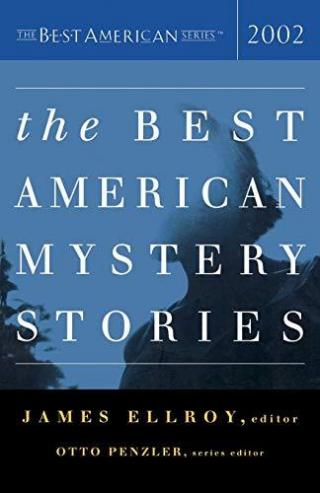
The Best American Mystery Stories 2002
- Автор: Грейди Джеймс, Камински Стюарт Мелвин
- Год: 2002
- Язык: английский
- Год: Houghton Mifflin Harcourt
- ISBN: 978-0-618-12494-7
- Жанр: Другие детективы

Электронная книга - «The Best American Mystery Stories 2002». Краткое содержание книги:
Harry jumped out front: “Let us through! Let Gene through!” They entered a barbershop. A white-shrouded half-clipped customer leapt out of his chair, and Doyle nudged Gene to obey the barber’s plea to take that throne.
“On the house for you two boys,” said the barber. “On the house.”
“What two boys?” said Gene.
The back room curtain opened and out came a husky giant whose muscles bulged his shirt sleeves. Eric Harmon said: “Me and you.”
The good part of Gene, the old part, the real part, wanted to say: You were here first, Eric. Take the chair. But the boxer he was now smiled and leaned back for the barber’s clip.
“I won’t be long,” said Gene. “Then you can have your turn.”
“Don’t I know it,” said Eric.
Only the snip snip of scissors sounded in the barbershop as Eric leaned against the wall. Doyle sat, nodded for Billie and Harry to sit, too. Two other customers pretended to read magazines. On the street outside the window, none of the shoulder-to-shoulder crowd moved; all of them faced every which way they could to keep that glass in the corner of their eyes.
“Is that okay?” whispered the barber after he spun Gene around to look in the mirror.
“Looks damn fine,” said Gene. “I look damn good, don’t I?”
Thought: Please Billie, know I don’t mean it!
“Never thought of you as a pretty boy,” said Eric.
“I never thought of you at all.” Gene got out of the chair, tossed the barber a quarter. Told the scissors man: “You do such fine work, think I’ll hang around and watch.”
Eric shook his head and took the chair. The white sheet whipped around him. Gene noticed the barber’s shaking hands.
“Careful there, Pete. Don’t nick our boy and make him red out too soon.”
“Doesn’t matter if he uses the razor,” said Eric. “I don’t bleed easy.”
“We’ll see.” Gene looked across the room. “Mind if I put on your radio?”
The barber didn’t break his concentration as he cut the younger man’s hair, and Gene walked over, tuned the radio to some hot New York jazz. Gene turned the volume up.
Gene said: “I got to wash up. But not as much as some.”
Then he walked through the curtain to the sink and the bathroom. The sound of radio jazz blanketed the room outside the curtain. Nobody could hear anything from the washroom. Gene turned on the water and didn’t look around as he heard the curtain swing open, get pulled shut.
“Think we gave them enough show, Eric?” Gene took a towel off the rack, turned around, drying his hands. The younger fighter stood watching him. At least two inches. At least twenty pounds.
“This isn’t a show for me,” said Eric. “We never met, not really, but I know who you are, seen you around. Always kind of admired you. So you should know this isn’t personal.”
“At least you’re that smart.”
“This is about winning. About who’s a champion. And that’ll be me. I’ll fight you fair, but I’ll beat you.”
“Eric, don’t kill yourself over—”
“California was a long time ago. Not long for people out there in the street, but for guys like us who have to climb into the ring, damn near the weight of forever ago. I got no feelings for what you did, except sorry for you and the guy who fell.”
“I knocked him down.”
“You’ll have to do more than that to me. This is my only chance to prove I’m somebody.”
“No it’s not.”
“Sure it is. Just look at you.”
Then the younger man stuck out his hand. When they shook, he didn’t try to crush Gene’s fingers, and Gene suddenly loved him for that.
“Give me a good fight,” said Eric. “I want to know I won something hard.”
Gene didn’t know what to say. Let him leave with silence. Gene gave him time to get clear of the barbershop, swept open the curtain, and there stood Sheriff John Otis.
“ ’Pears I didn’t have to hustle down here after all.” Texas John’s eyes pulled back from Gene to take in Billie, trembling Harry. Doyle. “Don’t see no trouble to put down.”
“Could have been,” said the barber. “Why—”
“My law ain’t about ‘could be.’ ’S about what I see with these two good eyes.” Those two good eyes rode Doyle. “Though just ’cause I size up a son of a bitch doesn’t mean I’ll give him what he deserves. But when he makes his wrong play, I drop the curtain.”
“Just like you were in a movie, huh?” said Doyle. “Not out here in the real world.”
The sheriff laughed, and his suit coat coincidentally opened with his swinging arms. Gene saw the Colt Peacemaker holstered on Texas John’s hip like it had been in his Ranger days. Saw the wooden stock for the Mauser slung under Otis’s right arm, knew that thousand-yard sniper automatic hung near the sheriff’s heart.
“This ain’t the real world. This is Shelby.”
“Imagine that,” said Doyle.
“Don’t have to,” answered Texas John. “I’m here. And we got phones and everything. And when I called around about a curly-haired fancy-dancy with a Butte license plate who claims to be a boxing manager, the boys down there wondered how you ended up in an honest game.”
“Just lucky, I guess.”
“Luck is a fragile thing,” said Doyle. “Be sure to watch it close. You can bet I will.”
The sheriff told Gene: “You in with some fine people, Hometown.”
His black cowboy boots shook the barbershop as he tromped out to Main Street.
“We’re back to the ranch,” said Doyle.
Great by me, thought Gene. Every day his training ran him like a growing steel tiger. Every night he lay beside Billie. He needed less sleep and more of her. She gave him all she could reach. She’d ask questions, care about his answers.
“What was the hardest thing to learn about boxing?” asked Billie.
“Making yourself pull down into the fighter’s crouch where you could hit and where you could get hurt. Getting past the terror. Your mouth all dry, your stomach heaving in and out, and you look across the ring and see that steely stare coming back at you and you hope he doesn’t see your stomach fluttering and then you see his and it’s jumping like mad, too, and oh Christ, any second they’ll ring that bell.”
He told her how easy it was to forget to keep your guard up. How his favorite combination was a lightning left-left-right, and when you throw the left jab, how you had to remember to bring it back at eye level, quick and straight. How after the second left, your dance had to move your left foot four inches to the left so your shoulders squared up and gave your right jab the snap that created power. How the uppercut was easy, go pigeon-toed and corkscrew your punch. How the hook took him months to learn, how he practiced a million times with each fist until he could keep his elbow up and whip it out tight and close, just eighteen inches of loop — two feet and it’s an arm punch, a pillow, a joke, a nothing and left you only with how lucky you were in dodging the others guy’s coming-in cannonball.
“But besides being good at it, what do you like about boxing?”
Took him all the next day to find the answer. That night they lay like spoons in the darkness, his face brushed by the perfume of her hair, her bare spine pressed against the mass of his chest, the two of them alone on the white sheet of their starlit bed.
“In the ring,” he whispered, “what’s happening is real. True. Even the feints, the fakes, and the cheats. You use every single bit of yourself and find more you didn’t know was there. No chain is gonna whip out of the sky and hang you dead and dropped before you know it. You’re not gonna need to shoot your own damn horse. You know exactly who you are. Where you are. It’s a fight. You’re a boxer.”