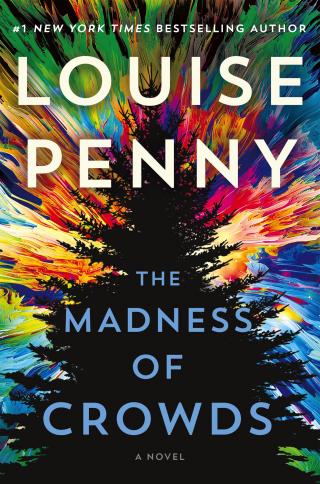
The Madness of Crowds
- Автор: Пенни Луиза
- Серия: Chief Inspector Gamache #17
- Год: 2021
- Язык: английский
- Год: St. Martin's Publishing Group
- ISBN: 9781250145284
- Жанр: Другие детективы

Электронная книга - «The Madness of Crowds». Краткое содержание книги:
You're a coward.
Time and again, as the New Year approaches, that charge is leveled against Armand Gamache.
It starts innocently enough.
While the residents of the Québec village of Three Pines take advantage of the deep snow to ski and toboggan, to drink hot chocolate in the bistro and share meals together, the Chief Inspector finds his holiday with his family interrupted by a simple request.
He's asked to provide security for what promises to be a non-event. A visiting professor of statistics will be giving a lecture at the nearby university.
While he is perplexed as to why the head of homicide for the Sûreté du Québec would be assigned this task, it sounds easy enough. That is, until Gamache starts looking into Professor Abigail Robinson and discovers an agenda so repulsive he begs the university to cancel the lecture.
They refuse, citing academic freedom, and accuse Gamache of censorship and intellectual cowardice. Before long, Professor Robinson's views start seeping into conversations. Spreading and infecting. So that truth and fact, reality and delusion, are so confused it's near impossible to tell them apart.
Discussions become debates, debates become arguments, which turn into fights. As sides are declared, a madness takes hold.
Abigail Robinson promises that if they follow her, ça va bien aller. All will be well. But not, Gamache and his team know, for everyone.
When a murder is committed, it falls to Armand Gamache, his second-in-command Jean-Guy Beauvoir, and their team to investigate the crime as well as this extraordinary popular delusion.
And the madness of crowds.
Isabelle continued to ask him innocuous questions about trails and snow conditions, until finally Alphonse Tardif cracked.
“Look, I know why I’m here. But we didn’t mean to do anything. Not—”
“Please, Monsieur Tardif,” said Maître Lacombe.
“No, I want to talk.” No listening to the lawyer for this one, thought Isabelle.
“Were you involved in the attack on Abigail Robinson at the gymnasium two days ago?” she asked.
“Ye—no.” He sighed. “We didn’t mean for anything to happen.”
“So the gunshots were an accident?”
“They were never meant to hurt her. Just stop the talk. Maybe scare her. But not kill her. Look, Édouard’s a great shot. If he’d wanted to hit her, he would have.”
“Is that what he told you when he asked you to hide the gun?”
“Don’t answer that, Monsieur Tardif,” said his lawyer.
“They already know. I just want this over with. Yes, I hid the gun.”
“And the firecrackers?”
“And them. In the bathroom, while Édouard distracted the caretaker. That was the plan.”
“Were you supposed to be there?”
“No. Édouard told me to get far away. So I did.”
“Have you seen what happened, at the event?”
“No. There’s no internet that deep into the Abitibi. But I heard about it. No one was killed.”
“No thanks to you or your brother.” Isabelle’s phone was on the dented metal table, and now she hit play on the video.
As he watched, his breathing became labored. When the firecrackers went off, and the crowd began to panic, his brows drew together.
And then the shots.
“The stupid shit,” he snapped. “But he missed. Like we planned.”
“Barely.” Lacoste clicked off her phone.
“Someone must’ve shoved his arm.”
“Who else was involved in the plot?”
“No one.”
“Why would you do this, Monsieur Tardif?” Isabelle’s voice was soft, calm. Clearly trying to understand. “You have no record. You and your brother are hardworking, decent members of the community. Why suddenly decide to do this? Even if the plan was just to scare Professor Robinson, you must have known the shots could cause a riot. Several were in fact hurt. One man had a heart attack.”
“Oh, God, I’m so sorry. We didn’t think. Is he going to be okay?”
“We think so. No thanks to you.”
Alphonse Tardif was angry, now. Furious in fact. “What an asshole.”
“Who?”
He seemed to struggle with himself. “Me. We just wanted to scare her. That’s all.”
Alphonse Tardif gave details of exactly where he’d been the day of the shooting. Who he’d been with. The cabins they’d stopped at.
And then he was charged with being an accessory to attempted murder.
In the basement of the Inn and Spa, Armand and Jean-Guy were consulting.
“Forensics came to the same conclusion we did,” said Beauvoir. “The murder weapon was a log, cut for firewood. Agents are looking for the weapon in the woods.”
“I just had a word with them. To be honest, I doubt they’ll find it. I think it was thrown onto the bonfire. Billy Williams had doused the flames to embers, but the young man who discovered the body—”
“Jacques Brodeur,” said Beauvoir.
“—said when he threw the stick into the bonfire, there were flames. Now, the wind had picked up and it’s possible there were embers under the ash and they came back to life, but I think they were helped along.”
“By the murder weapon,” said Beauvoir.
When Isabelle arrived back a few minutes later, she told them about the interview with Alphonse Tardif.
“It all fits,” she said. “So we can at least put that to bed.”
“Yes,” said Gamache.
One less investigation, one less complication, was always good. But—
“Is something bothering you, Isabelle?”
“It just seemed a bit too easy. Alphonse Tardif didn’t have to say anything. He sure didn’t have to confess. We have no proof. If he’d just sat quietly listening to his lawyer, we’d have had to let him go.”
“Maybe he wanted to confess,” said Beauvoir. “Some do.”
“Maybe.”
“But?” said Beauvoir.
“I don’t know. It just seemed too quick, too pat. And when I showed him the video, he got really angry, like it was all a surprise.”
“It was. He wasn’t there,” said Beauvoir.
“No, he said he was angry at himself, but I think he was furious at his brother, for doing it. That’s what it seemed like to me.”
“What’re you thinking?” asked Gamache.
“Nothing really. I suppose they’re exactly what they seem. Two local guys who got caught up in something. Who didn’t think it through.”
“Do you think they meant to kill her?” asked Beauvoir.
“Well, I’ve charged him with being an accessory to attempted murder, but I’m not so sure. I wish we had a clearer video.”
“Let’s keep looking for one,” said Gamache. “In the meantime, we have an actual murder. Let’s concentrate on that.”
“So far we’ve been assuming that Abigail Robinson was the intended victim last night,” said Jean-Guy. “But I think we need to consider that maybe she wasn’t.”
“But who’d want to kill Debbie Schneider?”
“Maybe they didn’t. There is another possibility.” Beauvoir looked from one to the other. Waiting to see if they saw it. “Chancellor Roberge. She holds a senior position at the University. Someone could have a grievance against her or the University. A professor or student, or a worker who was fired.”
“But no one knew she’d be at the party,” said Lacoste.
“Exactly. This murder wasn’t premeditated, we know that. So someone there sees the Chancellor and snaps.”
“You’re saying this might have nothing to do with Professor Robinson and her studies.”
“I’m saying it’s possible,” said Jean-Guy. “But there’s another possibility. A fairly obvious one.”
Gamache nodded. He’d thought of that too. It was the most obvious solution. “Colette Roberge killed Debbie Schneider while on their walk. But why?”
Isabelle barely suppressed a smile. A few weeks earlier, she and her family had been visiting the Gamaches. She’d gone into the bookstore in Three Pines and found Myrna and Clara drinking brandy eggnog and listening to A Child’s Christmas in Wales, read by Dylan Thomas himself. He talked about the gifts he’d been given, as a boy.
… And books which told me everything about the wasp, except why.
The Chief Inspector had just used exactly the same almost plaintive tone. Why?
“Why would anyone, never mind the Chancellor, want Debbie Schneider dead?” asked Gamache.
“And why now?” added Isabelle.
Why did Debbie Schneider have to die at that moment? Why not the day before, or after?
“Suppose,” said Beauvoir, thinking out loud, “suppose the killer supported what Professor Robinson was preaching. Suppose they saw that she was now more useful dead? A martyr to the cause. Isn’t that what Haniya Daoud suggested last night?”
Gamache nodded. Haniya had said that ideas could grow, flourish, fertilized by the body of a martyr. Yes, that could be it. An idea bloated by blood, made all the more potent.
“And Debbie Schneider was a mistake,” said Isabelle.
Or …
“Suppose she wasn’t a mistake?” Gamache said, leaning forward. “Suppose all this was set up by Professor Robinson? She got the idea after the attempt the day before. Suppose there was another attempt? A murder so obviously meant to be her, but tragically killing her best friend and assistant instead? Robinson would get international publicity for her campaign, without the inconvenience of having to die.”